
Introducing the Safety Word Challenge: A Smarter Way to Learn OHSE
Learning about occupational health and safety doesn’t always have to be serious, heavy, or policy-driven. While regulations, hazard assessments, and compliance frameworks are essential, engagement is just as important.
That’s exactly why we created the Safety Word Challenge — a simple, Wordle-inspired game built specifically around safety terminology.
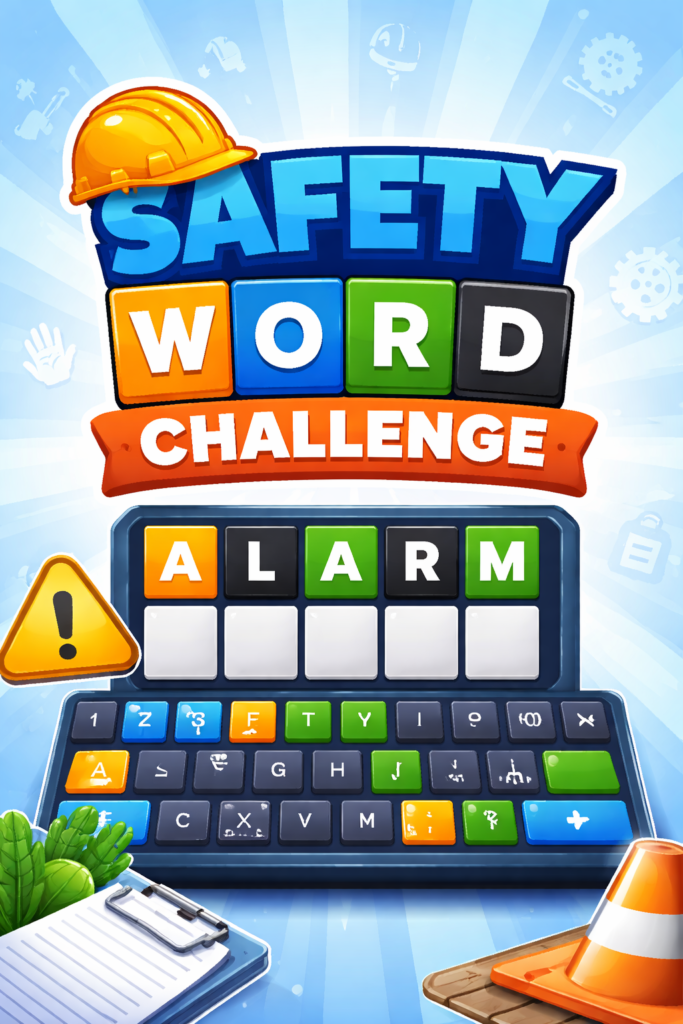
This interactive tool blends learning with daily engagement. It’s quick, accessible, and rooted in real OHSE concepts. Whether you’re a safety professional, supervisor, student, or worker, the Safety Word Challenge is designed to sharpen awareness in just a few minutes a day.
- Why a Safety Word Game?
- How the Safety Word Challenge Works
- Turning Engagement Into Learning
- Supporting a Strong Safety Culture
- Ideal Uses for Organizations
- Benefits for Safety Professionals
- Expanding the Concept
- Connecting Play With Purpose
- Keeping It Professional and Responsible
- How You Can Participate
- Final Thoughts
Why a Safety Word Game?
In occupational health, safety, and environment (OHSE), repetition builds awareness. The more frequently people encounter key safety terms, the more familiar they become. That familiarity translates into better hazard recognition and improved safety culture.
Traditional training methods — manuals, policies, toolbox talks — remain foundational. But reinforcement between formal training sessions is often missing. That’s where this game fills a gap.
By presenting a daily five-letter safety-related word, the game:
- Encourages active recall of safety vocabulary
- Sparks curiosity about safety terminology
- Reinforces hazard-related concepts
- Creates a habit of daily engagement
Instead of passively reading, users interact, think critically, and problem-solve.
How the Safety Word Challenge Works
The concept is simple:
- You have six attempts to guess a five-letter safety-related word.
- After each guess, you receive feedback:
- Correct letter in the correct position
- Correct letter in the wrong position
- Letter not in the word at all
- A new word appears daily.
Words are carefully selected from commonly used OHSE terminology and workplace safety language. Examples may include terms related to:
- Hazards
- Controls
- Emergency preparedness
- Environmental risks
- Workplace practices
- Equipment safety
Because the vocabulary is safety-focused, each round reinforces real-world OHSE concepts.
Turning Engagement Into Learning
This isn’t just a game for entertainment. It’s a micro-learning tool.
When someone guesses a word like “GUARD,” “SPILL,” or “ALARM,” it opens the door to further discussion:
- What types of guards are required on machinery?
- What is the proper spill response procedure?
- When should alarms be tested or inspected?
The game can easily connect to related articles, toolbox talks, or training modules. For example, after completing the challenge, users can be directed to:
- A short article explaining the concept
- A downloadable checklist
- A quick refresher on regulatory requirements
- A video from the Introduction to OHSE course
This integration transforms a five-minute game into a layered learning experience.
Supporting a Strong Safety Culture
One of the biggest challenges in workplace safety is maintaining attention over time. Safety initiatives often gain momentum after incidents, audits, or new regulations — but interest can fade.
Small, consistent engagement tools help sustain momentum.
The Safety Word Challenge supports safety culture by:
- Keeping safety language visible daily
- Encouraging friendly competition among teams
- Making OHSE less intimidating
- Creating conversation starters during meetings
Imagine starting a toolbox talk with:
“Did anyone solve today’s Safety Word?”
That single question can shift energy and participation levels immediately.
Ideal Uses for Organizations
This game is flexible and can be used in several ways:
Daily Office Engagement
Post the challenge on internal dashboards or company portals. Encourage teams to share results.
Toolbox Talk Icebreaker
Begin meetings with the day’s word. Use it as a lead-in to a related topic.
Safety Week Activities
During Safety Week or Environmental Awareness campaigns, integrate the challenge as part of a broader engagement strategy.
Training Reinforcement
After completing a module, assign participants to solve the Safety Word and reflect on its meaning.
This approach makes learning dynamic rather than passive.
Benefits for Safety Professionals
From a safety leadership perspective, tools like this offer several advantages:
1. Reinforces Terminology
OHSE language can sometimes feel technical or regulatory-heavy. Repetition builds comfort and confidence with terminology.
2. Encourages Micro-Learning
Short bursts of engagement are more sustainable than long, infrequent sessions.
3. Promotes Ownership
When employees voluntarily participate in safety-related activities, it reflects growing ownership of workplace safety.
4. Drives Website Engagement
For OHSE.ca, the Safety Word Challenge increases return visits and interaction, creating a more vibrant safety community.
Expanding the Concept
The current version focuses on five-letter words, but there’s room to grow. Future enhancements could include:
- Industry-specific word packs (construction, healthcare, warehousing)
- Environmental compliance editions
- Mental health and psychological safety terms
- Weekly advanced mode for safety professionals
- Leaderboards for friendly competition
The foundation is scalable.
Connecting Play With Purpose
Some may ask: does a game really contribute to workplace safety?
The answer lies in behavioral science. Learning improves when:
- It is interactive
- It is repeated
- It is emotionally engaging
- It encourages problem-solving
Even something as simple as guessing a word stimulates cognitive processing. When that word is tied to hazard recognition, prevention, or emergency response, the brain builds associations.
Over time, those associations strengthen safety awareness.
The goal isn’t to replace formal OHSE training. It’s to complement it.
Keeping It Professional and Responsible
It’s important that the Safety Word Challenge maintains professional integrity. Words are selected carefully to ensure they reflect legitimate safety concepts rather than trivial or unrelated terms.
The design is intentionally clean and distraction-free. No aggressive colors, no flashy elements — just straightforward interaction that keeps the focus on the word itself.
This aligns with the core principles of OHSE: clarity, consistency, and responsibility.
How You Can Participate
If you’re visiting OHSE.ca:
- Try the Safety Word Challenge daily.
- Share it with your team.
- Use it as a conversation starter.
- Suggest new safety words to include.
If you’re a safety leader, consider embedding the challenge in internal communications or adding it to safety newsletters.
Small engagement tools often create big cultural shifts.
Final Thoughts
Safety education doesn’t always have to be formal, heavy, or compliance-driven. While policies and procedures are critical, culture is built through consistent awareness and participation.
The Safety Word Challenge brings a fresh, interactive dimension to OHSE engagement. It blends learning with curiosity, reinforces terminology, and keeps workplace safety visible every day.
Try today’s challenge — and let safety become part of your daily routine, one word at a time.
No comments yet