

FIFA World Cup OHSE is more than a sports safety topic. It is a complete lesson in how large events must protect workers, fans, players, volunteers, contractors, communities, and the environment at the same time.
When millions of people travel, gather, celebrate, eat, move through transport systems, and enter stadiums, safety planning becomes just as important as the match itself.
The FIFA World Cup is one of the biggest sporting events in the world, and every host city must prepare for pressure on stadiums, roads, hotels, emergency services, waste systems, food vendors, and public spaces. This is why occupational health, safety, and environment planning must begin long before the first whistle.

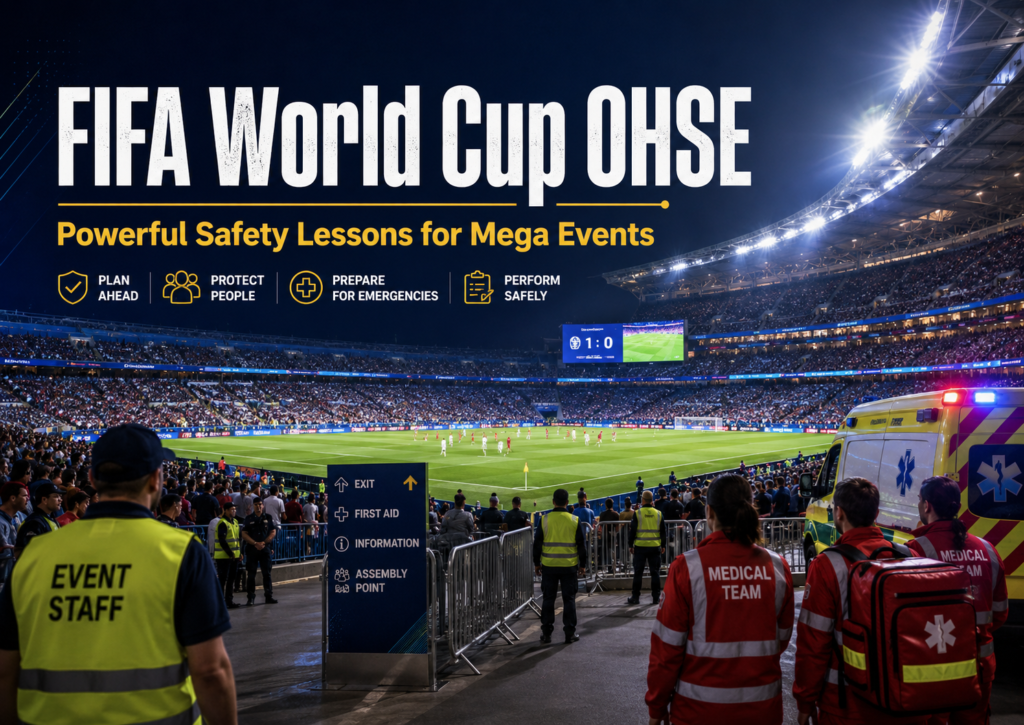
A successful mega event is not only measured by ticket sales or television views. It is also measured by how safely people work, how smoothly crowds move, how quickly emergencies are handled, and how responsibly the environment is protected.
[Image: A modern football stadium with safety staff, crowd-control barriers, recycling bins, first-aid teams, and fans entering safely. Alt text: FIFA World Cup OHSE]
- Why FIFA World Cup OHSE Matters
- Worker Safety Behind the Tournament
- Crowd Management and Fan Safety
- Emergency Preparedness for Mega Events
- Heat Stress and Public Health
- Environmental Protection and Sustainability
- Transportation and Community Safety
- Take the TTC to FIFA World Cup 2026™
- The Role of Training and Reporting
- Key Safety Lessons for All Mega Events
- Conclusion
Why FIFA World Cup OHSE Matters
FIFA World Cup OHSE matters because mega events create risks that ordinary workplaces rarely face. A normal workplace may manage employees, visitors, equipment, and contractors. A World Cup stadium must manage all of those, plus thousands of fans, international media, security teams, food services, cleaning crews, temporary workers, emergency responders, transport operators, and city authorities.


The most important lesson is that safety cannot be handled by one department alone. It must be integrated into event planning, venue design, contractor selection, staff training, crowd movement, environmental management, and post-event cleanup. Strong OHSE systems create clear responsibilities before problems happen.
For example, a stadium operator may focus on seating, lighting, entry gates, and evacuation routes. A city may focus on road closures, public transport, fan zones, and emergency medical access. Contractors may focus on temporary structures, electrical systems, cleaning, catering, or stage setup. If each group works separately, risks can be missed. If they work through one coordinated OHSE plan, the event becomes safer and more controlled.
This is why event organizers should study official resources such as FIFA Sustainability, the FIFA World Cup 26 Sustainability & Human Rights Strategy, and international event standards like ISO 20121 Sustainable Event Management.
Worker Safety Behind the Tournament
Fans usually see the final match-day experience, but thousands of workers prepare the event behind the scenes. FIFA World Cup OHSE must include construction workers, cleaners, food handlers, security staff, drivers, volunteers, maintenance teams, media crews, and temporary-event workers.
Before the tournament, construction and renovation work may involve working at heights, lifting operations, electrical installation, vehicle movement, confined areas, temporary structures, and heavy equipment. These tasks require proper training, permits, supervision, personal protective equipment, and daily hazard checks.

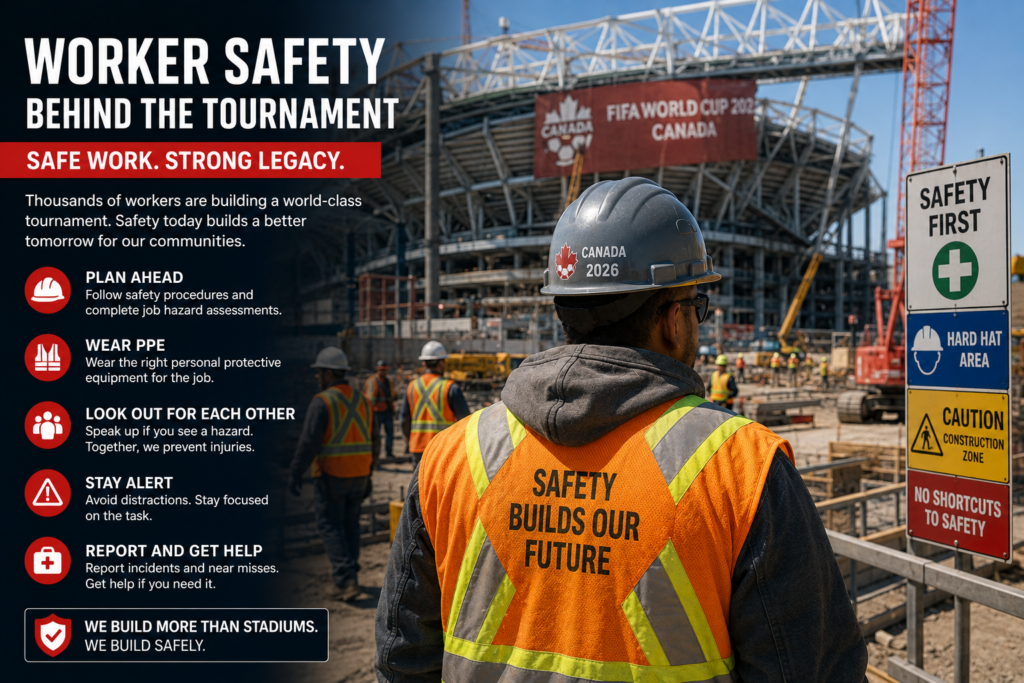
During the tournament, workers may face long shifts, fatigue, heat exposure, crowd pressure, slips and trips, manual handling injuries, noise exposure, and stress. A good OHSE plan should include rest breaks, hydration points, shaded areas, shift rotation, clear reporting channels, and quick access to first aid.
Contractor safety is another major lesson. Mega events often depend on many suppliers. If a contractor has poor safety practices, the entire event can be affected. Organizers should require safety documentation, insurance, training records, risk assessments, emergency procedures, and incident-reporting systems before work begins. For more practical safety content, readers can also visit our internal guide on /workplace-safety-checklist/.
Crowd Management and Fan Safety
Crowd safety is one of the most important parts of FIFA World Cup OHSE. A football crowd is emotional, excited, loud, and constantly moving. People arrive at different times, use different entrances, buy food, look for washrooms, move to seats, celebrate goals, and leave in large waves after the final whistle.
Poor crowd planning can cause congestion, panic, blocked exits, long queues, and medical delays. Strong planning helps people move safely from public transport to the stadium, through security checks, into seating areas, and back out again.
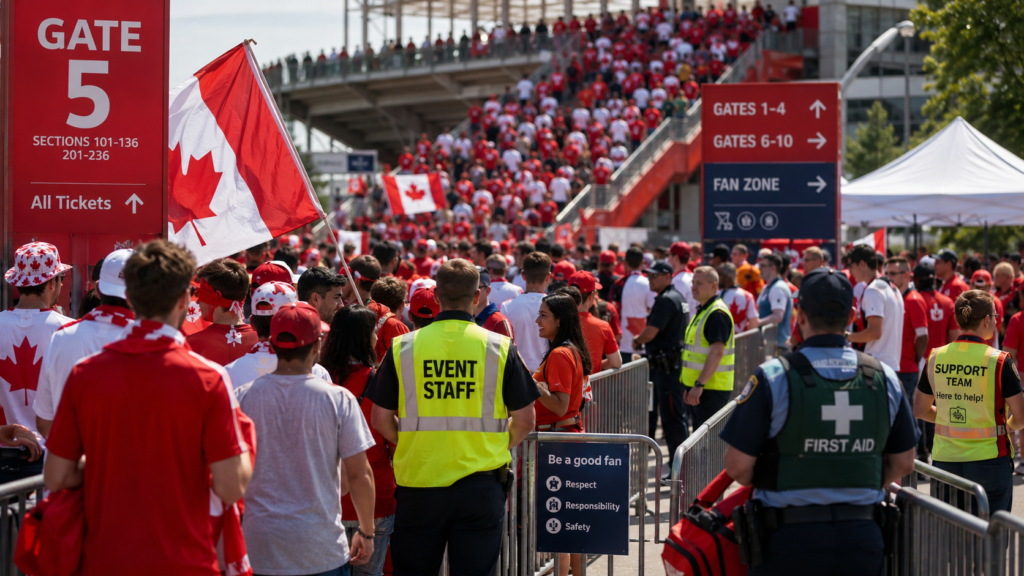
Important controls include clear signage, trained stewards, wide walking routes, visible emergency exits, crowd-flow barriers, accessible entry points, public announcements, and real-time monitoring. Control rooms should track crowd density, gate delays, weather alerts, security issues, and emergency calls.
Fan safety also includes children, older adults, people with disabilities, and visitors who may not speak the local language. Signage should use simple symbols, multilingual messages, and clear directions. Accessibility must be included in seating, washrooms, transport, emergency exits, and customer service points.
For a deeper internal resource, organizers can connect this topic with /event-risk-assessment-guide/.
Emergency Preparedness for Mega Events


Emergency planning is where FIFA World Cup OHSE becomes critical. A mega event must be ready for medical emergencies, fire alarms, severe weather, crowd surges, power failures, transport disruption, security incidents, and communication breakdowns.
The key lesson is preparation before the event. Emergency teams should test evacuation routes, communication systems, backup power, first-aid rooms, ambulance access, and command-center coordination. Staff should know who makes decisions, who contacts emergency services, and how information is shared with the public.
Drills are essential. A written plan is useful, but it is not enough. Teams should practise realistic scenarios such as a blocked exit, a medical emergency in a crowded section, a storm warning, or a power outage. After each drill, organizers should identify gaps and fix them.
Communication must be simple and fast. In a noisy stadium, people may not hear instructions clearly. Visual screens, mobile alerts, public-address systems, stewards, and security staff should all work together. The message should tell people what is happening, what they should do, and where they should go.
Heat Stress and Public Health
Heat stress is a serious OHSE issue for large summer events. Fans may stand in queues, walk long distances, sit in direct sun, or travel between fan zones and stadiums. Workers may spend hours outside while wearing uniforms or protective equipment.
FIFA World Cup OHSE planning must include hydration, shade, cooling areas, misting stations, and medical support.
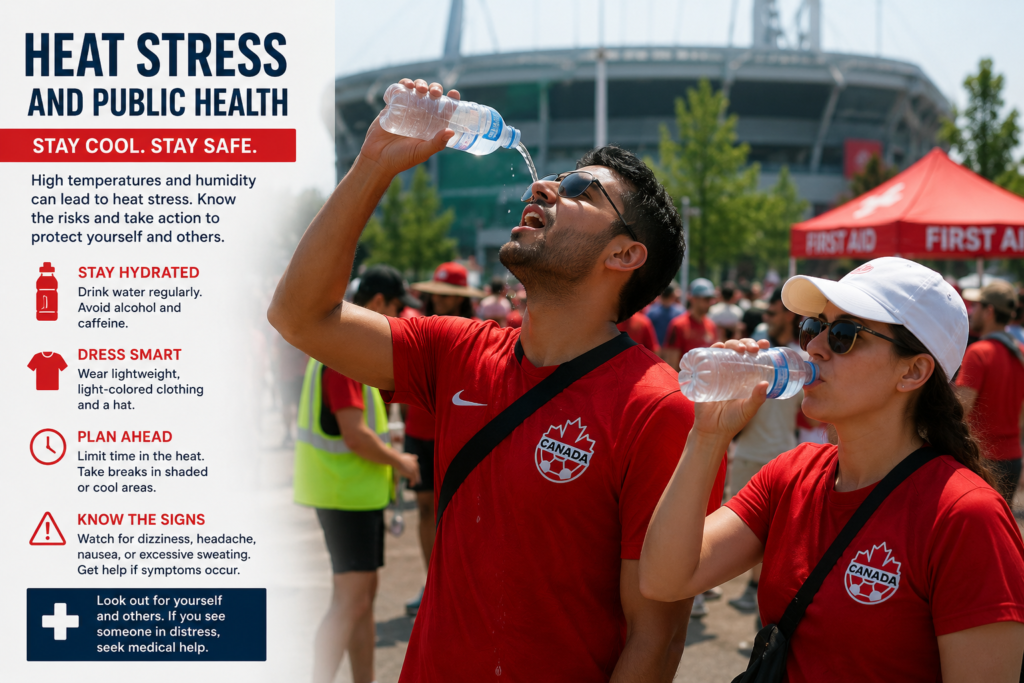
The health risk is higher when people are dehydrated, tired, crowded, or unfamiliar with the climate. Organizers should provide water access, shaded waiting areas, cooling tents, sunscreen messaging, and clear signs that show where medical support is available.
Public health also includes sanitation. Large events need clean washrooms, handwashing stations, waste removal, pest control, safe drinking water, and proper food handling. Food vendors should follow temperature controls, allergen communication, hygiene rules, and regular inspections.
A strong public-health plan protects both fans and workers. It also protects the reputation of the event.
Environmental Protection and Sustainability
FIFA World Cup OHSE is not only about injury prevention. The “E” in OHSE is just as important. Mega events can create large environmental impacts through travel emissions, energy use, water consumption, food waste, single-use packaging, noise, and temporary infrastructure.
Environmental planning should begin with waste reduction. Stadiums should provide recycling and composting systems, reduce unnecessary packaging, train vendors, and use clear bin signage. Cleaning teams should know how to separate waste safely and avoid contamination.
Energy management is another priority. Stadiums can reduce impact through efficient lighting, smart building controls, renewable-energy options, and careful scheduling of equipment. Water management also matters, especially in hot weather. Venues should monitor water use, prevent leaks, and plan for high-demand periods.
Sustainable procurement is a powerful lesson for any event organizer. Products should be selected based on safety, durability, environmental impact, and responsible sourcing. The UN Guiding Principles on Business and Human Rights are also useful because mega events affect workers, communities, suppliers, and visitors.
For internal reading, this article can connect naturally to /environmental-management-system/.
Transportation and Community Safety
The safety zone of a World Cup match does not stop at the stadium gate. Roads, sidewalks, train stations, buses, parking areas, hotels, restaurants, and fan zones are all part of the event footprint. FIFA World Cup OHSE planning must include the full journey of the fan.
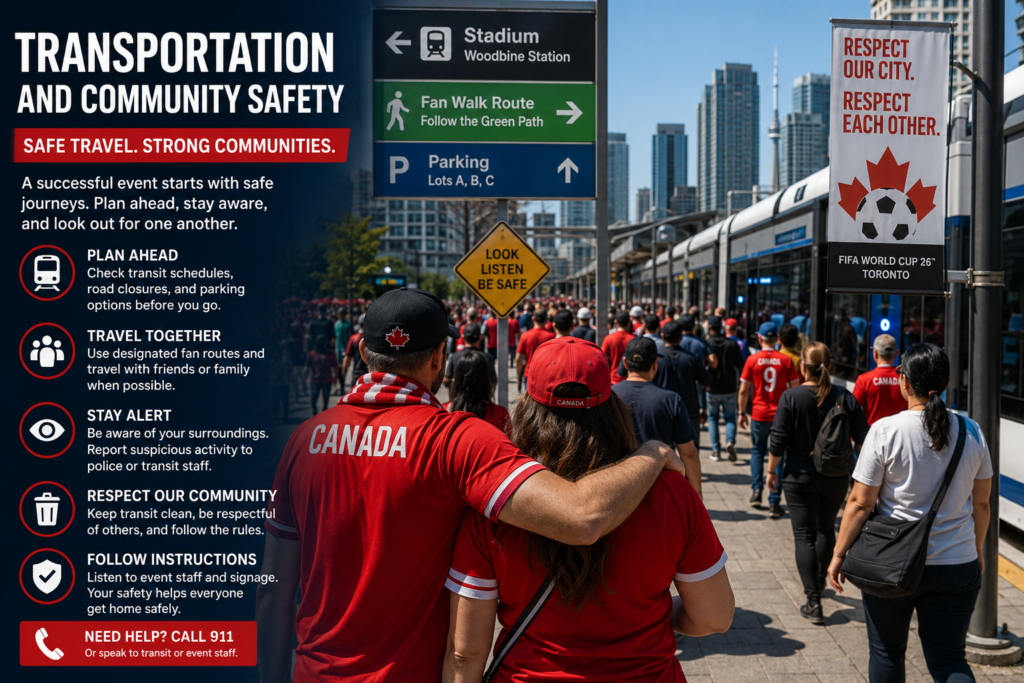
Transport safety includes traffic control, pedestrian routes, shuttle buses, ride-share pickup areas, emergency lanes, accessible transport, and crowd movement after the match. If thousands of fans leave at the same time, pressure on transit stations can become a safety issue.
Local communities must also be considered. Residents may face road closures, noise, waste, traffic delays, and business disruption. Good communication helps reduce frustration. Host cities should provide clear public notices, maps, schedules, and emergency contact information.
Community safety also includes protecting local workers and vulnerable groups. Mega events should not create unsafe working conditions, unfair treatment, or preventable environmental damage.
Take the TTC to FIFA World Cup 2026™


The Role of Training and Reporting
Training is one of the strongest safety tools in FIFA World Cup OHSE. Every worker and volunteer should know their role, their supervisor, the main hazards, emergency procedures, reporting methods, and basic customer-safety expectations.
Training should be practical, not just theoretical. Stewards should practise crowd guidance. Food workers should understand hygiene rules. Cleaning teams should know chemical safety and waste handling. Drivers should understand traffic routes. Volunteers should know how to direct fans and report concerns.
Incident reporting is equally important. A good OHSE culture encourages people to report hazards before they become injuries. Near misses, blocked exits, damaged barriers, overheating risks, electrical issues, and crowd bottlenecks should be reported quickly. The goal is not to blame people. The goal is to fix problems early.
Digital reporting tools can help event teams track issues in real time. A central dashboard can show open hazards, completed actions, responsible teams, and priority levels.
Key Safety Lessons for All Mega Events
The biggest lesson from FIFA World Cup OHSE is that safety must be planned as a complete system. It cannot be added at the last minute. Mega events need leadership, coordination, training, inspections, communication, and continuous improvement.
Event organizers should remember these core lessons:
- Start OHSE planning early.
- Include workers, fans, contractors, volunteers, and communities.
- Connect stadium planning with city planning.
- Prepare for heat, weather, medical issues, and crowd pressure.
- Use clear communication before, during, and after the event.
- Treat environmental protection as part of safety.
- Train everyone according to their role.
- Review incidents and improve after every event.
When these lessons are applied correctly, mega events become safer, cleaner, more organized, and more enjoyable.
Conclusion
FIFA World Cup OHSE shows that safety at mega events is not only about avoiding accidents. It is about protecting people, respecting communities, reducing environmental impact, and creating a well-managed experience from arrival to departure.
Every stadium, city, contractor, and event organizer can learn from the scale of the FIFA World Cup. Whether the event is a football tournament, concert, festival, conference, or public celebration, the same principle applies: safety must be built into every decision.
A successful event is not just one that attracts a crowd. It is one where workers return home safely, fans enjoy the experience, emergencies are controlled, waste is managed responsibly, and the host community benefits from better planning. That is the real power of FIFA World Cup OHSE.