


- handling corrosive substances safely: Essential OHSE Practices for Safer Workplaces
- Understanding the risks of handling corrosive substances safely
- Prevention measures and the hierarchy of controls for handling corrosive substances safely
- PPE requirements for handling corrosive substances safely
- Compliance, training, and practical examples of handling corrosive substances safely
handling corrosive substances safely: Essential OHSE Practices for Safer Workplaces


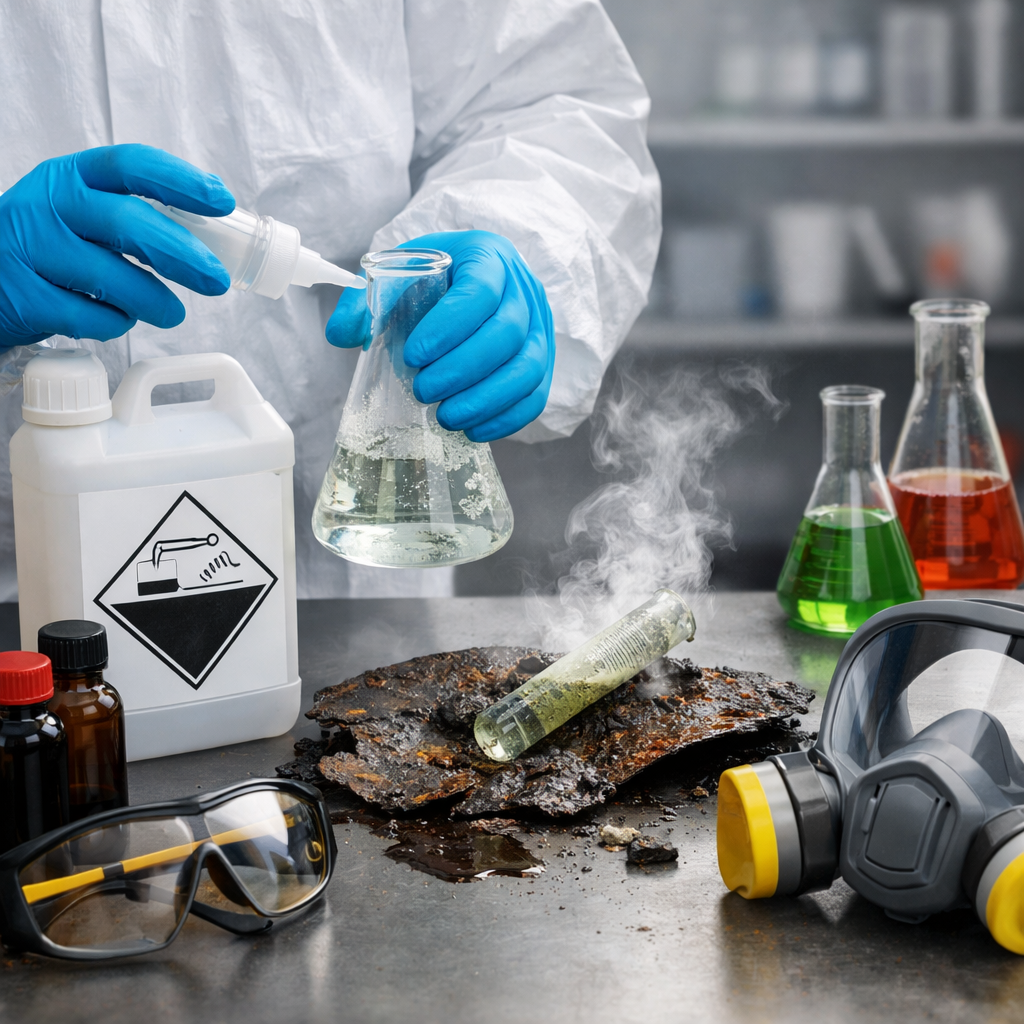
handling corrosive substances safely is a core responsibility in any workplace where acids, alkalis, cleaning chemicals, battery fluids, or industrial process agents are used.
These substances can burn skin, damage eyes, corrode metals, and create dangerous fumes, making strong OHSE controls essential from storage through disposal.
Whether the setting is a laboratory, warehouse, workshop, food plant, water treatment facility, or manufacturing site, the same principle applies: corrosives must be identified, assessed, controlled, and handled by trained workers using proper procedures.
Good safety practice reduces injuries, prevents environmental damage, supports legal compliance, and keeps operations running without costly incidents.
This guide explains the main risks, prevention strategies, personal protective equipment, compliance duties, and practical workplace examples related to handling corrosive substances safely.
Understanding the risks of handling corrosive substances safely
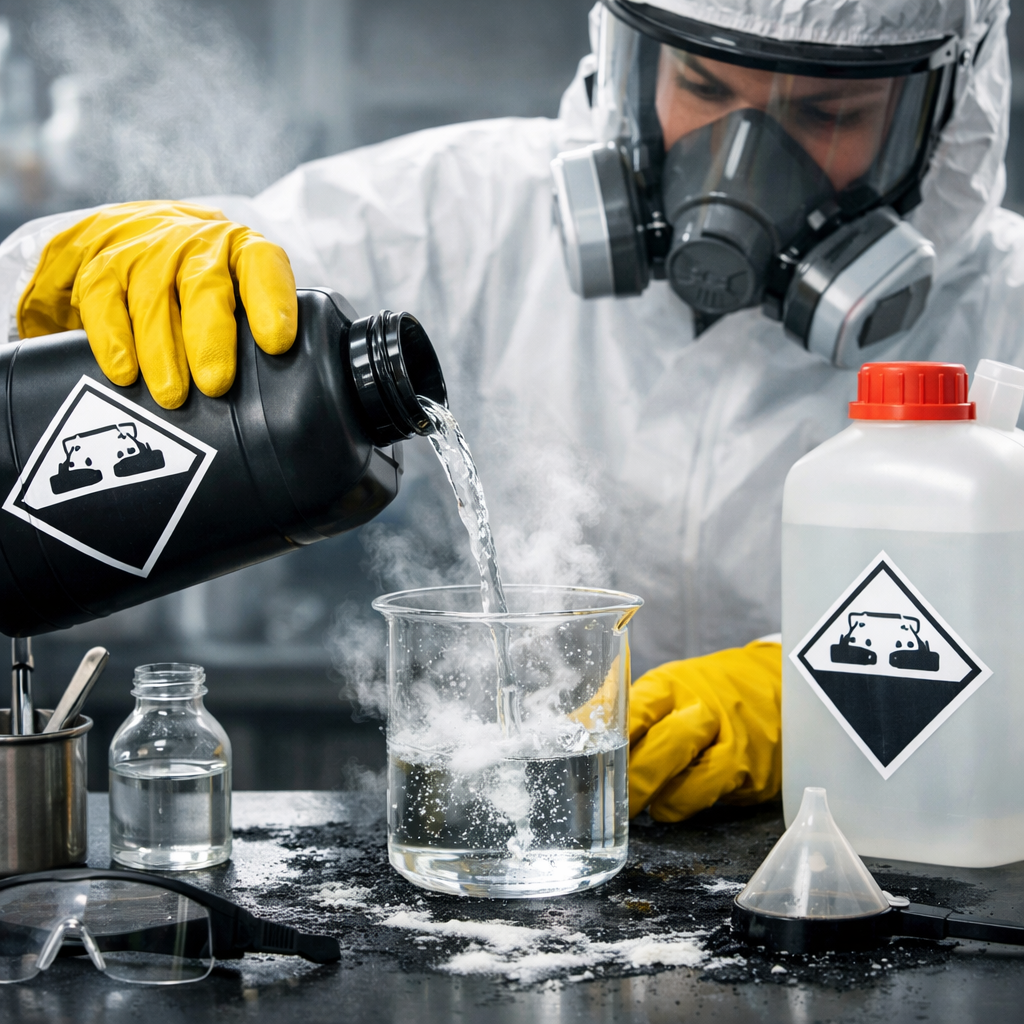
Corrosive substances are materials that can destroy or irreversibly damage living tissue and degrade equipment on contact.
Common examples include sulfuric acid, hydrochloric acid, sodium hydroxide, ammonia-based cleaners, descalers, drain cleaners, and some disinfectants.
In many workplaces, corrosives are not limited to obvious industrial chemicals. They may also be found in maintenance products, sanitation chemicals, plating solutions, and laboratory reagents.
Health and workplace hazards
The most immediate risk is chemical burns to the skin and eyes.
Even a small splash can cause severe tissue damage, permanent vision loss, or delayed injury that worsens if first aid is not applied quickly.

Inhalation is another serious hazard. Some corrosive substances release vapors or mists that can irritate or burn the nose, throat, and lungs.
In enclosed or poorly ventilated areas, exposure may become far more severe.
Corrosives can also damage containers, shelving, tools, flooring, and process equipment.
If incompatible substances are mixed, they may generate heat, toxic gases, fire, or violent reactions. For example, mixing acids with bleach can release hazardous chlorine gas.
That is why handling corrosive substances safely is not just about direct contact. It also involves segregation, ventilation, labeling, spill readiness, and sound supervision.
Common consequences of poor control
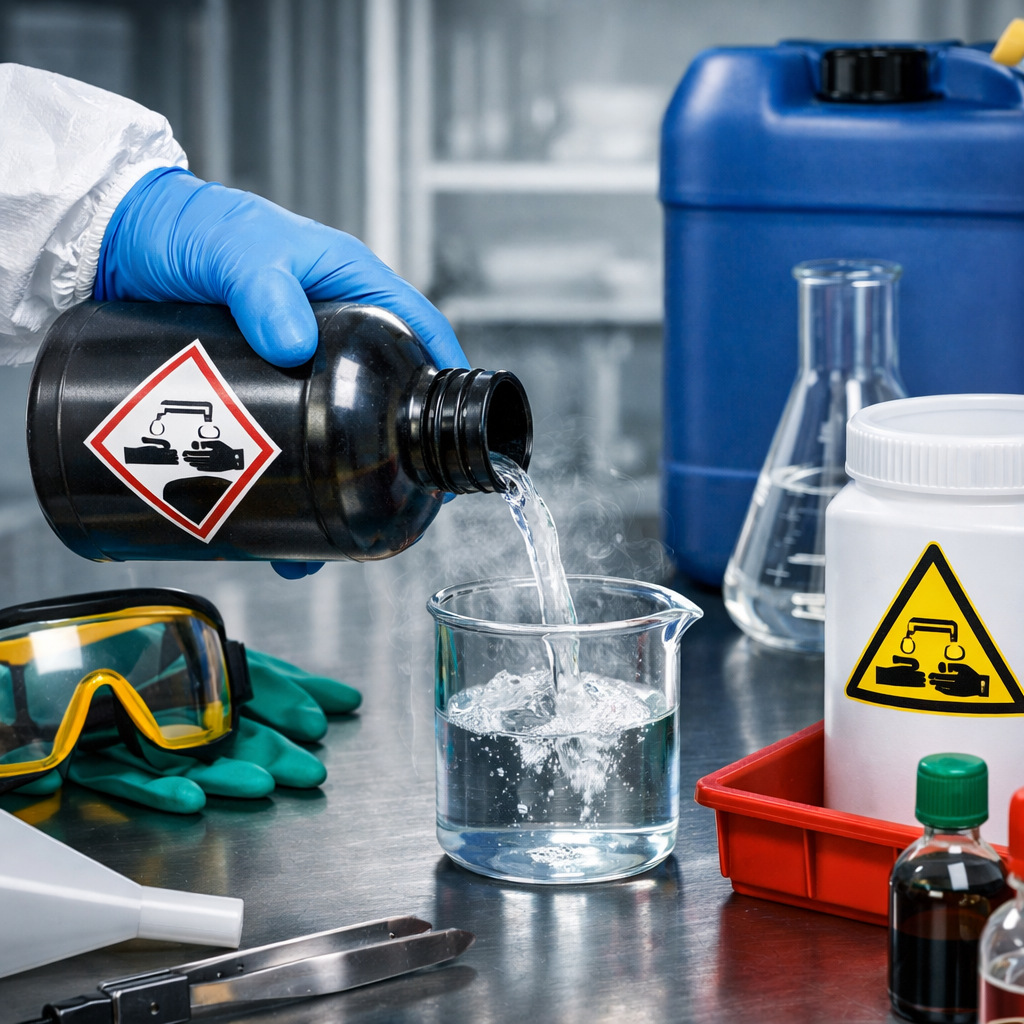
- Chemical burns to skin and eyes
- Respiratory irritation or lung injury from fumes or mists
- Equipment corrosion and structural damage
- Chemical spills and environmental contamination
- Reactive incidents from incompatible storage or mixing
- Lost time injuries, compensation claims, and enforcement action
Prevention measures and the hierarchy of controls for handling corrosive substances safely
The most effective way to improve safety is to apply the Hierarchy of Controls.
This approach focuses on removing hazards where possible before relying on workers to protect themselves.
Applying the hierarchy in practice
Elimination means removing the corrosive substance entirely if it is no longer needed for the task.
For example, a site may discontinue an unnecessary acid cleaning step by redesigning part of the process.
Substitution involves replacing a highly corrosive chemical with a less hazardous product where technically feasible.
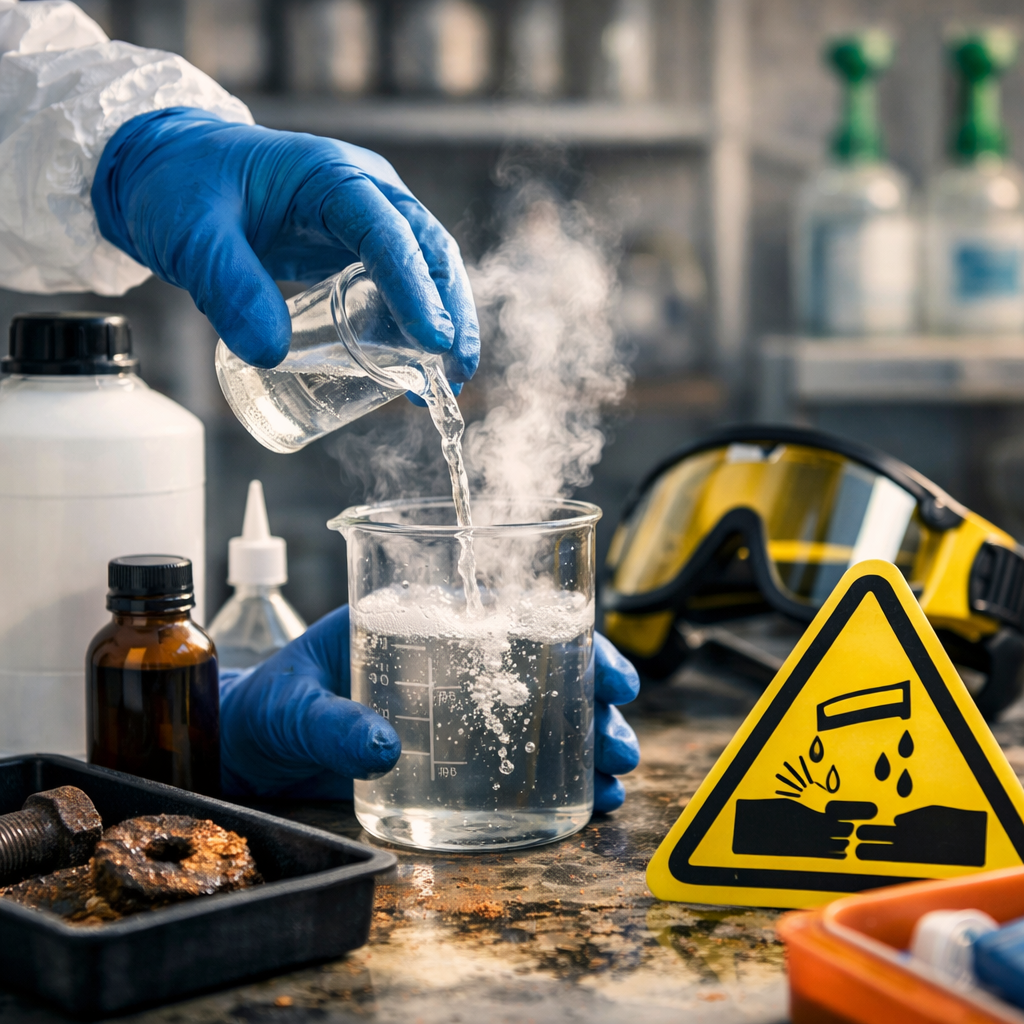
A cleaning contractor, for instance, may switch from a strong caustic product to a milder approved formulation that still meets hygiene requirements.
Engineering controls include local exhaust ventilation, enclosed transfer systems, corrosion-resistant storage cabinets, splash guards, eyewash stations, safety showers, and bunded storage areas.
These controls are especially important in fixed work areas where repeated chemical use occurs.
Administrative controls include safe work procedures, chemical registers, training, supervision, clear labeling, restricted access, incident reporting, and scheduled inspections.
Good housekeeping also matters. Containers should be closed, leaks repaired promptly, and decanting minimized where possible.
PPE is the last line of defense, not the first. It is essential, but it should support stronger upstream controls rather than replace them.
Safe storage and handling basics
Handling corrosive substances safely starts long before a worker opens a container.
Chemicals should be stored in compatible containers, kept upright, and segregated from reactive materials such as oxidizers, organics, or chlorine products where required.
Storage areas should be cool, secure, clearly marked, and fitted with spill containment where appropriate.
Workers should always check the Safety Data Sheet before use and follow site procedures for dilution, transfer, and waste disposal.
As a rule, chemicals should never be mixed unless a validated procedure specifically requires it.
Further guidance from OSHA’s Hazard Communication resources and CCOHS guidance on corrosive materials can help employers strengthen their systems.
PPE requirements for handling corrosive substances safely
When direct exposure remains possible, PPE must match the task, the substance, and the exposure route.
Choosing the wrong glove or face protection can leave workers exposed even when they appear to be protected.
Selecting suitable PPE
Eye and face protection is critical because corrosive splashes can cause permanent injury in seconds.
Depending on the risk, workers may need chemical goggles, a face shield, or both.
Ordinary safety glasses are often not enough for splash-prone work.
Gloves must be chemically compatible with the product being handled.
Nitrile, neoprene, butyl, PVC, or other glove materials may be suitable depending on the chemical and contact time. Glove selection should be based on manufacturer breakthrough data, not guesswork.
Protective clothing may include aprons, sleeves, coveralls, and chemical-resistant boots.
Where airborne exposure is possible, respiratory protection may also be necessary, but only as part of a compliant respiratory protection program.
| Task | Common Corrosive Risk | Typical PPE |
|---|---|---|
| Decanting acid into smaller containers | Splash to face, hands, torso | Chemical goggles, face shield, resistant gloves, apron |
| Caustic cleaning in production area | Skin contact, mist inhalation | Goggles, gloves, coveralls, boots, task-specific respiratory protection if required |
| Battery maintenance | Acid splash, damaged clothing | Face protection, acid-resistant gloves, apron |
| Spill response | Direct contact, fumes, slip hazard | Spill kit PPE matched to substance and SDS instructions |
PPE should be inspected before use, cleaned after use when appropriate, and replaced when damaged or contaminated.
Workers also need training on how to put PPE on, remove it safely, and recognize its limits.
For related workplace planning, many employers also review their workplace risk assessment guide and emergency response planning basics to ensure corrosive hazards are fully covered.
Compliance, training, and practical examples of handling corrosive substances safely
OHSE compliance requires more than buying safer containers and posting warning signs.
Employers must identify hazardous products, assess tasks, maintain Safety Data Sheets, ensure labels are legible, provide worker instruction, and prepare for emergencies.
Depending on the jurisdiction, requirements may be shaped by OSHA standards, WHMIS duties, local hazardous substances regulations, and industry-specific codes.
Organizations such as OSHA and CCOHS provide practical compliance information that can support workplace procedures and training programs.
Training and emergency readiness
Workers should be trained to read labels and Safety Data Sheets, understand incompatible substances, wear the correct PPE, and respond correctly to spills or exposure incidents.
Emergency equipment such as eyewash stations and safety showers must be accessible, tested, and located close to corrosive use areas.
First aid procedures should be clear and rehearsed. In most splash cases, immediate flushing with water is critical while following the SDS and seeking medical attention.
Practical workplace examples
In a food processing plant, a sanitation worker uses a caustic cleaner at the end of a shift.
Handling corrosive substances safely in this setting means using a dosing system instead of open pouring, wearing chemical goggles and gloves, checking ventilation, and ensuring the chemical is stored away from incompatible products.
In an automotive workshop, battery maintenance exposes workers to sulfuric acid.
Safe handling includes using acid-resistant gloves, keeping neutralizing material and eyewash nearby, and inspecting batteries for cracks before movement.
In a laboratory, a technician diluting acid must use the correct method, add acid to water rather than water to acid where applicable, work in a controlled area, and follow the lab’s written procedure.
These examples show that handling corrosive substances safely depends on matching controls to the real task, not relying on generic rules alone.
In every industry, consistent planning, proper PPE, training, and compliance form the foundation of safer work.
Ultimately, handling corrosive substances safely protects people, equipment, and business continuity. When employers apply the hierarchy of controls, maintain compliant systems, and prepare workers for real-world tasks, they significantly reduce the likelihood of burns, exposure events, and preventable incidents. A strong OHSE approach to handling corrosive substances safely is not optional; it is an essential part of responsible workplace management.