
- What is Hazard Communication Standard ?
- Why the Hazard Communication Standard matters now
- What the Hazard Communication Standard requires
- Labels under the Hazard Communication Standard
- Safety Data Sheets: access beats perfection
- Training that sticks (and passes audits)
- Building your written program
- Common pitfalls—and how to fix them
- What changed recently—and what it means for you
- Auditing your Hazard Communication Standard: a quick 10-point check
- Frequently asked questions about the Hazard Communication Standard
- Bringing it all together
What is Hazard Communication Standard ?
Hazard Communication Standard is OSHA’s cornerstone “Right-to-Understand” rule that ensures workers know the chemical hazards they face—and how to protect themselves—through consistent labeling, Safety Data Sheets (SDS), and effective training.

If your operation uses, stores, mixes, ships, or even occasionally handles hazardous chemicals, the Hazard Communication Standard (29 CFR 1910.1200) is the compliance backbone your program rests on.
Why the Hazard Communication Standard matters now
The last few years have seen important updates to keep the system aligned with the UN’s GHS framework and to clarify rules for small packages, mixtures, and trade secrets.
For employers, that means the Hazard Communication Standard is not just a paperwork exercise; it is a living program that directly shapes how your people read labels, find SDSs, and make reliable decisions during normal work and emergencies.
Organizations that treat HazCom as a culture—rather than a binder—see fewer incidents, faster onboarding, and stronger audit performance.
Internal tip: If you publish safety content for your workforce, connect this topic to related pieces like your Respiratory Protection Programs and Emergency Signal Words articles so workers can move from chemical hazards to PPE and emergency response in a single learning journey.
What the Hazard Communication Standard requires
At its core, the Hazard Communication Standard requires a written program, a complete chemical inventory, compliant labels, accessible SDSs, and employee training. Each element must work together.
Your written program explains how you will label secondary containers, where SDSs live, who trains whom, and how you manage contractors and multi-employer sites.
The chemical inventory is the index for everything else—no inventory, no completeness. Labels and SDSs communicate consistent hazard information, and training turns information into safe behaviors.
When you build or refresh your HazCom, insist on traceability. Every chemical on your inventory should map to an SDS, and every SDS should be easily reachable—online or in a clearly marked binder—during a power outage, evacuation, or network hiccup.
Labels under the Hazard Communication Standard
Shipped containers must carry product identifier, signal word, hazard statements, pictograms, precautionary statements, and supplier information.
Workplace (secondary) containers need labels that convey at least the product identifier and general hazard information; many employers adopt GHS-style mini-labels for consistency.
The major win is recognition: when workers see the flame, corrosion, or health-hazard pictogram, they instantly know what they’re dealing with.
Small packages create practical challenges. The latest amendments allow flexibilities (e.g., fold-out labels or outer-container labeling) while keeping core elements visible. Don’t treat this as an afterthought—auditors often start at your smallest, most frequently handled containers.
Safety Data Sheets: access beats perfection
The Hazard Communication Standard standardizes SDSs into a 16-section format so workers and responders can quickly find first-aid, firefighting, spill response, exposure controls, and stability/reactivity information.
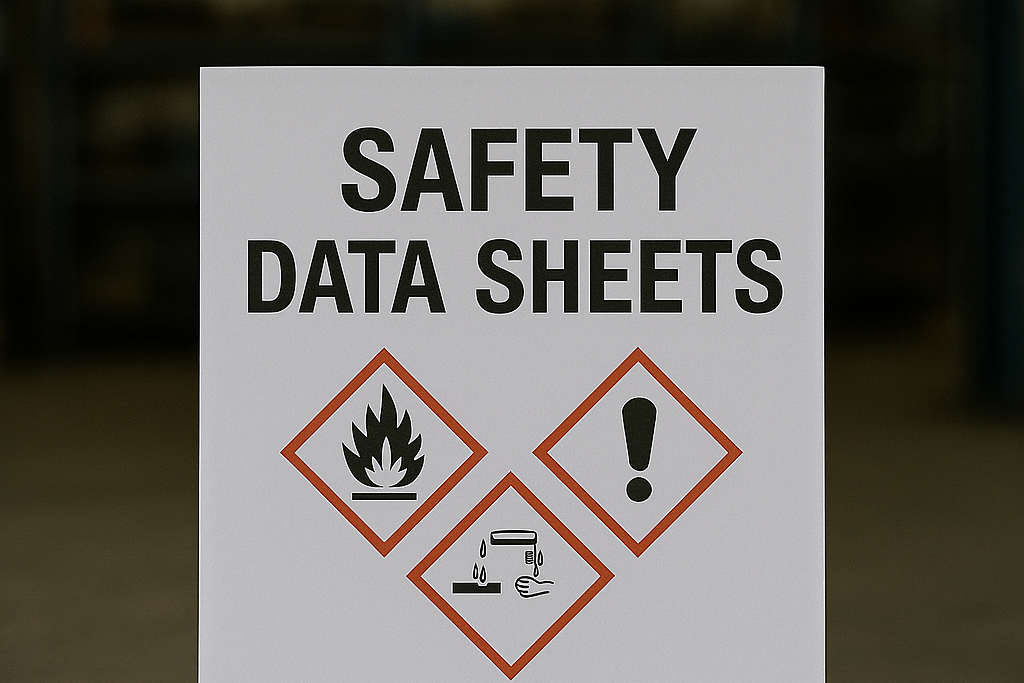
Digital systems are fine, but uninterrupted access is king. If your SDSs sit behind a login, ask: Can my night-shift crew and contractors pull these up in 10 seconds when it matters? Many employers keep a printed SDS index and QR codes at storage areas to close the last-mile gap.
For mixtures, ensure you’re receiving the most current SDS version and that revisions are captured in your system. Periodic inventory and SDS reconciliations—quarterly is a good starting cadence—prevent drift.
Training that sticks (and passes audits)
The Hazard Communication Standard requires training at initial assignment and whenever a new chemical hazard is introduced. High-impact training covers three things: how to read labels, how to use SDSs, and how to apply protective measures (PPE, ventilation, hygiene, storage).
Bring it to life with real containers from your floor, mock spill cards, and rapid-fire label drills. Short toolbox talks—e.g., “What does Danger vs Warning change for me?”—help maintain retention between annual refreshers.
Internal link it smartly: After your core session, point learners to quick reads like Just Culture in Safety to reinforce reporting and learning behaviors that make HazCom work.
Building your written program

Your written program is the user manual for your HazCom system. Keep it concise, role-based, and operational:
- Purpose & scope: Where the Hazard Communication Standard applies in your operation (including labs, maintenance shops, or mobile crews).
- Roles & responsibilities: Who classifies, who labels, who trains, who audits, and who maintains the SDS library.
- Labeling rules: How you label secondary containers, small containers, and temporary transfer bottles; how you handle damaged or missing labels.
- SDS management: Receipt, version control, access method, and retention.
- Training plan: Induction, refresher frequency, evaluation, and contractor orientation.
- Non-routine tasks & emergencies: How workers get hazard info for seldom-performed work (e.g., tank cleaning) and what to do during spills or fires.
- Multi-employer worksites: How you share hazard info with host employers, subcontractors, and visitors.
Keep the document lean and push details (like SDS index or label templates) into appendices you can update without policy sign-off delays.
Common pitfalls—and how to fix them
- Unlabeled secondary containers. Fix with a simple rule: no label, no use. Place blank GHS-style labels at dispensing points and train crews to fill them before they move an ounce.
- Out-of-date SDSs. Set quarterly checks; map every inventory item to a current SDS.
- Digital-only access with bottlenecks. Add a printed binder at each storage area and QR code posters.
- Training that’s all slide, no hands-on. Use real labels, actual SDSs, and a 90-second “find the first-aid section” drill.
- No plan for visitors/contractors. Create a one-page HazCom orientation you can staple to permits or hand out at the gate.
What changed recently—and what it means for you
To keep alignment with GHS and clarify gray areas, OSHA updated the Hazard Communication Standard with new guidance on small packages, several hazard classes, and trade secrets.
For most employers, the impact is practical: review supplier labels as they update, check your secondary-container formats, and refresh your training slides so they match what workers now see on incoming products. It’s also a good moment to tighten your mixture SDS housekeeping and ensure your procurement process demands compliant labels/SDSs up front.
For deeper context or to cite primary sources in your safety manual, consult OSHA’s official pages on Hazard Communication (HCS) and the 2024 HazCom final rule update. For broader worker-focused chemical safety resources, see NIOSH and the UN’s GHS “Purple Book” overview. (These standard links are do-follow by default.)
Canadian readers: If you operate cross-border, align training with WHMIS vocabulary and label/SDS formats so crews can move seamlessly between sites; see OHSE.ca for Canadian safety reading and updates.
Auditing your Hazard Communication Standard: a quick 10-point check
Use this list for monthly walk-throughs or pre-audit tune-ups:
- Inventory complete? Every chemical present—and nothing obsolete—on the list.
- SDS coverage? One current SDS per inventory item; emergency access tested.
- Label integrity? Shipped labels intact; secondary containers labeled before use.
- Small-package approach? Clear, consistent method for tiny containers.
- Storage & segregation? Incompatibles separated; flammables in approved storage.
- Ventilation & controls? Engineering controls noted in SDS are actually implemented.
- PPE match? PPE requirements reflect SDS sections and air monitoring where applicable.
- Training currency? New hires trained; refresher cadence maintained; quizzes retained.
- Contractor/visitor plan? HazCom info shared at onboarding and in permits.
- Continuous improvement? Near-misses and label/SDS “confusions” feed into updates.
If you track improvements publicly on your site, consider a short “What we fixed this month” note and link it from your Safety Tools & Templates page.
Frequently asked questions about the Hazard Communication Standard
- Is consumer-grade product use covered? Usually not, if used in a way and frequency comparable to ordinary consumer use. Document your rationale.
- Do I have to relabel a supplier’s drum? No—keep the shipped label intact. Add workplace labels only if contents are transferred to secondary containers.
- How often must I retrain? At initial assignment and when new hazards are introduced. Most employers add an annual refresher to keep knowledge fresh.
- Who owns the SDS library? Assign a named role (not a committee) and provide deputies for coverage.
Bringing it all together
The Hazard Communication Standard succeeds when it’s visible in daily work: labels that match reality, SDSs workers can grab in seconds, and training that helps people make decisions under pressure.
Keep your program simple, test it in the field, and iterate as your chemical inventory evolves. With a clear written plan, disciplined inventory/SDS controls, and hands-on training, you’ll protect your teams, meet regulatory expectations, and build a safety culture that lasts—rooted in the Hazard Communication Standard.
No comments yet