 Skip to content

Noise and Hearing Loss at Work are silent threats that often creep up slowly, with damage only becoming obvious years later.
By the time workers notice ringing in their ears or difficulty hearing conversations, permanent harm may already be done.
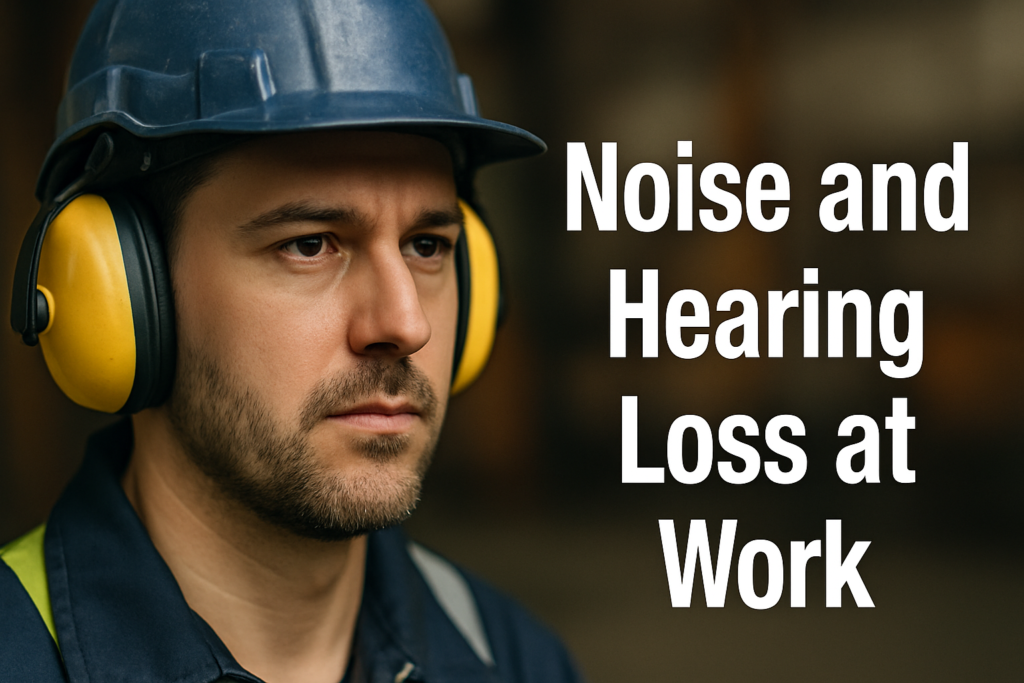
The good news is that Noise and Hearing Loss at Work are almost entirely preventable when you follow a structured, practical approach to controlling exposure.
- 1. Measure noise, don’t guess
- 2. Identify who is exposed and for how long
- 3. Eliminate noise at the source wherever possible
- 4. Use engineering controls to reduce noise transmission
- 5. Redesign workstations and layouts
- 6. Control exposure time with smarter scheduling
- 7. Select the right hearing protection for each task
- 8. Train, fit-test, and coach workers continuously
- 9. Monitor hearing with audiometric testing
- 10. Review, audit, and continuously improve your program
1. Measure noise, don’t guess
You cannot control what you haven’t measured. Many workplaces underestimate Noise and Hearing Loss at Work because they rely on “it seems loud” instead of real data. Use a calibrated sound level meter or a professional noise survey to measure dBA levels across different areas, tasks, and times of day.
Capture both continuous noise (e.g., machinery hum) and peak or impact noise (e.g., hammering, metal impacts). Document the readings, the locations, and the activities happening at the time.
These measurements form the baseline for your hearing conservation program and justify further controls, training, and medical surveillance.
Link this step with your existing workplace hazard identification and risk assessment process so noise is not treated as a separate issue but as a core part of your overall OHSE system.
2. Identify who is exposed and for how long
Noise and Hearing Loss at Work are about both volume and duration. Two workers can be in the same area and have very different exposures depending on their tasks and time spent near noisy sources. Once you have measurements, map them to specific roles, workstations, and tasks.
Create simple exposure profiles: who is in high-noise areas for most of their shift, who enters briefly, and who is only occasionally exposed.
Pay attention to mobile workers like maintenance staff, cleaners, and supervisors who move through multiple zones in a day.
This step helps you prioritize controls for the people at greatest risk and decide who needs hearing tests and personal protective equipment.
3. Eliminate noise at the source wherever possible
The most effective way to prevent Noise and Hearing Loss at Work is to remove the noise itself.
Before you jump to earplugs, challenge the necessity of the noise source:
- Can a noisy machine be replaced with a quieter model?
- Is there a different process that produces less noise?
- Can you move noisy operations outdoors or to a separate room?
When purchasing new equipment, include noise levels as a key selection criterion. Ask suppliers for sound power data and compare options, not just on price and capacity, but on noise performance as well.

Over the life of the equipment, the reduction in hearing-related claims, complaints, and errors can more than offset the cost of quieter technology.
4. Use engineering controls to reduce noise transmission
Even when you cannot fully eliminate a noisy process, you can significantly reduce Noise and Hearing Loss at Work through engineering controls. Consider:
- Acoustic enclosures or guards around machines
- Sound-absorbing panels on walls and ceilings
- Barriers between noisy equipment and quiet work areas
- Vibration isolation mounts to prevent structure-borne noise
Work with maintenance, engineering, or external consultants to design solutions that fit your environment.
Resources from organizations such as CCOHS and NIOSH provide practical guidance on noise control options and design principles you can adapt to your site.
5. Redesign workstations and layouts
Sometimes Noise and Hearing Loss at Work can be reduced simply by changing where people work. If quiet administrative tasks are done close to noisy machinery, consider relocating desks, control panels, or inspection stations to low-noise zones.
Revisit your layout with a “noise map” in hand and look for opportunities to:
- Increase distance between workers and noise sources
- Group loud machines together and separate them from offices
- Create quiet zones for breaks, meetings, and focused work
This doesn’t always require major construction. Even moving a workstation a few meters or rotating a desk away from a reflective surface can noticeably reduce exposure levels.

6. Control exposure time with smarter scheduling
When engineering changes aren’t enough, managing time is a powerful tool to control Noise and Hearing Loss at Work. Rotate workers between high- and low-noise tasks so no one spends an entire shift in the loudest areas. Limit overtime in noisy jobs and provide quiet recovery periods.
Build exposure limits into job planning and permits, especially during shutdowns or maintenance when many noisy tasks happen at once.
If you already use the Prepare – Observe – Identify – Assess – Control – Review structure in your safety assessments, integrate noise exposure time as a key risk factor that must be considered before work begins.
7. Select the right hearing protection for each task
Personal protective equipment is the last line of defence against Noise and Hearing Loss at Work, not the first. But when PPE is needed, it must be chosen carefully. Consider:
- The level of attenuation required based on measured noise levels
- Compatibility with other PPE like hard hats and eye protection
- Comfort, climate, and worker preference (earmuffs vs. earplugs)
Avoid over-protection; if workers feel isolated or cannot hear alarms or colleagues, they may remove their protection at exactly the wrong moment.
Share manufacturer information and fit instructions, and link to credible resources such as OSHA’s hearing conservation guidance.
8. Train, fit-test, and coach workers continuously
Training is essential to making Noise and Hearing Loss at Work visible and real. Go beyond a one-time orientation. Provide regular toolbox talks on:
- How noise damages the inner ear over time
- Early signs of hearing loss and tinnitus
- Correct insertion of earplugs and adjustment of earmuffs
- The importance of wearing hearing protection 100% of the time in designated areas
Include practical demos and hands-on practice. Supervisors should actively coach and correct improper use in the field.
Where possible, use quantitative fit-testing or verification tools to show workers how well their chosen protection actually performs.
9. Monitor hearing with audiometric testing
A strong hearing conservation program includes medical surveillance to catch Noise and Hearing Loss at Work before it becomes disabling. Arrange baseline audiometric tests when workers start in noisy roles, and follow up at regular intervals as required by your jurisdiction.

Review the results with an occupational health professional, looking for standard threshold shifts or other early changes. Use this data to identify high-risk tasks, evaluate the effectiveness of your controls, and have confidential conversations with workers about protecting their hearing at work and at home.
Where appropriate, connect this monitoring with other health and safety initiatives promoted on your internal OHSE hub or sites like OHSE.ca, so workers see hearing conservation as part of a broader wellness strategy.
10. Review, audit, and continuously improve your program
Noise and Hearing Loss at Work risks evolve with new equipment, processes, and work patterns. Make regular reviews part of your safety cycle:
- Re-measure noise after major changes or renovations
- Audit compliance with hearing protection rules
- Check that signage, demarcated noise zones, and procedures are up to date
- Incorporate lessons from near misses, worker feedback, and audiometric trends
Tie these reviews into your overall safety management system and leadership walkabouts.
When workers see leaders taking Noise and Hearing Loss at Work seriously—asking questions, wearing protection, investing in controls—participation and compliance improve dramatically.
By combining measurement, engineering, smart scheduling, appropriate PPE, training, and health surveillance, you can dramatically reduce Noise and Hearing Loss at Work and protect workers’ quality of life for years to come.
These 10 practical steps are not complicated, but they do require commitment, consistency, and a clear message that protecting hearing is just as important as preventing visible injuries.
No comments yet