

Ontario OHSE Report : OHSE—Occupational Health, Safety, and Environment—has taken center stage in Canada this month, with a wave of reports, reforms, and funding announcements sparking heated debate.

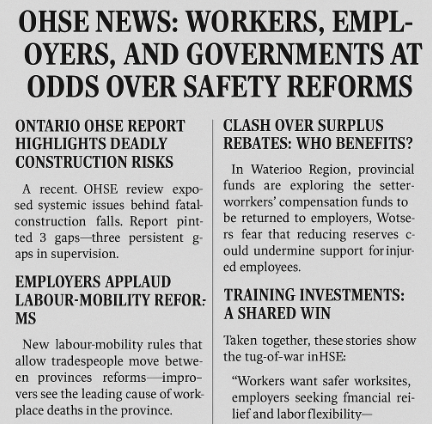
From Ontario’s construction safety concerns to employer demands for surplus rebates, the conversation reveals how complex workplace safety truly is when workers, businesses, and governments each push their own priorities.
Ontario OHSE Report Highlights Deadly Construction Risks
A recent OHSE review in Ontario exposed systemic issues behind fatal construction falls. Despite years of regulations and safety campaigns, falls remain the leading cause of workplace deaths in the province.
The report pointed to three persistent gaps:
- Training deficiencies: Many workers lacked practical fall-prevention experience despite holding certifications.
- Supervision lapses: Inconsistent oversight at worksites left safety procedures unenforced.
- Regulatory blind spots: Subcontractors and small firms often slipped under inspectors’ radar.
For workers, this report validates long-standing concerns about unsafe sites. For employers, it raises pressure to address hazards without stalling projects.
Governments now face demands for tougher enforcement and better compliance monitoring.
Employers Applaud Labour-Mobility Reforms
At the same time, Ontario’s labour-mobility reforms are being praised by employers eager to fill skill shortages. These rules make it easier for certified tradespeople to move between provinces without unnecessary red tape.

Business leaders say this will:
- Ease hiring delays.
- Help address labour shortages.
- Improve efficiency on large infrastructure projects.
Yet unions and safety advocates warn that without harmonized OHSE standards, moving workers across borders could expose them to inconsistent training and uneven workplace protections.
Clash Over Surplus Rebates: Who Benefits?
The Canadian Federation of Independent Business (CFIB) is lobbying workers’ compensation boards in New Brunswick, Ontario, BC, PEI, and Yukon to return surplus funds to employers.
For small businesses, the rebates could be significant. In New Brunswick alone, a five-employee company could receive more than $5,300 back. Employers argue this money would ease inflationary pressures and help them reinvest in operations.
Workers, however, fear that stripping reserves could weaken support systems for injured employees. Advocates insist surpluses should remain available to guarantee long-term compensation, rehabilitation, and fair treatment.
This debate captures a larger question: should OHSE funds primarily protect workers or provide relief to businesses?
National OHSE Harmonization Under Discussion
Across Canada, ministers are exploring the harmonization of OHSE standards between provinces and federally regulated workplaces. Employers support harmonization to reduce compliance costs and eliminate duplication.
Workers, meanwhile, demand a strong voice in shaping policy to prevent safety from being watered down in the name of efficiency.
The outcome of this discussion could redefine OHSE protections nationwide—especially in high-risk sectors like construction, mining, and healthcare.
Training Investments: A Shared Win
Not all news has been divisive. In Ontario’s Waterloo Region, the Grand Valley Construction Association secured nearly $1.5 million in provincial Skills Development Fund support.
This funding will expand:
- Safety training programs.
- Professional development opportunities.
- Job placement services for construction workers.
By directly investing in worker skills, the program benefits both employers and employees—proving that some OHSE initiatives can indeed satisfy all sides.
What This Means for OHSE in Canada
Taken together, these stories show the tug-of-war in OHSE today:
- Workers want safer worksites, stronger enforcement, and fairer compensation.
- Employers want financial relief, labour flexibility, and reduced red tape.
- Governments are caught in the middle, balancing safety with economic growth.
One thing is clear: OHSE will remain a hot-button issue as Canada pushes for safer workplaces while navigating economic pressures.
For workers and employers alike, staying informed about these developments is crucial—because the outcomes will shape not only safety standards, but also how risks and responsibilities are shared across the country.