


warehouse fire hazard prevention: Practical Strategies to Reduce Risk and Improve OHSE Performance

warehouse fire hazard prevention is a critical part of occupational health, safety, and environmental management in any storage or distribution facility.
From high-piled stock and battery charging areas to forklifts, packaging waste, and electrical systems, warehouses contain multiple ignition sources and fuel loads that can turn a small incident into a major emergency.
A serious warehouse fire can cause injuries, fatalities, stock loss, structural damage, business interruption, and environmental harm. It can also expose employers to legal penalties if hazards were known but not properly controlled.
For safety leaders, supervisors, and facility managers, the goal is not only to respond to fires but to stop them from starting in the first place. Effective warehouse fire hazard prevention combines risk assessment, housekeeping, equipment maintenance, staff training, personal protective equipment, and compliance with recognized standards from organizations such as OSHA and CCOHS.
This article explains the main fire risks in warehouses, practical prevention measures, PPE considerations, compliance requirements, and real-world examples that support stronger OHSE outcomes.
- Understanding warehouse fire hazard prevention and the main fire risks
- Warehouse fire hazard prevention through risk assessment and the Hierarchy of Controls
- Key control measures for warehouse fire hazard prevention
- PPE, training, compliance, and practical examples in warehouse fire hazard prevention
- Conclusion: Building a stronger warehouse fire hazard prevention culture
Understanding warehouse fire hazard prevention and the main fire risks
Warehouse fire hazard prevention starts with understanding how fires begin and spread in storage environments.
Most warehouse fires involve the fire triangle: heat, fuel, and oxygen. In warehouses, fuel is often abundant due to cardboard, plastic wrap, wooden pallets, flammable liquids, aerosols, textiles, and stored goods. Heat can come from faulty wiring, hot work, overloaded circuits, vehicle engines, heaters, friction, and battery charging equipment.
Common warehouse fire hazards
- Poor housekeeping: Accumulated cardboard, shrink wrap, dust, and waste create a fast-burning fuel source.
- Electrical faults: Damaged cords, overloaded power boards, aging panels, and unmaintained equipment can arc or overheat.
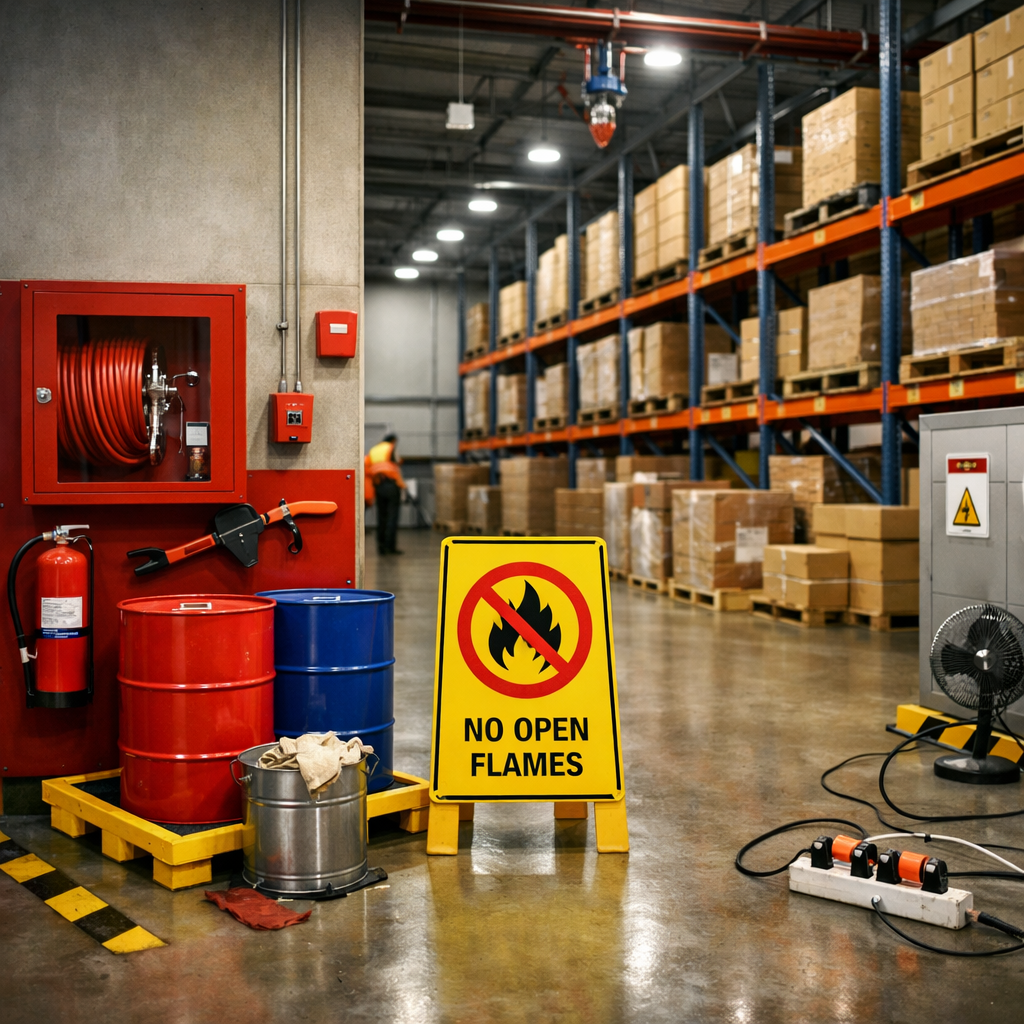
- Battery charging stations: Lithium-ion and lead-acid battery areas may present risks from thermal runaway, sparks, or hydrogen gas.
- Hot work: Welding, grinding, and cutting can ignite nearby combustibles if controls are weak.
- Flammable and combustible materials: Solvents, paints, aerosols, fuels, and certain cleaning products increase fire intensity.
- Blocked fire protection systems: Obstructed sprinklers, extinguishers, hose reels, and exits reduce emergency effectiveness.
- Improper storage: Overstocking, high-piled storage, and reduced aisle clearance can accelerate fire spread and limit access.
A practical example is a picking area where empty cartons and plastic wrap are left beside a battery charging bay. If a charger overheats or a battery fails, nearby combustibles can ignite quickly. What looks like a routine housekeeping issue can become a major loss event in minutes.
Warehouse fire hazard prevention through risk assessment and the Hierarchy of Controls
The most effective warehouse fire hazard prevention programs are based on formal risk assessment and the Hierarchy of Controls.
Rather than relying only on extinguishers and alarms, employers should identify hazards, assess likelihood and consequence, and implement controls that remove or reduce fire risk at the source.
Applying the Hierarchy of Controls
- Elimination: Remove unnecessary flammable materials, excess packaging waste, and unused chemicals from the warehouse.
- Substitution: Replace highly flammable products with safer alternatives where possible, such as lower-flammability cleaning agents.
- Engineering controls: Install fire-rated storage rooms, automatic sprinklers, smoke detection, battery room ventilation, bollards to protect electrical panels, and explosion-proof equipment where required.
- Administrative controls: Use hot work permits, inspection schedules, emergency plans, traffic management rules, and stock storage limits.
- PPE: Provide appropriate protective gear for specific tasks, especially maintenance, emergency response, and chemical handling.
For example, if flammable aerosols are stored in bulk, elimination may not be possible. In that case, engineering controls such as approved cabinets or segregated storage areas, backed by administrative controls like inventory limits and inspection routines, will be essential.
Regular fire risk assessments should also account for seasonal changes. During peak inventory periods, temporary stock may block exits, narrow aisles, or obstruct sprinklers. These temporary conditions often create permanent-looking hazards unless actively managed.
You can also strengthen your process by aligning fire prevention with related safety efforts such as workplace risk assessment and warehouse safety checklist programs.
Key control measures for warehouse fire hazard prevention
Good warehouse fire hazard prevention depends on consistent day-to-day controls, not just written procedures.
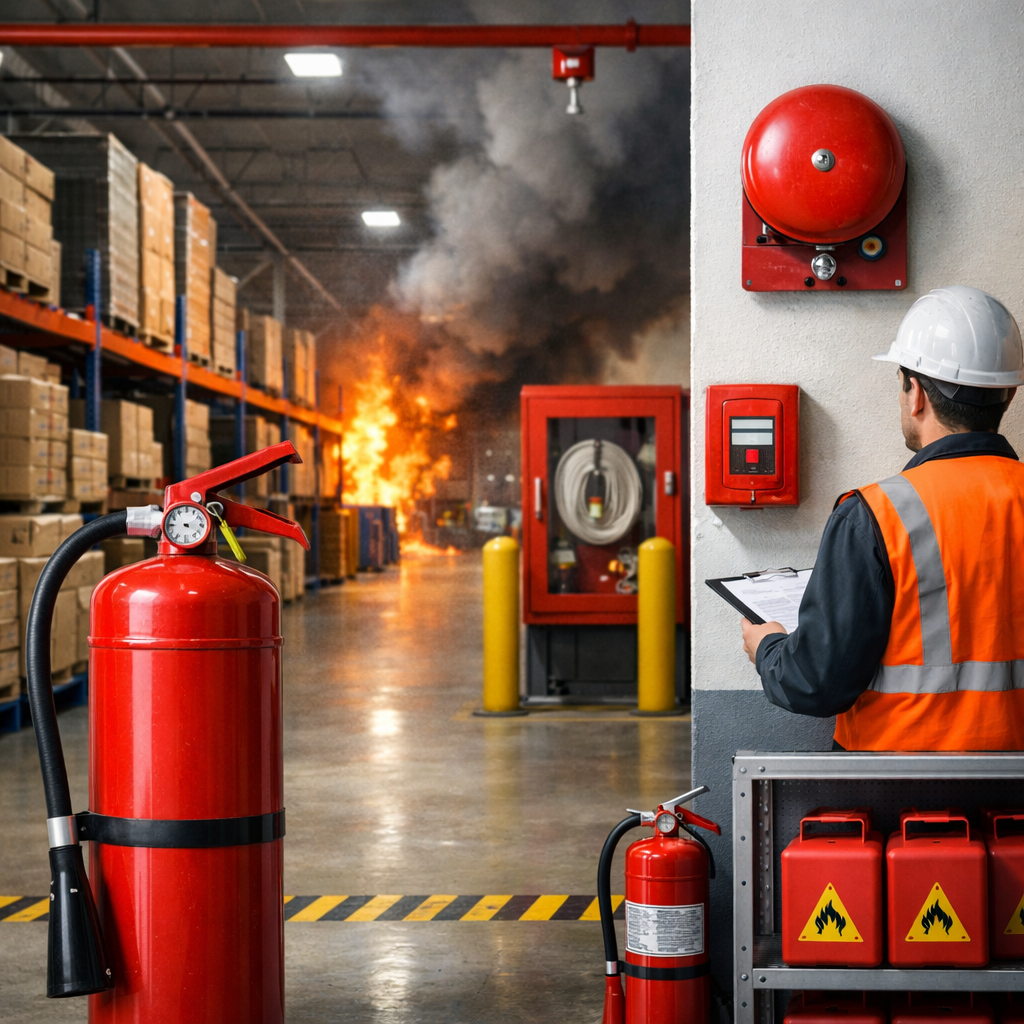
Supervisors should focus on the practical conditions that influence ignition, fire growth, and emergency response.
Housekeeping and storage control
Clean warehouses are safer warehouses. Waste should be removed routinely, especially from packing stations, charging areas, and near plant or machinery.
Storage should never block fire exits, alarm call points, extinguishers, sprinkler heads, or electrical panels. Aisles must remain clear enough for evacuation and emergency access.
Electrical and equipment safety
All electrical systems should be inspected and maintained by competent persons. Temporary wiring should be minimized, damaged cables replaced immediately, and power boards used correctly.
Forklifts, conveyors, chargers, and other equipment should be checked for overheating, damaged components, and fluid leaks. Preventive maintenance is a core fire prevention measure, not just a reliability task.
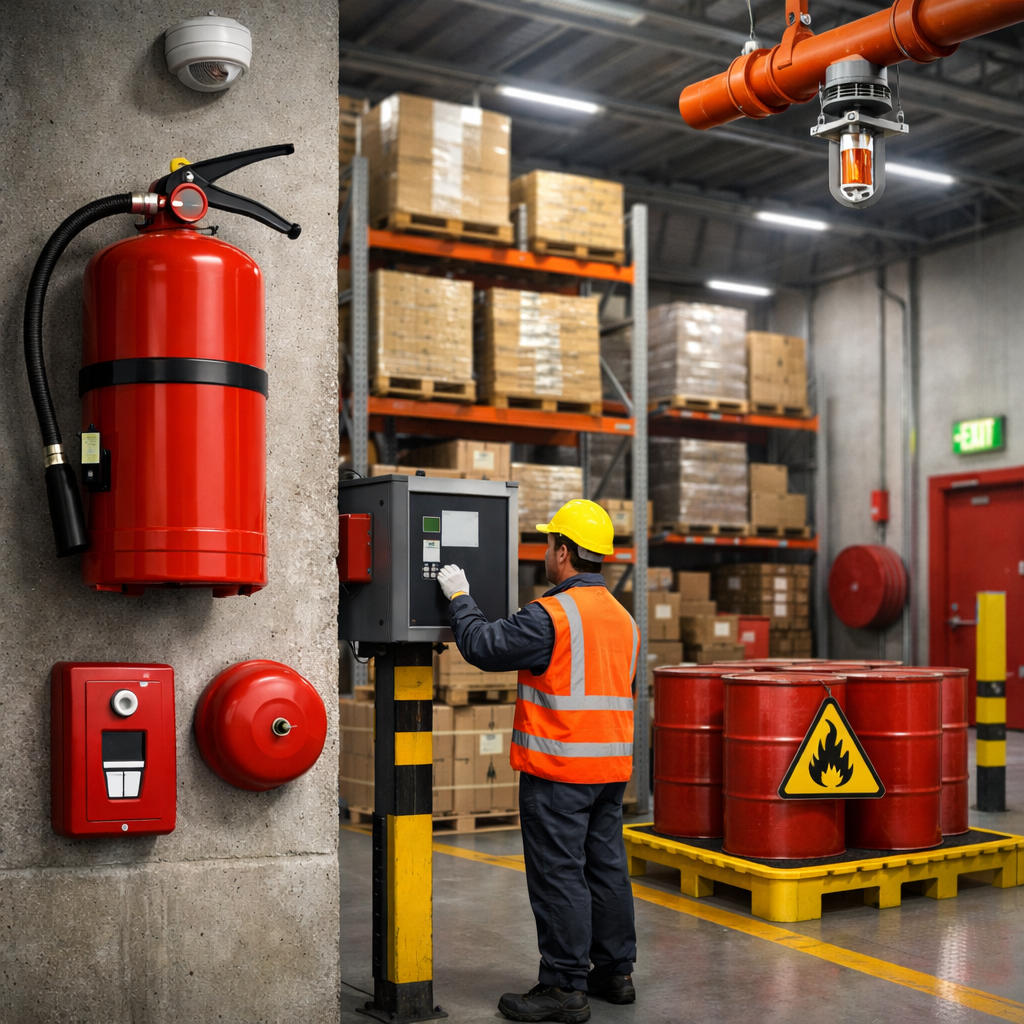
Hot work and contractor management
Hot work should only be done under a permit system with clear controls such as area inspection, removal of combustibles, fire watch, and post-work monitoring.
Contractors must understand site fire risks, alarm procedures, and restricted areas before starting work.
Fire protection systems and emergency readiness
Detection and suppression systems must be matched to the warehouse layout and stored materials. High-piled storage may require specialized sprinkler design, and battery or hazardous goods areas may need additional safeguards.
According to the NFPA, storage configuration and commodity class significantly affect fire protection requirements. Routine inspection, testing, and maintenance are essential to ensure systems work when needed.
| Hazard Area | Main Risk | Practical Control |
|---|---|---|
| Battery charging station | Overheating, sparks, gas release | Ventilation, separation from combustibles, inspection, signage |
| Packing and dispatch zone | Cardboard and plastic fuel load | Frequent waste removal and clear housekeeping rules |
| Electrical room | Arc fault or overloaded circuits | Restricted access, preventive maintenance, no storage nearby |
| Flammable liquid storage | Rapid fire spread | Approved cabinets, segregation, spill control, quantity limits |
PPE, training, compliance, and practical examples in warehouse fire hazard prevention
PPE has an important but limited role in warehouse fire hazard prevention.
It does not replace engineering or administrative controls, but it can reduce harm during inspections, maintenance, emergency response, and handling of hazardous substances.
PPE considerations
- Safety footwear: Protects workers during evacuation and routine warehouse operations.
- Gloves: Useful for handling waste, damaged goods, or hazardous materials.
- Eye protection: Needed for maintenance tasks, battery handling, and hot work support.
- Flame-resistant clothing: May be required for higher-risk maintenance activities or specialized operations.
- Respiratory protection: Should only be used for defined tasks and with proper assessment, fit testing, and training where required.
Training is equally important. Workers should know how to identify early warning signs such as overheating chargers, burning odors, sparking equipment, obstructed exits, or damaged fire doors.
They should also know what not to do. For instance, employees should never attempt to fight a growing fire without training, the right extinguisher, and a safe escape path.
Compliance and OHSE responsibilities
Legal duties vary by location, but employers generally must provide a safe workplace, control fire risks, maintain equipment, train workers, and prepare for emergencies.
OSHA guidance, CCOHS resources, local fire codes, insurer requirements, and building regulations all influence warehouse fire safety expectations. Documentation matters. If inspections, maintenance, drills, and corrective actions are not recorded, it becomes difficult to prove due diligence.
A compliant fire safety program typically includes:
- Fire risk assessments and hazard registers
- Inspection and maintenance records for alarms, extinguishers, and sprinklers
- Emergency response plans and evacuation diagrams
- Worker induction and refresher training
- Hot work permits and contractor controls
- Incident reporting and corrective action tracking
Practical workplace examples
In one common scenario, a warehouse stores returned goods in a temporary holding area near an electrical switchboard. Over time, the pile grows, airflow reduces, and access to the panel becomes restricted. During an inspection, a supervisor identifies the issue, removes the stock, marks a no-storage zone, and adds the area to weekly checks. This is a simple but effective warehouse fire hazard prevention action.
In another example, a site using electric forklifts experiences repeated charger overheating alarms. Instead of replacing units one by one without further review, the safety team investigates ventilation, cable condition, cleaning frequency, and charging practices. They reorganize the charging area, improve separation distances, retrain workers, and install thermal monitoring. The result is a more robust control system rather than a one-time fix.
These examples show that fire prevention works best when hazards are addressed systematically and early.
Conclusion: Building a stronger warehouse fire hazard prevention culture
warehouse fire hazard prevention is not a single device, checklist, or training session. It is an ongoing OHSE process that combines hazard identification, the Hierarchy of Controls, housekeeping, maintenance, PPE, emergency planning, and compliance.
Warehouses are dynamic workplaces where layouts, inventory levels, equipment use, and staffing pressures change quickly. That is why fire risks must be reviewed regularly and managed proactively.
When employers invest in warehouse fire hazard prevention, they protect workers, preserve assets, reduce downtime, and strengthen legal compliance. Most importantly, they create a safer workplace where everyday decisions support fire safety long before an alarm ever sounds.