


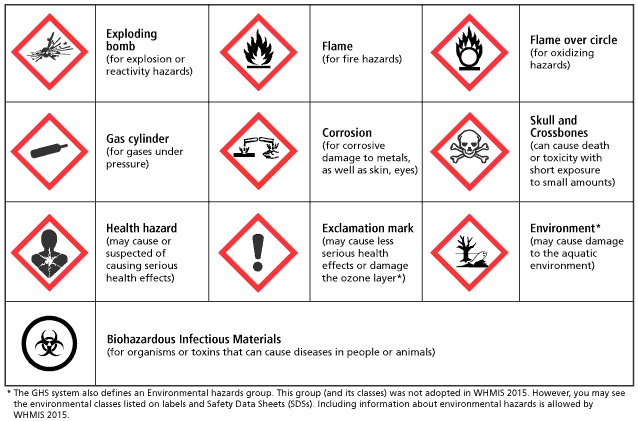
WHMIS Pictograms are at the heart of hazard communication in Canadian workplaces. These bold, standardized symbols are essential for recognizing chemical dangers at a glance.
At the beginning of any job that involves hazardous products, understanding WHMIS pictograms is not just recommended—it’s a legal and life-saving requirement.
From construction sites to laboratories, these pictograms provide instant visual cues to help workers stay safe, make informed decisions, and comply with national regulations.
- What Are WHMIS Pictograms?
- Why Are WHMIS Pictograms Important?
- Types of WHMIS Pictograms and Their Meanings
- What pictograms are used with WHMIS hazard classes and categories?
- Do all hazard classes and categories require a pictogram?
- How to Use WHMIS Pictograms Effectively in the Workplace
- WHMIS Pictograms vs. Other Symbols
- WHMIS Pictograms and Legal Requirements
- The Future of WHMIS Pictograms
- Internal Resources and Tools
- Conclusion: Why WHMIS Pictograms Matter
What Are WHMIS Pictograms?
WHMIS pictograms are standardized graphical symbols found on labels of hazardous products in Canada. They are a core element of the Workplace Hazardous Materials Information System (WHMIS), which aligns with the Globally Harmonized System of Classification and Labelling of Chemicals (GHS).
These pictograms serve one main function: to immediately alert workers to the type of hazard associated with a product, such as flammability, toxicity, or environmental danger.
Each pictogram features a specific symbol inside a red-bordered diamond or a black circle (for biohazardous materials).
Why Are WHMIS Pictograms Important?
WHMIS pictograms play a vital role in preventing accidents by providing:
- Clear hazard identification without needing to read detailed instructions
- Quick understanding of potential risks and necessary precautions
- Consistent communication across industries and workplaces
- Support for training and emergency response planning
Using pictograms correctly helps workers choose proper PPE, follow safe handling procedures, and react quickly in emergencies.
Types of WHMIS Pictograms and Their Meanings
Below is a detailed table and explanation of each WHMIS pictogram, its symbol, and the types of hazards it represents.
| Pictogram | Symbol | Hazards |
|---|---|---|
 | Flame | Flammable gases, aerosols, liquids, solids, self-heating, organic peroxides |
 | Flame Over Circle | Oxidizing gases, liquids, solids |
 | Gas Cylinder | Gases under pressure |
 | Corrosion | Skin corrosion/burns, eye damage, corrosive to metals |
 | Skull and Crossbones | Acute toxicity (fatal or toxic) |
 | Health Hazard | Carcinogen, respiratory sensitizer, reproductive toxicity, organ toxicity |
 | Exclamation Mark | Irritation (skin, eye), skin sensitizer, narcotic effects, ozone hazard |
 | Exploding Bomb | Explosives, self-reactive substances |
 | Environment (non-mandatory) | Aquatic toxicity |
 | Biohazard Symbol | Bacteria, viruses, or toxins causing serious disease or death |

What pictograms are used with WHMIS hazard classes and categories?
The following pictograms are associated with these hazard classes and categories.

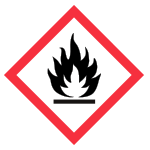
The flame pictogram is used for the following classes and categories:
- Flammable gases (Category 1A and 1B Flammable gas; Category 1A and 1B Chemically unstable gas; Category 1A Pyrophoric gas) )
- Aerosols (Category 1 and 2)
- Flammable liquids (Category 1, 2 and 3)
- Flammable solids (Category 1 and 2)
- Pyrophoric liquids (Category 1)
- Pyrophoric solids (Category 1)
- Self-heating substances and mixtures (Category 1 and 2)
- Substances and mixtures which, in contact with water, emit flammable gases (Category 1, 2 and 3)
- Self-reactive substances and mixtures (Types B*, C, D, E and F)
- Organic peroxides (Types B*, C, D, E and F)
- Chemicals under pressure (Category 1** and 2**)
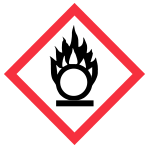
The flame over circle pictogram is used for the following classes and categories:
- Oxidizing gases (Category 1)
- Oxidizing liquids (Category 1, 2 and 3)
- Oxidizing solids (Category 1, 2 and 3)
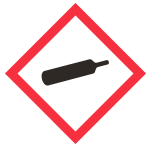
The gas cylinder pictogram is used for the following classes and categories:
- Gases under pressure (Compressed gas, Liquefied gas, Refrigerated liquefied gas, and Dissolved gas)
- Chemicals under pressure (Category 1**, 2** and 3)
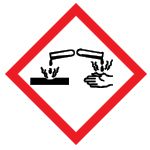
The corrosion pictogram is used for the following classes and categories:
- Corrosive to metals (Category 1)
- Skin corrosion/irritation – Skin corrosion (Category 1, 1A, 1B and 1C)
- Serious eye damage/eye irritation – Serious eye damage (Category 1)
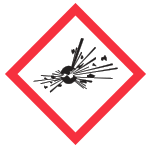
The exploding bomb pictogram is used for the following classes and categories:
- Self-reactive substances and mixtures (Types A and B*)
- Organic peroxides (Types A and B*)
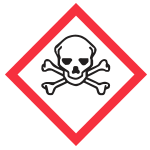
The skull and crossbones pictogram is used for the following classes and categories:
- Acute toxicity –
- Oral (Category 1, 2 and 3)
- Dermal (Category 1, 2 and 3)
- Inhalation (Category 1, 2 and 3)
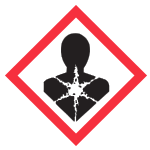
The health hazard pictogram is used for the following classes and categories:
- Respiratory or skin sensitization – Respiratory sensitizer (Category 1, 1A and 1B)
- Germ cell mutagenicity (Category 1, 1A, 1B and 2)
- Carcinogenicity (Category 1, 1A, 1B, and 2)
- Reproductive toxicity (Category 1, 1A, 1B and 2)
- Specific Target Organ Toxicity – Single exposure (Category 1 and 2)
- Specific Target Organ Toxicity – Repeated exposure (Category 1 and 2)
- Aspiration hazard (Category 1)
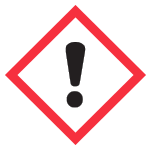
The exclamation mark pictogram is used for the following classes and categories:
- Acute toxicity – Oral, Dermal, Inhalation (Category 4)
- Skin corrosion/irritation – Skin irritation (Category 2)
- Serious eye damage/eye irritation – Eye irritation (Category 2 and 2A)
- Respiratory or skin sensitization – Skin sensitizer (Category 1, 1A and 1B)
- Specific target organ toxicity – Single exposure (Category 3)
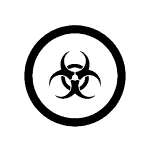
The biohazardous infectious materials pictogram is used for the following classes and categories:
- Biohazardous Infectious Materials (Category 1)
* Both the Flame and Explosive pictograms are used for Self-reactive substances and mixtures (Type B) and Organic peroxides (Type B).
** Both the Flame and Cylinder pictograms are used for Chemicals under pressure, categories 1 and 2.
NOTE: Physical Hazards Not Otherwise Classified and Health Hazards Not Otherwise Classified classes are required to have a GHS pictogram that is appropriate to the hazard identified.
Do all hazard classes and categories require a pictogram?
No. There are hazardous products that meet the criteria for a hazard class or category, but these classes and categories do not require a pictogram. The product label and Section 2 (Hazards Identification) of the SDS still require the signal word, hazard statement(s), and other required label elements.
WHMIS classes and categories that do not require a pictogram are:
- Aerosols – Category 3
- Flammable gases – Category 2
- Flammable liquids – Category 4
- Self-reactive substances and mixtures – Type G
- Organic peroxides – Type G
- Combustible dusts – Category 1
- Simple Asphyxiants – Category 1
- Serious eye damage/eye irritation – Eye Irritation – Category 2B
- Reproductive toxicity – Effects on or via lactation
All these pictograms are regulated by Health Canada and must appear on all hazardous product labels and Safety Data Sheets (SDS).
How to Use WHMIS Pictograms Effectively in the Workplace
Every worker and employer must know how to use WHMIS pictograms effectively. Here’s how they contribute to daily operations:
1. Read Labels and SDS Carefully
Labels on hazardous products always include the relevant WHMIS pictogram(s). Pair this with information on the SDS to understand full handling and storage instructions.
2. Post Pictograms in Visible Locations
Use posters and signage with pictograms in storage rooms, lab areas, and chemical handling zones to reinforce recognition.
3. Include in Worker Training
WHMIS training must cover pictogram meanings, real-world examples, and scenarios. This helps with retention and compliance.
4. Integrate with PPE Programs
Match pictograms to the appropriate personal protective equipment (PPE). For instance, corrosive materials require gloves and face protection.
5. Audit for Compliance
Regular inspections should include a checklist for pictogram visibility, correct labeling, and updated SDS availability.
WHMIS Pictograms vs. Other Symbols
WHMIS pictograms are often confused with other safety signs. Here’s how they differ:
- WHMIS pictograms appear on product labels and SDSs.
- Workplace safety signs (e.g., fire exit or first aid signs) are general site warnings.
- Transportation of Dangerous Goods (TDG) symbols are used during shipping and transportation.
It’s critical to not mix these up. Each serves a distinct purpose and is regulated by different laws.
WHMIS Pictograms and Legal Requirements
Employers in Canada must ensure:
- All hazardous products have WHMIS-compliant labels
- All employees are trained on WHMIS including pictogram recognition
- Safety Data Sheets are current and accessible
- Annual or ongoing refresher training is provided
Failure to comply can result in fines or workplace closure, especially under provincial OH&S regulations like those enforced by WorkSafeBC or Ontario’s Ministry of Labour.
The Future of WHMIS Pictograms
Canada periodically updates WHMIS standards in alignment with GHS revisions. WHMIS 2015, for example, modernized the pictogram format and classification. Future updates may bring digital training aids, QR-coded SDS access, and more.
Stay informed through reliable resources such as:
- CCOHS WHMIS Pictogram Guide
- OHSE.ca – For Canadian occupational health and safety updates
Internal Resources and Tools
Employers can create customized training using:
- Digital WHMIS quizzes
- Printable pictogram flashcards
- Interactive SDS access kiosks
Internal resources like these help reinforce WHMIS knowledge and build a safety culture.
For example, if your workplace handles cleaning chemicals or flammable paints, employees should always be able to connect the Flame or Corrosion pictogram with safe handling steps stored in your training manual or SOPs.
Conclusion: Why WHMIS Pictograms Matter
WHMIS pictograms are not just visual aids—they are powerful safety tools that protect lives. Recognizing and understanding these symbols is the first step to preventing injuries, illnesses, and regulatory violations in workplaces across Canada.
By using WHMIS pictograms daily, employers and employees foster safer habits, faster responses, and clearer hazard recognition—the true foundation of effective workplace safety programs.