
Powerful Ergonomic Assessment Techniques to Reduce MSD Risks

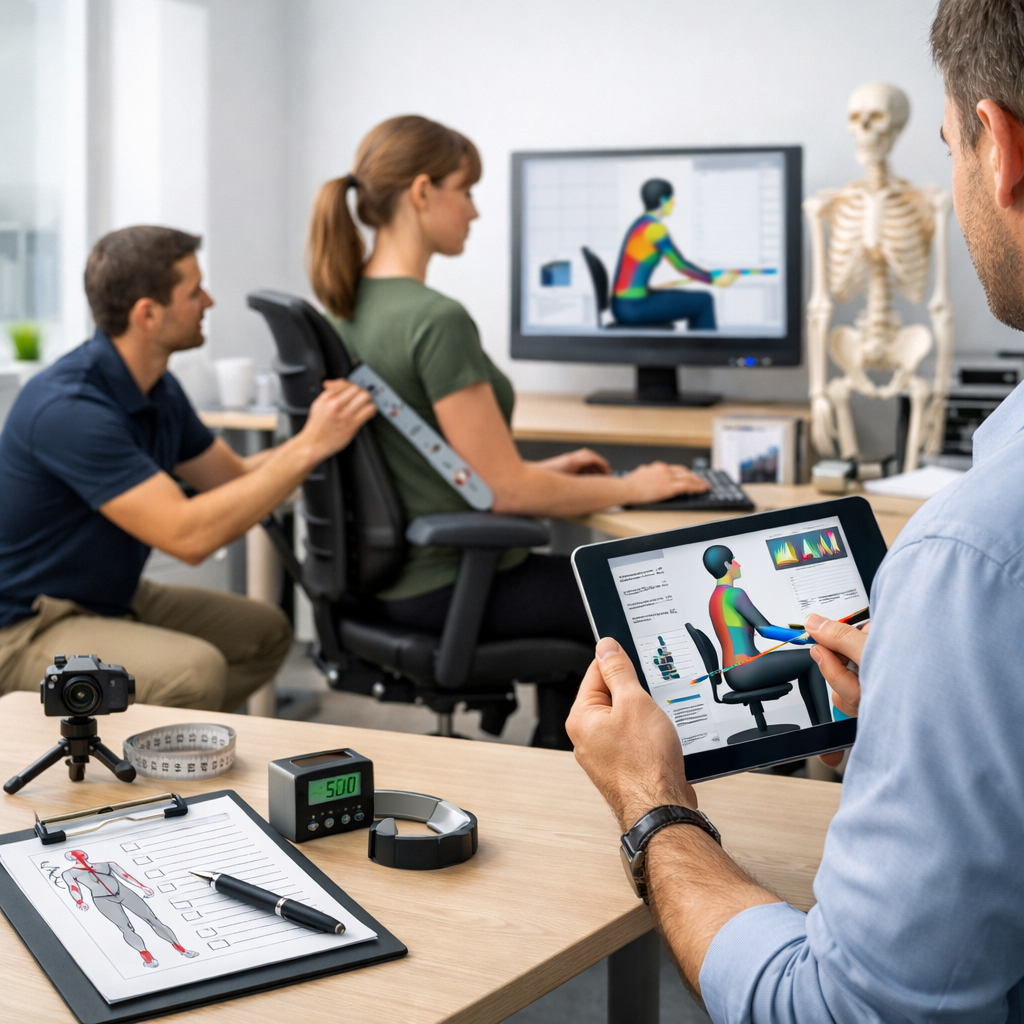
Ergonomic assessment techniques are one of the most effective ways to identify and control the daily tasks, postures, and work conditions that lead to musculoskeletal disorders (MSDs).
From office desks to hospital wards and warehouse floors, poor workstation design, repetitive motion, forceful exertion, and awkward posture can quietly build into serious injuries over time.
Organizations that use structured ergonomic assessments can reduce strain, improve comfort, and support productivity while meeting health and safety expectations.
MSDs affect muscles, tendons, ligaments, joints, and nerves, and they commonly show up as back pain, shoulder strain, tendonitis, or carpal tunnel symptoms.
According to guidance from OSHA and CCOHS, early identification of ergonomic hazards is essential because these risks often develop gradually rather than through one obvious incident.

This article explains practical ergonomic assessment techniques, how to spot key risk factors in offices, healthcare, and warehouses, and how to apply controls that meaningfully reduce MSD risks.
Why ergonomic assessment techniques matter in MSD prevention
Ergonomic assessments do more than check whether a chair looks comfortable or whether lifting training has been completed.
They examine the fit between the worker, the task, the tools, and the environment.
When that fit is poor, workers may reach too far, twist too often, lift too much, or repeat the same motion for hours.
Over time, those exposures increase the chance of fatigue, discomfort, and injury.

The most reliable ergonomic assessment techniques focus on several common risk factors at once rather than isolating only one issue.
These include posture, repetition, force, contact stress, vibration, duration, work pace, and recovery time.
For example, a warehouse worker lifting light boxes may still face high MSD risk if the task is performed quickly for an entire shift with frequent bending and twisting.
Likewise, an office employee can develop neck and shoulder pain from prolonged static posture even when no heavy lifting is involved.
A practical assessment process often combines observation, worker feedback, task measurement, and review of injury data.

Many employers also support this process through safety program management and regular workplace risk assessment activities, helping ergonomic issues get addressed before they become lost-time injuries.
Core risk factors to look for
- Awkward posture: bending, twisting, overhead reaching, neck flexion, and wrist deviation
- Repetition: performing the same motion frequently with little variation
- Force: lifting, pushing, pulling, gripping, or pinching with high effort
- Static loading: holding the same posture for long periods
- Contact stress: hard edges pressing into wrists, forearms, thighs, or shoulders
- Duration and pace: extended exposure with limited rest or recovery
- Environmental factors: lighting, temperature, flooring, and vibration
Ergonomic assessment techniques for offices
Office environments are often treated as low risk, but that assumption can hide serious ergonomic concerns.
Desk work commonly involves prolonged sitting, poorly positioned monitors, unsupported wrists, and limited movement throughout the day.
One of the simplest ergonomic assessment techniques in offices is a workstation fit review.
This includes checking chair height, lumbar support, keyboard and mouse placement, monitor height, screen distance, and foot support.

The goal is to keep joints in neutral positions and reduce unnecessary reach or strain.
How to spot office ergonomic risk factors
Start by watching how the employee actually works, not just how the workstation appears when unoccupied.
A monitor may be centered correctly, but the worker might spend most of the day turned toward a second screen or reaching for a mouse placed too far away.
Look for shoulders elevated while typing, wrists bent upward, forward head posture, slouching, and seats adjusted too high or too low.
Signs of risk also include employees reporting eye strain, numbness, headaches, or discomfort that worsens as the day progresses.
Short discomfort surveys and direct conversations are valuable because workers often adapt to poor setups without reporting them until symptoms intensify.
Useful controls in office settings
Apply the Hierarchy of Controls where possible, even in administrative environments.
Elimination may mean removing unnecessary laptop-only workstations and replacing them with full desktop setups or docking stations.
Engineering controls can include adjustable chairs, sit-stand desks, monitor arms, footrests, and ergonomic keyboards.
Administrative controls may involve microbreaks, task variation, and training workers to adjust their own equipment properly.
PPE is rarely the main answer for office ergonomics, so equipment and work design should come first.
Ergonomic assessment techniques for healthcare settings
Healthcare workers face some of the highest MSD risks because their work combines force, repetition, awkward posture, and unpredictable patient movement.
Nurses, aides, therapists, and support staff may reposition patients, push heavy equipment, stand for long periods, and perform tasks in tight spaces.
Effective ergonomic assessment techniques in healthcare must focus on patient handling, room layout, equipment use, and staffing patterns.
Observation is critical because patient care tasks can vary significantly by shift, department, and patient condition.
How to spot ergonomic risk factors in healthcare
Watch for manual lifting or repositioning of patients without mechanical assistance.
Also note bending over beds set too low, reaching across stretchers, twisting while transferring patients, and pushing beds or carts with high rolling resistance.
Repetitive hand-intensive tasks, such as charting on poorly positioned computers on wheels or using forceful grip with instruments, can also contribute to upper limb strain.
Another common issue is time pressure.
When staffing is tight or patient demands are urgent, workers may skip safe handling aids even when they are available.
Priority controls for healthcare MSD risks
The strongest controls usually involve engineering solutions such as ceiling lifts, floor lifts, slide sheets, height-adjustable beds, and well-maintained transport equipment.
Administrative controls include safe patient handling policies, adequate staffing, refresher training, and clear criteria for when mechanical aids must be used.
Supervisors should also assess whether equipment is conveniently located, because tools that are difficult to access are less likely to be used consistently.
Healthcare employers can also refer to guidance from the NIOSH ergonomics resources for practical prevention approaches.
Ergonomic assessment techniques for warehouses and material handling
Warehouses present a different risk profile, but the basic principles remain the same.
Workers may lift, lower, carry, push, pull, scan, sort, stack, and pick items for long periods, often under production pressure.
In these environments, ergonomic assessment techniques should examine load weight, lift frequency, horizontal reach, vertical height, travel distance, and twisting demands.
Tasks should be assessed where they really occur, including receiving docks, picking aisles, packing stations, and shipping areas.
How to spot warehouse ergonomic risk factors
Look for loads handled from floor level or above shoulder height, especially when workers must bend or reach deeply into pallets or shelving.
Watch for twisting during lifting, one-handed carrying, long pushing distances, and fast-paced picking with repetitive scanning or gripping.
Poor floor conditions, poorly designed pallet positions, and mismatched cart handle heights can significantly increase force demands.
If workers are improvising by climbing on racks, overreaching, or dragging loads instead of using proper devices, the task likely needs redesign.
Simple assessment methods and examples
Several recognized tools can support warehouse assessments, depending on the task.
| Technique | Best used for | What it helps identify |
|---|---|---|
| Task observation checklist | All industries | Awkward posture, repetition, force, duration |
| Worker discomfort survey | Offices, healthcare, warehouses | Early symptoms and hidden problem areas |
| NIOSH Lifting Equation | Manual lifting tasks | Whether lifting demands are too high |
| RULA or REBA assessment | Postural analysis | Body positions that increase MSD risk |
Controls in warehouses often begin with elimination or substitution, such as reducing manual handling through conveyor systems, lift tables, pallet positioners, or vacuum lifters.
Engineering controls may also include better shelf heights, improved cart design, and powered transport devices.
Administrative controls can include job rotation, realistic productivity targets, and scheduled recovery time, but they should not replace physical improvements when stronger controls are feasible.
Building a practical ergonomic assessment program
The best results come when ergonomic assessment techniques are built into routine safety management instead of used only after injuries occur.
A strong program starts with identifying high-risk jobs using incident records, absenteeism trends, first aid reports, and worker complaints.
It then prioritizes tasks with the highest combination of force, posture, repetition, and exposure time.
Supervisors and workers should be involved together because employees often know exactly which tasks cause the most strain and why.
Photographs, short videos, and direct measurements can make findings more objective and easier to act on.
Just as important, corrective actions should be tracked to confirm they actually reduced risk rather than simply shifting it elsewhere.
Follow-up matters.
An adjusted office chair, a new patient lift, or a redesigned picking station only works if workers are trained, equipment is available, and the solution fits the real demands of the job.
Reviewing outcomes after changes helps ensure controls are practical, used consistently, and aligned with the Hierarchy of Controls.
In the long term, ergonomic assessment techniques support healthier workplaces by turning discomfort reports, task observations, and risk data into targeted improvements that prevent MSDs before they become costly injuries.
No comments yet