


pallet stacking safety standards: A Practical OHSE Guide for Safer Warehouses

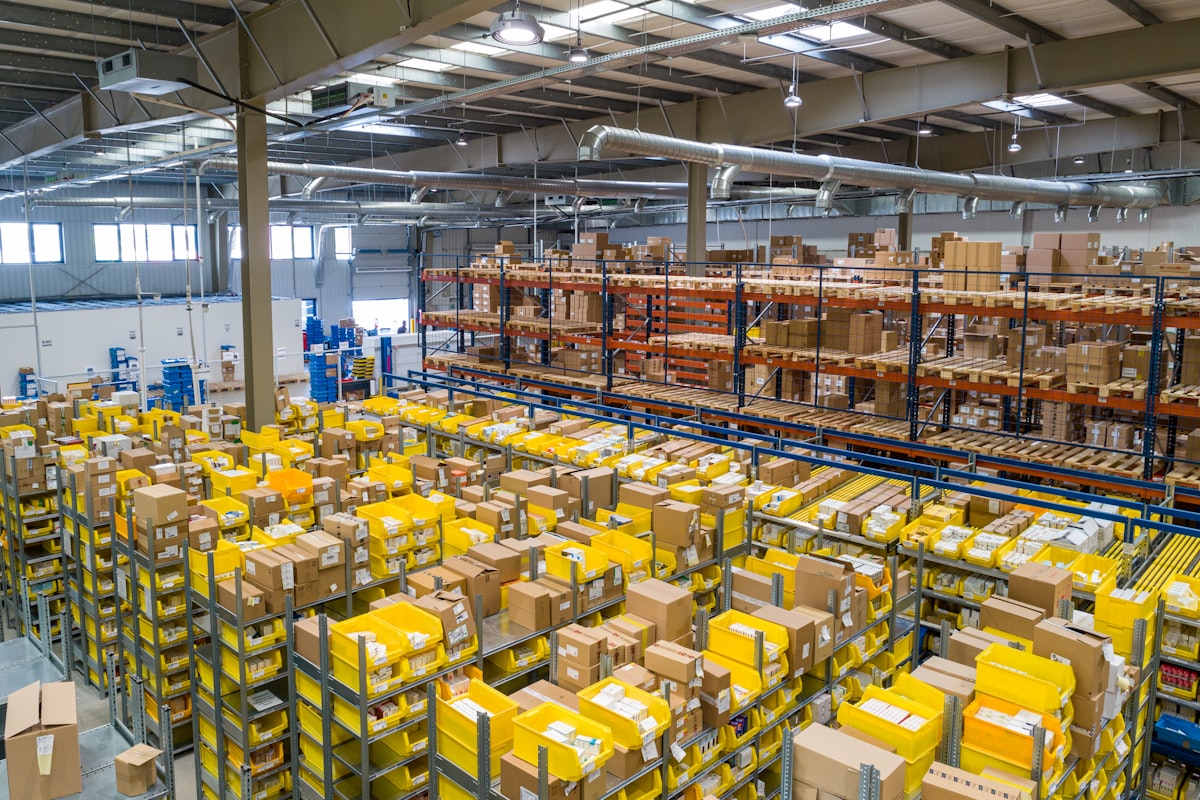
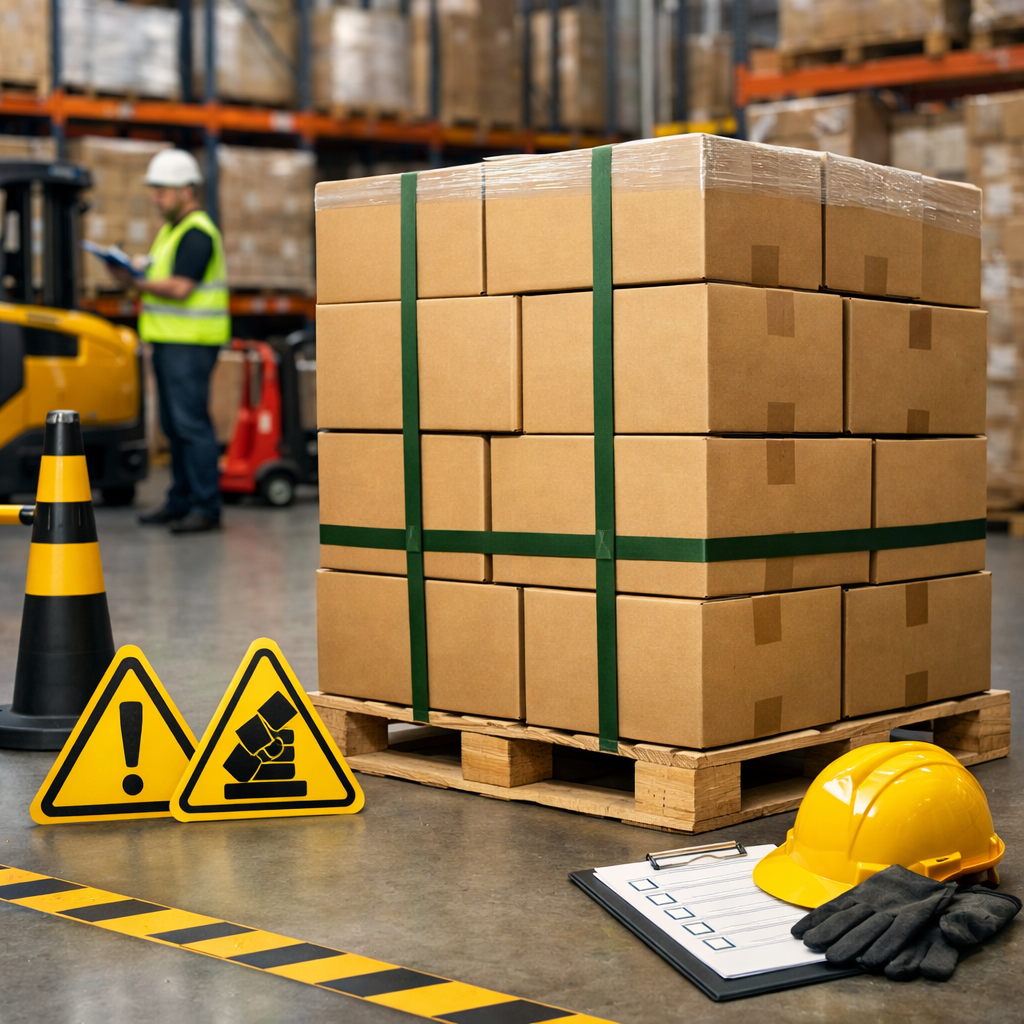
pallet stacking safety standards are a critical part of safe warehouse operations, distribution centers, retail backrooms, and manufacturing sites.
When pallets are stacked incorrectly, the result can be falling loads, struck-by incidents, damaged stock, forklift instability, blocked exits, and serious worker injuries.
Strong stacking practices do more than protect products. They protect people, support legal compliance, and reduce downtime caused by preventable incidents.
Whether a business stores goods by hand or with powered equipment, safe pallet stacking depends on clear procedures, competent workers, suitable equipment, and regular inspections.
Guidance from organizations such as OSHA and CCOHS reinforces the same basic principle: stored materials must be stable, secure, and arranged so they do not create hazards.
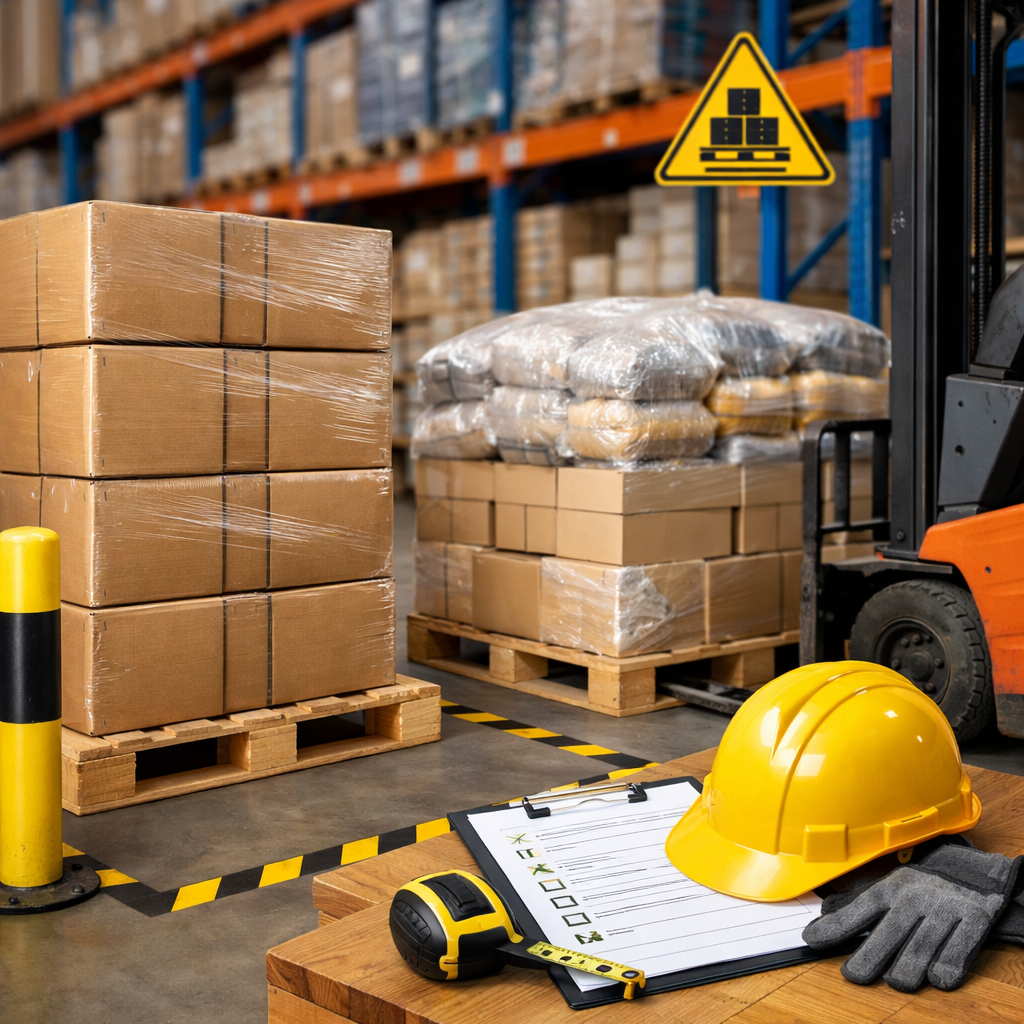
For teams developing warehouse rules, it also helps to align stacking procedures with your broader warehouse safety checklist and forklift safety procedures.
Why pallet stacking safety standards matter in real workplaces
In OHSE terms, pallet stacking is a routine task with high consequence if controls are weak.
A stack may look acceptable at first glance, yet still fail because of damaged pallets, uneven weight distribution, excessive height, poor shrink wrapping, or floor conditions.
Common incidents include cartons sliding from upper levels, pallets collapsing during movement, and workers being struck while retrieving stock.
Forklift operators also face increased risk when loads are unstable or stacked too high to travel safely.
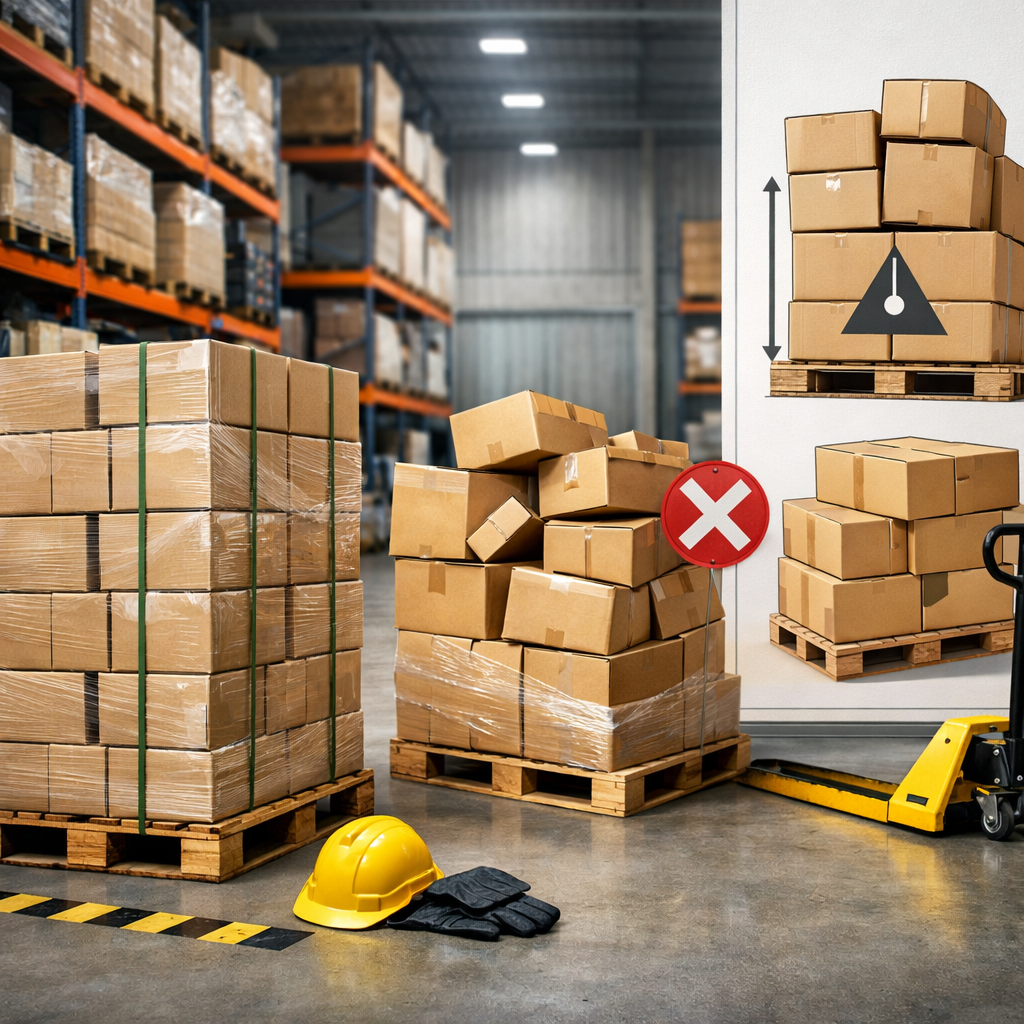
In busy facilities, these hazards become worse when aisles are congested, deadlines are tight, and mixed pallet types are used without assessment.
For example, a warehouse may stack lightweight cartons on top of heavy bagged goods to save space. The lower layer compresses unevenly, the upper cartons shift, and the stack leans into an aisle.
Another common example occurs in receiving areas where rushed staff double-stack broken pallets. Once a forklift enters underneath, the bottom pallet fails and the load drops.
These are not rare events. They are predictable failures linked to poor planning, weak supervision, and inconsistent application of pallet stacking safety standards.
Main risks linked to poor pallet stacking
- Falling objects: cartons, drums, or loose materials can strike workers below.
- Collapse of stacked loads: unstable or over-height stacks may fail suddenly.
- Forklift incidents: unbalanced loads can tip, slide, or obstruct visibility.
- Manual handling injuries: workers may overreach or twist while building unstable stacks.
- Blocked access: unsafe storage can obstruct walkways, sprinklers, extinguishers, or exits.
- Product and structural damage: collapsing pallets may damage racking, flooring, and stock.
Core pallet stacking safety standards and safe stacking principles
Effective pallet stacking safety standards begin with load stability.

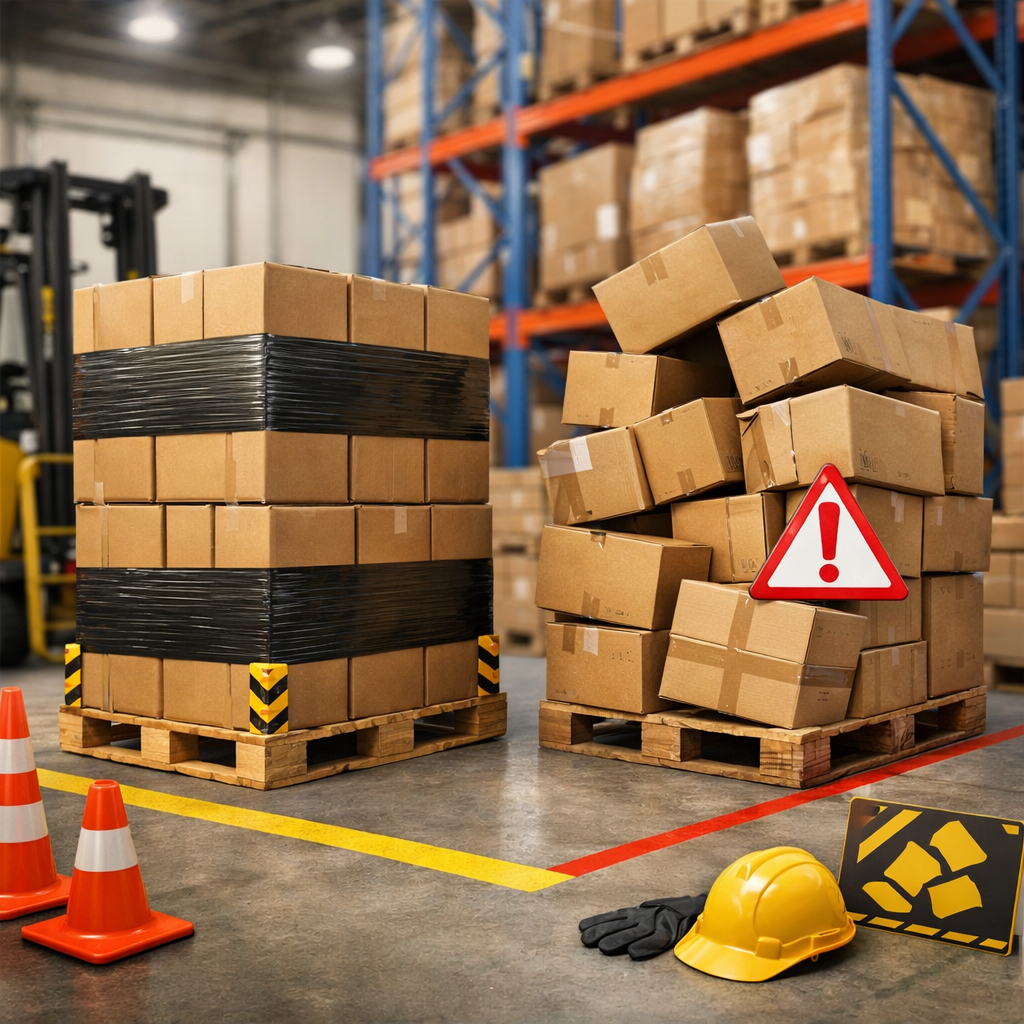
Every pallet should be suitable for the weight and type of goods being stored, and the load should be stacked evenly with heavier items at the bottom and lighter items on top.
Overhang should be minimized because cartons extending beyond pallet edges are more likely to crush, snag, or slip during handling.
Stack height should be based on the pallet condition, load type, storage duration, environment, and handling method.
There is no safe universal height for every workplace, which is why site-specific limits are essential.
Employers should document these limits for different stock categories and storage zones.
Practical pallet stacking rules that support compliance
- Use only pallets that are intact, dry, and rated for the intended load.
- Do not stack incompatible items together without a stability assessment.
- Place heavy and dense products on the bottom layer.
- Keep the load centered and distribute weight evenly.
- Avoid excessive stack height, especially for free-standing pallets.
- Secure loads with stretch wrap, banding, or other suitable restraints where required.
- Keep aisles, emergency exits, fire equipment, and electrical panels clear.
- Inspect stacks routinely for leaning, damage, or shifting.
- Separate pedestrian routes from forklift traffic wherever possible.
Floor condition also matters.
Even a well-built stack can become unsafe if placed on uneven, cracked, slippery, or overloaded flooring.
Moisture exposure may weaken cardboard packaging and timber pallets, especially in cold storage transition areas or loading docks.
For this reason, pallet stacking safety standards should include environmental controls, housekeeping, and clear defect reporting.
Simple workplace examples
In a food warehouse, wrapped cartons may be stacked to a lower maximum height than canned products because the packaging is less rigid.
In a hardware store backroom, bagged material may require interlocking layers and corner support to prevent slumping.
In a manufacturing plant, return pallets should be segregated by condition so broken units are removed before reuse.
Applying the hierarchy of controls to pallet stacking hazards
The hierarchy of controls is one of the most effective OHSE tools for reducing storage-related risk.
Instead of relying only on worker caution, employers should first look for stronger controls that remove or reduce the hazard at its source.
How the hierarchy of controls applies
| Control level | How it applies to pallet stacking | Workplace example |
|---|---|---|
| Elimination | Remove unnecessary double handling or floor stacking | Use direct put-away into racking instead of temporary aisle stacking |
| Substitution | Replace weak pallets or unstable packaging with safer alternatives | Use plastic pallets for wet areas where timber degrades |
| Engineering controls | Use physical systems that improve stability and separation | Install barriers, rack protection, or designated stacking zones |
| Administrative controls | Set procedures, training, inspections, and height limits | Daily pre-use pallet checks and written stacking SOPs |
| PPE | Protect workers where residual risk remains | Safety footwear, gloves, high-visibility clothing, and hard hats where required |
Administrative controls are common, but they should not be the only defense.
If a warehouse repeatedly experiences leaning stacks, the answer may be redesigning storage flow, introducing load containment equipment, or reducing floor-stacked inventory.
Where forklifts operate near pedestrians, marked exclusion zones and barriers are often more reliable than verbal warnings alone.
OSHA materials handling guidance and CCOHS resources support this layered approach to hazard control.
PPE, inspections, training, and compliance responsibilities
PPE is important, but it does not replace proper pallet stacking safety standards.
Workers involved in pallet handling should wear PPE based on the risk assessment and the nature of the products stored.
Typical PPE may include safety shoes with toe protection, gloves for handling timber or banding, high-visibility clothing in mobile plant areas, and hard hats where overhead storage or falling-object hazards exist.
Eye protection may also be needed when cutting wrap or straps under tension.
Training and supervision requirements
Training should cover more than basic lifting technique.
Workers need to know how to identify damaged pallets, recognize unstable loads, apply wrapping or banding correctly, follow stack height rules, and report hazards immediately.
Forklift operators should be trained not to move leaning or unsecured pallets unless the load has been made safe.
Supervisors should verify that stacking procedures are being followed during normal work, not just during audits.
Short refresher sessions can be especially useful after near misses, layout changes, or seasonal increases in stock volume.
Inspection and maintenance
Routine inspections are essential for compliance and prevention.
Checks should include pallet condition, load stability, aisle width, floor damage, housekeeping, and signage.
Facilities should also inspect wrapping equipment, pallet jacks, forklifts, and any racking systems nearby.
A simple rule works well: if a pallet is cracked, missing boards, wet, heavily warped, or visibly unstable, remove it from service immediately.
Compliance and legal duty
Employers have a duty to provide safe systems of work, safe storage arrangements, information, training, and supervision.
While exact legal requirements vary by jurisdiction, the expectation is consistent: stored materials must not create a foreseeable risk to workers or visitors.
Documented pallet stacking safety standards help demonstrate due diligence.
These documents should include load limits, maximum heights, segregation rules, traffic controls, inspection frequency, incident reporting, and emergency response arrangements.
Compliance is stronger when procedures are supported by toolbox talks, visual guides at storage areas, and incident trend reviews.
Building a safer pallet stacking program
A practical pallet stacking program should be easy for workers to follow under real operating conditions.
That means clear rules, realistic storage limits, proper equipment, and enough time to do the job safely.
Start by assessing the products handled, pallet types used, floor conditions, traffic movement, and storage duration.
Then create stacking rules for each area rather than relying on a one-size-fits-all approach.
For example, receiving areas may need short-term staging limits, while dispatch zones may require extra load wrapping before transport.
Managers should review incident reports, near misses, and damage records to identify recurring failures.
If a certain product line often leans or collapses, the issue may be packaging design, pallet quality, or the stacking pattern itself.
Corrective action should focus on root causes, not just worker reminders.
In the end, pallet stacking safety standards are most effective when they combine risk assessment, hierarchy-of-controls thinking, competent supervision, suitable PPE, and regular inspection.
By treating pallet stacking as a serious OHSE priority, organizations can reduce injuries, prevent product loss, and create more orderly, compliant, and efficient workplaces.