
Emergency Response Planning is the backbone of a resilient safety program.
Fires, chemical spills, medical emergencies, severe weather, violence, and power failures can halt operations in seconds—but a well-designed plan turns chaos into coordinated action.
When workers know exactly what to do, Emergency Response Planning reduces injuries, limits damage, and speeds up recovery.

- 1. Clarify why Emergency Response Planning matters
- 2. Build a cross-functional Emergency Response Planning team
- 3. Identify realistic emergency scenarios for your workplace
- 4. Assess risks, impacts, and existing controls
- 5. Define clear activation criteria and communication methods
- 6. Develop protective action procedures for each scenario
- 7. Put Emergency Response Planning in a clear, accessible format
- 8. Equip your workplace with the right resources
- 9. Train, drill, and coordinate with external responders
- 10. Review, audit, and continuously improve your Emergency Response Planning
1. Clarify why Emergency Response Planning matters
Before writing procedures, your leaders and workforce need to understand the “why.” An emergency plan is not just a binder for audits; in many jurisdictions it is a legal requirement and must include minimum elements such as reporting procedures, evacuation, and accounting for employees.
Explain how a strong plan protects people, property, the environment, and business continuity. Use recent incidents from your own organization—or public events in your industry—to show what happens when planning is weak.
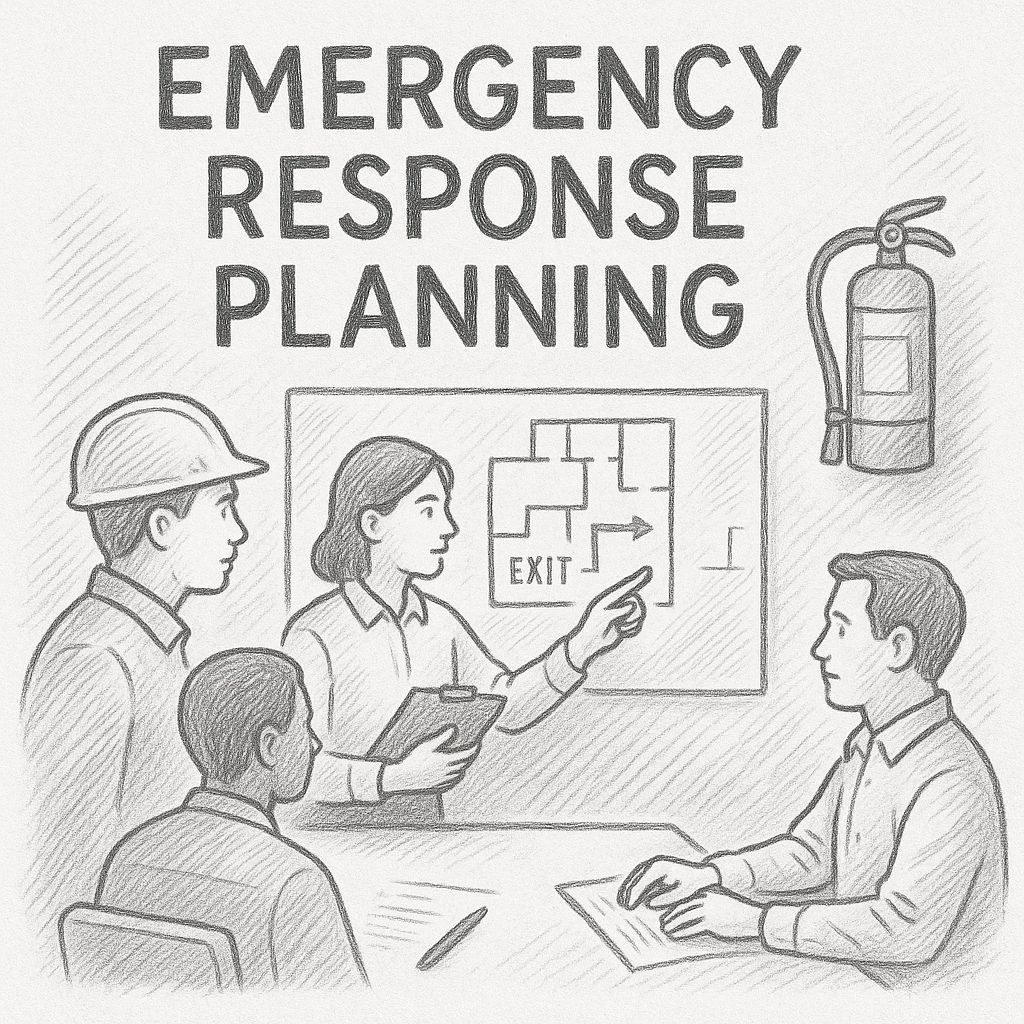
Linking this back to your broader safety system and resources on your own site (for example, your article on Workplace Hazard Identification – 10 Golden Rules for Safer Workplaces) reinforces that emergency planning is part of everyday risk management, not an isolated document.
2. Build a cross-functional Emergency Response Planning team
Emergency Response Planning cannot be done by OHSE alone. Assemble a planning team that includes operations, maintenance, HR, security, IT, communications, and joint health and safety committee members.
Assign a clear leader and define roles such as:
- Plan coordinator
- Floor wardens or marshals
- First aid and medical response leads
- Business continuity / IT recovery contacts
Involving diverse stakeholders early will surface practical details that a safety professional might miss—like badge access rules, IT failover times, or union notification requirements. It also creates ownership, which is essential when you later roll out drills and training.
3. Identify realistic emergency scenarios for your workplace
Next, identify the emergencies that are credible for your site.
Guidance from organizations like CCOHS and Ready.gov suggests considering fires and explosions, hazardous material releases, medical emergencies, weather events, power failures, and security threats.

Walk through your operations and ask:
- What could cause an immediate threat to life or serious injury?
- What could severely disrupt operations or damage brand reputation?
- What emergencies affect the community around us?
Map these scenarios to specific areas (e.g., warehouse, lab, office floors) and times (night shifts, shutdowns, weekends) so your Emergency Response Planning reflects real working conditions instead of generic checklists.
4. Assess risks, impacts, and existing controls
For each scenario, assess how likely it is, how severe the consequences could be, and what controls you already have.
This risk and impact assessment should build on your broader hazard and risk process and link back to existing controls such as fire detection, spill containment, or access control.
Consider:
- Number and vulnerability of people exposed
- Presence of hazardous substances or critical equipment
- Escape routes and safe refuge areas
- Potential impact on neighbours, environment, and emergency services
Using a simple risk matrix helps you prioritize which scenarios need the most detailed Emergency Response Planning and resources.
High-risk, high-impact events (for example, a large ammonia leak or explosion potential in a processing area) deserve more attention than minor, low-impact events.
5. Define clear activation criteria and communication methods
A common weakness in Emergency Response Planning is vague activation rules: people hesitate, wondering “Is this bad enough to pull the alarm?” Your plan should define specific triggers for:
- Raising the alarm (fire, gas detection, radio call, code words)
- Evacuation, shelter-in-place, lockdown, or partial shutdown
- Requesting external help (fire, ambulance, spill contractors, utilities)
Document how alarms are sounded (sirens, PA system, text alerts, radios) and what backup methods exist if power or communications fail.
Ready.gov and OSHA both stress the importance of reliable alarm systems and clear reporting procedures as core elements of an emergency action plan.
6. Develop protective action procedures for each scenario
For every high-priority scenario, your Emergency Response Planning must describe what workers and supervisors should actually do in the first minutes. Focus on simple, action-oriented steps written in clear language. Typical protective actions include:
- Evacuation: routes, exits, assembly areas, headcounts, re-entry controls.
- Shelter-in-place: how to secure rooms, shut down ventilation, and communicate with occupants.
- Lockdown or security events: securing doors, safe rooms, and communication protocols.
- Medical emergencies: who calls for help, first aid roles, AED locations, and coordination with paramedics.
- Hazardous materials events: spill response, isolation, and when to evacuate vs. shelter-in-place.
Avoid overloading the first responders with long paragraphs. Use numbered steps, diagrams, and flow charts where possible so that in a stressful moment, the “what do I do now?” answer is obvious.
7. Put Emergency Response Planning in a clear, accessible format
A plan that lives only in a thick binder is almost useless. Once procedures are defined, structure your Emergency Response Planning into sections that workers can quickly navigate:
- Site-wide overview and command structure
- Scenario-specific procedures (one section per type of emergency)
- Site maps, utilities shut-off locations, and hazardous inventory summaries
- Contact lists for internal and external responders
Store the plan both digitally (on your intranet or OHSE portal such as OHSE.ca) and physically at key locations like reception, control rooms, and security posts.
Ensure version control is in place so people always grab the current plan during an emergency.
8. Equip your workplace with the right resources
Emergency Response Planning must be backed by equipment and supplies. Review each scenario and confirm you have what you need, where you need it, in working order. Examples include:
- Fire extinguishers and hose cabinets
- First aid kits, stretchers, oxygen, and AEDs
- Spill kits for chemicals, fuel, or biological hazards
- Flashlights, radios, high-visibility vests, and incident command boards
- Backup power or UPS for critical systems and alarms
Maintain an inspection schedule and log so equipment is checked and serviced.
Align your resources with external best-practice guidance such as national fire codes, emergency planning regulations, and sector-specific standards.
9. Train, drill, and coordinate with external responders
Even the best Emergency Response Planning fails without practice. All workers must know the basics: alarm tones, evacuation routes, assembly areas, who is in charge, and how to report an emergency. Key roles (floor wardens, first aiders, spill responders) need deeper scenario-based training.
Run regular drills for fire, evacuation, and at least one “tabletop” exercise per year for more complex scenarios such as hazardous releases or security events. Invite local fire, EMS, or municipal emergency management teams where possible; many agencies encourage joint planning and provide free guidance and templates.
Drills also expose practical issues like blocked exits, inaudible alarms, or confusing instructions—problems you can fix in your next plan revision.
10. Review, audit, and continuously improve your Emergency Response Planning
Finally, treat Emergency Response Planning as a living program, not a one-off project. Review the plan:
- After every drill or real emergency (hot wash / debrief)
- When buildings, processes, chemicals, or staffing patterns change
- When new regulations, codes, or corporate standards are introduced
Audit documentation, training records, equipment inspections, and worker awareness. Compare your program against external checklists from groups like OSHA and CCOHS to ensure you still meet or exceed best-practice requirements.
Update related procedures and cross-link to other risk topics on your website, such as Noise and Hearing Loss at Work – 10 Practical Steps to Control Exposure or your confined space and fire safety articles, so readers can see how all elements of your safety program connect.
Effective Emergency Response Planning is about clear roles, realistic scenarios, and simple actions that people can remember under stress.
When you measure your risks, involve your workforce, equip your site, and continuously test and refine your program, you build a workplace that can respond confidently to the unexpected—and get everyone home safe at the end of the day through strong, practical Emergency Response Planning.
No comments yet