 Skip to content

Emergency Response Planning for Low-Visibility Weather Conditions is no longer something employers can treat as an occasional seasonal concern. Fog, mist, blowing snow, smoke, and dust can reduce visibility so quickly that routine work turns into a serious emergency risk.
Canadian emergency guidance notes that poor visibility can make routes difficult to navigate, increase the risk of collisions, cause disorientation, and delay emergency response. CCOHS also advises workplaces to account for extreme conditions by monitoring weather, maintaining communication, and preparing emergency response and rescue plans.

Many employers already have a general emergency plan, but low-visibility events need extra attention because they affect how people move, communicate, evacuate, drive, and locate one another. A normal evacuation route may become unsafe if workers cannot clearly see stairs, traffic lanes, loading areas, or assembly points.
A supervisor may not be able to confirm whether a contractor has exited the site. A first aid team may struggle to reach an injured worker if roads, yards, or access points are obscured.
OSHA states that a well-developed emergency action plan helps reduce injuries and damage during emergencies, while CCOHS says emergency preparedness is an important part of a workplace health and safety program.
- Why Low-Visibility Weather Changes Emergency Planning
- Building Emergency Response Planning for Low-Visibility Weather Conditions Around Risk Assessment
- Communication Is the Core of Emergency Response Planning for Low-Visibility Weather Conditions
- Evacuation, Shelter, and Accountability
- Traffic, Vehicles, and Site Access During Low-Visibility Events
- Training and Drills Make the Plan Work
- Practical Controls That Strengthen the Plan
- Final Thoughts
Why Low-Visibility Weather Changes Emergency Planning
The biggest mistake in emergency planning is assuming that all emergencies can be managed with the same procedures. In low-visibility weather, even simple actions become harder. Workers may move more slowly, lose orientation, miss alarms or hand signals, and have difficulty seeing hazards, vehicles, or coworkers.
Environment and Climate Change Canada’s impact guidance warns that higher-severity visibility events can make travel dangerous to impossible and may cause major delays for emergency response.
That means the emergency plan has to go beyond a basic evacuation map on the wall. It must address how the workplace will recognize deteriorating visibility, who has authority to suspend work, how workers will be alerted, what routes remain safe, and how accountability will be confirmed once people move to shelter or assembly areas.
CCOHS recommends that emergency planning teams perform a vulnerability assessment to identify which weather events could occur and what risks they would create for workers and the organization.
Building Emergency Response Planning for Low-Visibility Weather Conditions Around Risk Assessment
A strong plan starts with hazard identification and risk assessment. Employers should review which low-visibility conditions are realistic for their location and operation. Fog may affect transportation yards, ports, airports, hospitals, campuses, and construction sites. Blowing snow may disrupt industrial sites, utilities, warehouses, and road crews.
Smoke or dust may affect outdoor maintenance, agriculture, waste handling, and remote work sites. CCOHS recommends starting with hazard identification and using the hierarchy of controls to eliminate or reduce risk as much as possible.
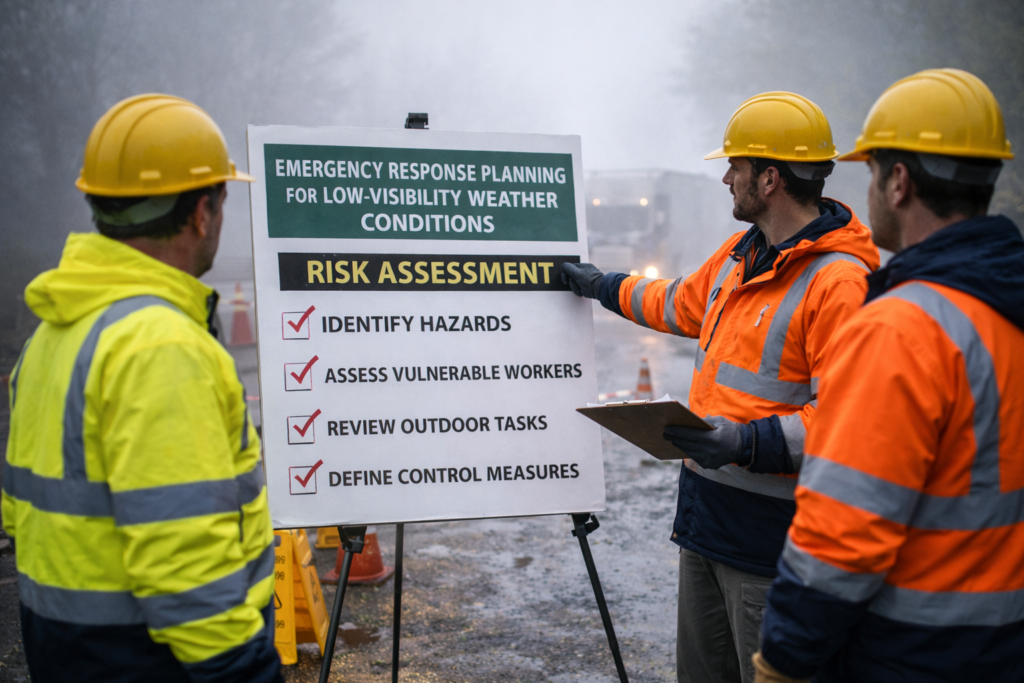
This assessment should look at both the weather event and the work being done. A low-visibility event is much more dangerous where mobile equipment is operating, where pedestrians mix with vehicles, where workers travel between buildings, or where emergency services depend on fast site access.
It should also consider vulnerable workers, including outdoor staff, new workers, visitors, and people who may need additional assistance during an evacuation. CCOHS specifically notes that unique vulnerabilities, including mobility concerns, should be considered in emergency planning.
Communication Is the Core of Emergency Response Planning for Low-Visibility Weather Conditions
Communication failures are one of the most serious hidden risks during low-visibility events. Workers may not see visual cues, hand signals, traffic patterns, or even approaching equipment. CCOHS advises maintaining communication between all parties involved when working in extreme conditions, and OSHA says workers should understand reporting procedures, alarm systems, evacuation plans, and shutdown procedures as part of the emergency action plan.
For that reason, employers should build layered communication into the plan. Audible alarms are important, but they may need to be supported by radios, text alerts, paging systems, flashing lights, or direct supervisor contact. CCOHS notes that evacuation signals should be clear and consistent to avoid confusion. In noisy or complex environments, relying on one method alone may not be enough.
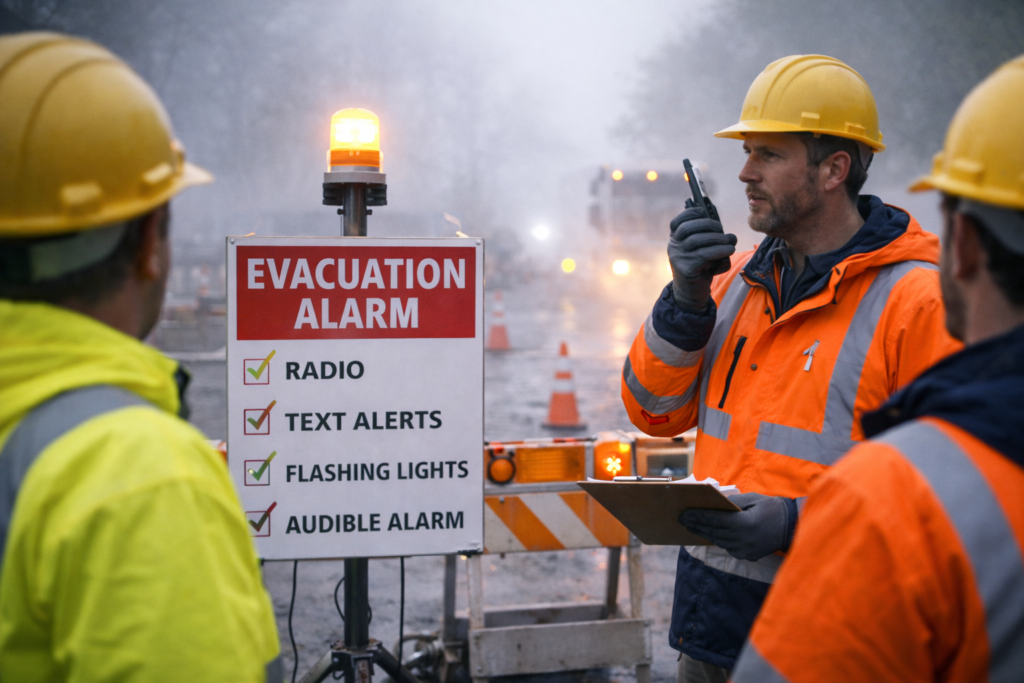
The plan should also spell out exactly who makes the call to stop work, who contacts emergency services, who coordinates evacuation or shelter-in-place actions, and who performs head counts. When roles are vague, people hesitate. During a real event, hesitation creates risk.
Evacuation, Shelter, and Accountability
OSHA’s emergency action plan guidance identifies several core elements: reporting emergencies, evacuation procedures, assignments for critical operations, accounting for employees after evacuation, rescue and medical duties, and contact persons. Those elements become even more important in low-visibility weather because confusion can spread fast.
In some cases, evacuation is the safest choice. In others, sheltering in place may be better, especially when outdoor travel is more dangerous than remaining inside. A good plan should define both options.
It should identify safe indoor refuge areas, backup assembly points, alternate access routes, and the conditions that trigger each response. If the usual muster point is across a parking lot or roadway, it may not be suitable during dense fog, smoke, or blowing snow.
Accountability must also be practical. Supervisors should know exactly how workers, contractors, and visitors will be counted. Paper sign-in sheets may fail if multiple entrances are used or if visitors are moving between buildings. Digital rosters, radio check-ins, designated floor wardens, and department-based accountability systems often work better when visibility is poor.
Traffic, Vehicles, and Site Access During Low-Visibility Events
One of the most dangerous parts of low-visibility weather is vehicle movement. Canadian preparedness guidance on fog highlights the collision risk associated with poor visibility, and CCOHS repeatedly emphasizes worker visibility and safer traffic control around moving vehicles.
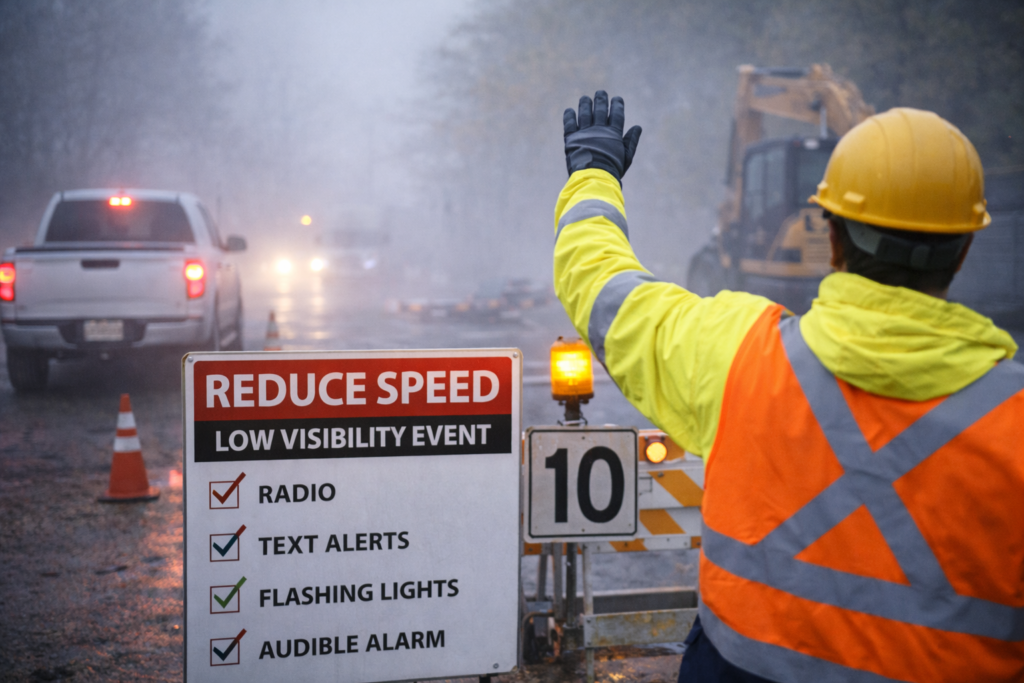
High-visibility safety apparel helps workers be seen sooner, especially in low light and poor visibility, but it is only one part of the solution.
Emergency Response Planning for Low-Visibility Weather Conditions should therefore include traffic controls such as reduced site speed limits, temporary route closures, suspended reversing operations where possible, designated pedestrian routes, and signallers or spotters where safe and appropriate. CCOHS notes that signallers should wear high-visibility apparel and not be distracted while performing those duties.
Another planning point is emergency vehicle access. If ambulances, fire services, or security teams cannot find the correct entrance quickly, response time will suffer.
Employers should make sure site maps, address markers, gate procedures, and access instructions remain usable in poor visibility. This is especially important for campuses, industrial facilities, and large outdoor sites.
Training and Drills Make the Plan Work
A written plan is only useful if workers know how to follow it. OSHA says employers should train workers on the types of emergencies that may occur and the proper course of action, while CCOHS stresses emergency preparedness as part of workplace safety programs.
Training for low-visibility weather should be specific rather than generic. Workers should know how to report deteriorating conditions, where to go if visual landmarks are obscured, which work activities must stop, how to use radios or backup communication methods, and how to assist visitors or coworkers without creating additional danger.
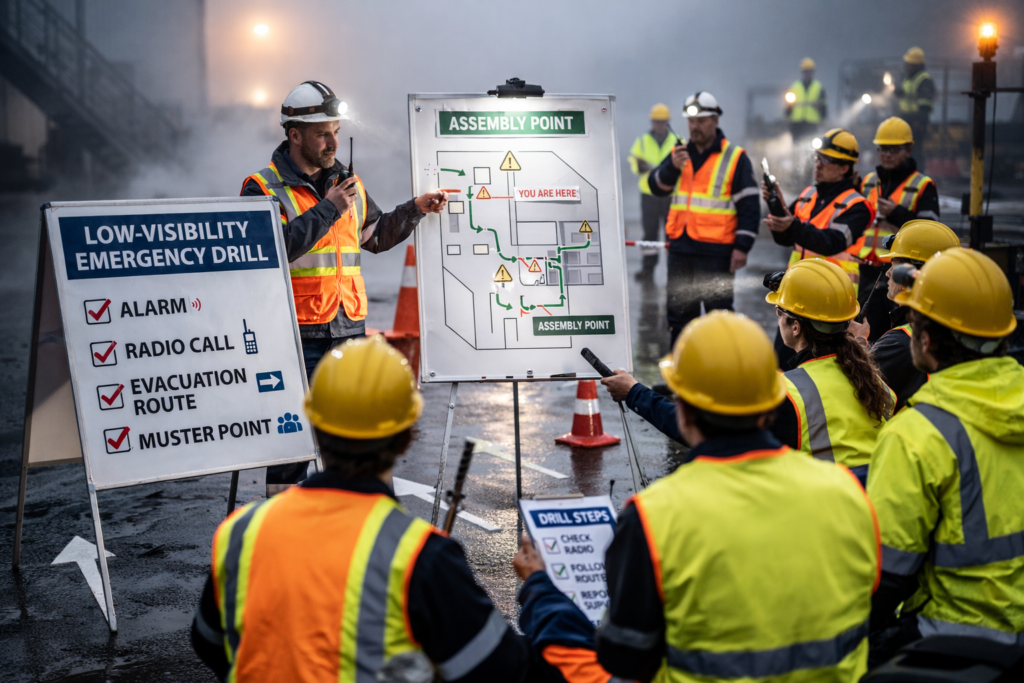
Drills should also test realistic conditions. For example, a workplace may discover that one assembly point is too exposed, that radios fail in a certain area, or that contractors were never included in the accountability process.
This is where related internal resources can strengthen the article flow as well. You can naturally connect this topic to your own guides on workplace emergency preparedness, winter driving safety for employees, and slip, trip, and fall prevention.
Practical Controls That Strengthen the Plan
The best emergency response plans combine planning with prevention. CCOHS recommends monitoring weather conditions, planning transportation alternatives, using administrative controls, and designing work sites with safety in mind where possible.
In practical terms, that means employers should monitor forecasts and official alerts from Environment and Climate Change Canada, define trigger points for delayed starts or suspended outdoor tasks, improve exterior lighting, keep entrances and walkways clear, and verify that high-visibility PPE meets appropriate requirements.
Employers can also refer to CCOHS emergency planning guidance, OSHA emergency action plan guidance, and Government of Canada fog preparedness information when reviewing or updating procedures.
Final Thoughts
Emergency Response Planning for Low-Visibility Weather Conditions should be treated as a core part of workplace emergency management, not a minor add-on to a general severe weather plan. When visibility drops, workers face higher risks of disorientation, traffic incidents, delayed rescue, failed communication, and unsafe evacuation.
The most effective response is a proactive one: assess the hazard, define clear triggers, assign roles, improve communication, control traffic, plan alternate routes, and train everyone before the weather event occurs.
That is how safer organizations prepare for the real challenges created by Emergency Response Planning for Low-Visibility Weather Conditions.
No comments yet