
Fruits for Staff Breaks is one of the simplest, most visible ways to support occupational health without changing job roles, schedules, or workloads.
It works because it nudges healthier choices during the exact moments employees reset their energy and focus—breaks—while also sending a clear message that wellbeing is part of the workplace culture, not an afterthought.
- Why Fruits for Staff Breaks belongs in an occupational health strategy
- The health pathways: what fruit actually changes at work
- Safety and performance: the fatigue connection
- Evidence that free fruit at work increases healthy intake
- How to run Fruits for Staff Breaks without creating new hazards
- Food safety, hygiene, and allergen controls that keep it OHSE-compliant
- What fruit to choose: low-mess, inclusive, budget-friendly
- Implementation plan: make it easy for supervisors and fair for staff
- Addressing common objections: sugar, cost, and “we already have snacks”
- Making it part of a bigger OHSE picture
Why Fruits for Staff Breaks belongs in an occupational health strategy
Occupational health isn’t only about preventing injuries; it’s also about reducing fatigue, supporting mental wellbeing, and creating conditions where people can work safely and sustainably. Break-time nutrition affects alertness, mood, and energy—factors that influence errors, near misses, and overall work quality.
Workplaces that make healthy options easier help staff follow public-health guidance more consistently. For example, reputable guidance encourages eating plenty of vegetables and fruits as part of a healthy pattern, emphasizing fibre and essential nutrients.
The health pathways: what fruit actually changes at work
When staff choose fruit instead of heavily processed snacks, several occupational-health-relevant benefits can stack up over time. Fruit adds fibre, hydration, and micronutrients that support steady energy and better appetite control compared with sugary, low-fibre options.
Over the long run, fruit- and vegetable-rich eating patterns are associated with lower blood pressure and reduced risk of cardiovascular disease and stroke—important because chronic disease risk impacts attendance, stamina, and recovery.
There’s also a practical “day-to-day” pathway. Canada’s workplace health guidance notes that healthier eating is linked with improved mood and energy and reduced anxiety/stress—exactly the kind of psychosocial lift that helps people cope with busy shifts and demanding environments.
Safety and performance: the fatigue connection
Fatigue is a safety issue. It’s tied to slower reaction time, reduced concentration, and higher error rates—especially in roles involving driving, patient care, machinery, or repetitive decision-making.
Nutrition isn’t the only fatigue control, but it’s a supportive one: Canadian occupational guidance on fatigue includes advice to eat at regular intervals and consume a balanced diet that includes fruits and vegetables. That guidance fits naturally into a break-room program where fruit is readily available.
This is where Fruits for Staff Breaks becomes more than a “nice perk.” It’s a low-friction control that supports consistent fueling, particularly for staff who may skip meals or rely on vending-machine snacks during short breaks.
“Workplace Fatigue Management” — : workplace-fatigue-management)
Evidence that free fruit at work increases healthy intake
Workplace nutrition interventions have been studied, and the evidence base is strongest for approaches that increase fruit and vegetable intake.
More specifically, research on fresh fruit availability at worksites has found significant increases in fruit/vegetable consumption in intervention groups compared with controls, showing that “availability” is a powerful lever.

So even if you don’t run a full wellness campaign, simply making fruit visible and easy can move the needle—especially for employees who weren’t meeting recommendations in the first place.
How to run Fruits for Staff Breaks without creating new hazards
Any food program should be treated like a mini operational change: it can reduce risk in one area (fatigue/healthy eating) but introduce risk in another (hygiene, allergens, pests, slips). A strong approach is to build simple controls into the setup so the program stays safe and low-maintenance.
Start by deciding what form of fruit you’ll provide:
- Whole fruit (apples, bananas, oranges) is lowest risk and lowest handling.
- Washed and packaged fruit can be great for convenience but needs supplier controls.
- Cut fruit is higher risk (food safety + allergens + surfaces) and should be done carefully or purchased pre-packaged from approved vendors.
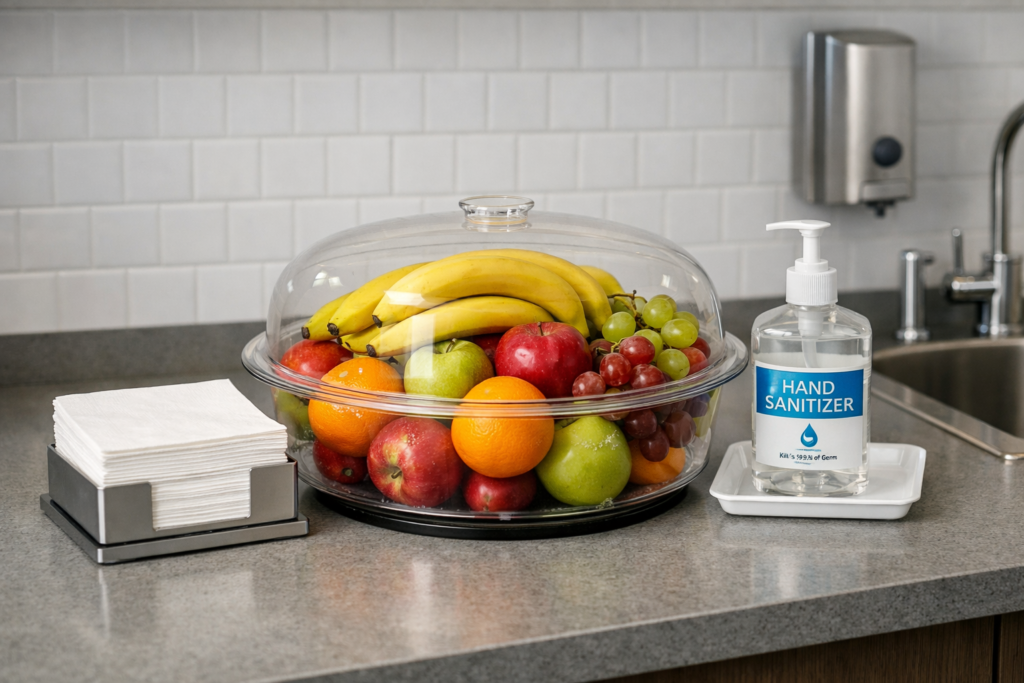
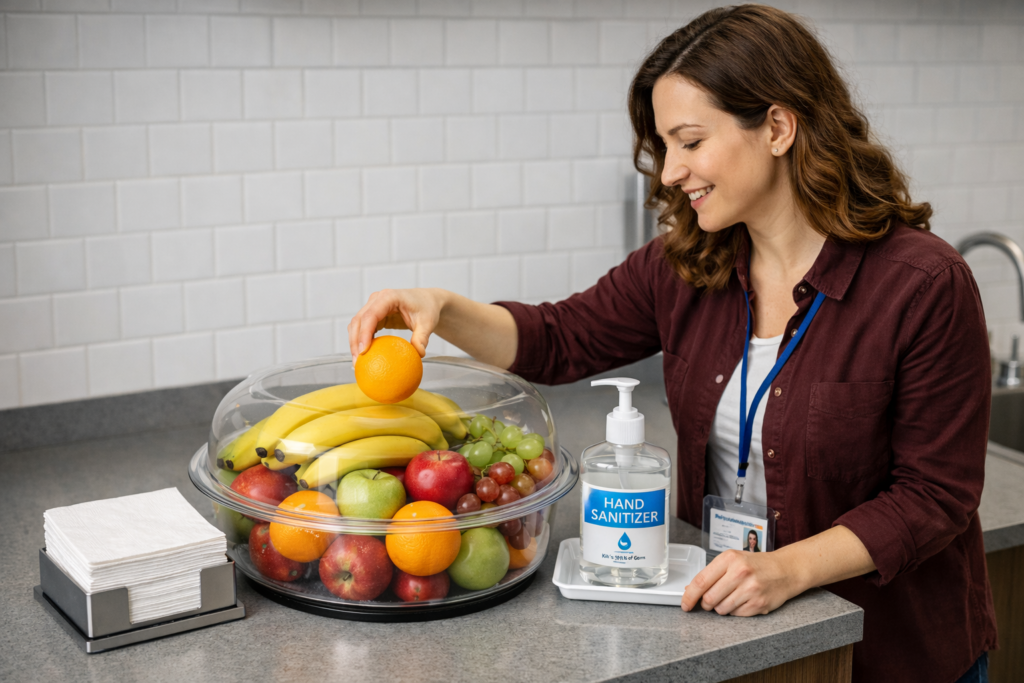
Place the fruit station where it supports hand hygiene and housekeeping. A counter near a sink is ideal. Add napkins, a small lined bin, and a wipeable surface so peels don’t become slip or pest issues.
“Hand Hygiene Basics at Work” — hand-hygiene-basics)
Food safety, hygiene, and allergen controls that keep it OHSE-compliant
To keep Fruits for Staff Breaks safe, focus on controls that are simple enough to sustain:
Hygiene and cross-contamination
Whole fruit should be clean and visibly fresh. If you provide pre-washed fruit, store it as recommended and avoid repackaging. If staff might cut fruit on-site, provide a designated cutting board, disposable gloves if appropriate, and a documented cleaning routine for surfaces and utensils.
Temperature control
Most whole fruit is fine at room temperature for short periods, but cut fruit generally requires refrigeration and time limits. If you can’t manage that consistently, keep it to whole fruit or sealed single-serve packs.
Allergen and sensitivity considerations
Fruit allergies are less common than nuts, but they exist. Use simple signage: “Ingredients: assorted fruit. If you have allergies, check the label or ask your supervisor.” Avoid mixed snack bowls that might include nuts unless you have a clear allergen management plan.
Pest and housekeeping
Fruit waste attracts pests. Ensure bins are lidded, emptied daily, and the area is wiped at least once per shift (or more in high-traffic spaces).
These controls protect staff while also protecting the program’s credibility—nothing kills a wellness initiative faster than a messy counter, fruit flies, or unclear cleanliness ownership.
What fruit to choose: low-mess, inclusive, budget-friendly
A smart fruit mix is seasonal, easy to grab, and not overly sticky. Apples, bananas, oranges/mandarins, pears, and grapes (in sealed containers) tend to work well. Berries are popular but often require refrigeration and can be fragile; they’re best as occasional “feature fruit” days.
To keep it inclusive, rotate options and add a few practical extras:
- A small “firm fruit” mix for people who prefer less sweetness (apples/pears).
- Softer options periodically (ripe bananas) for those with dental sensitivity.
- Clear “washed/not washed” cues depending on your process.
If you want alignment with public guidance, Canada’s Food Guide encourages making vegetables and fruits a regular part of meals and snacks, and highlights their nutrients like fibre and vitamins/minerals.
Implementation plan: make it easy for supervisors and fair for staff
A sustainable Fruits for Staff Breaks program usually has three ingredients: ownership, cadence, and feedback.
Ownership
Assign responsibility at the process level, not to a single person. For example: Facilities refills twice weekly; a shift lead checks tidiness once per shift; cleaning staff include the counter in their routine. When ownership is vague, the station becomes cluttered, and participation drops.
Cadence
Start small: two deliveries/refills per week is often enough. Track what disappears fastest and adjust. A predictable schedule helps staff trust the program (“it’ll be there on nights too”), which supports fairness across shifts.
Feedback
Ask one simple question monthly: “What fruit should we keep / stop / add?” Keep it anonymous to avoid social pressure. You can also track waste volume—waste is a practical metric that tells you whether the mix is working.
(“Building a Healthy Workplace Culture” — : healthy-workplace-culture)
Addressing common objections: sugar, cost, and “we already have snacks”
Some workplaces hesitate because fruit contains sugar. The key distinction is whole fruit vs. sugary processed snacks. Whole fruit comes with fibre and water that change how the body handles that sugar, and it tends to be more satiating than candy or baked goods.
Harvard’s nutrition guidance emphasizes that diets rich in fruits and vegetables can support health outcomes like lower blood pressure and reduced risk of heart disease and stroke, and can help with appetite control.
Cost is real, but waste and inequity are usually bigger risks than the purchase price. Start with a modest pilot in one area, pick sturdy seasonal fruit, and measure uptake. If uptake is high, it’s a strong sign the program is meeting a real need—especially for staff who don’t have time to shop mid-shift.
Making it part of a bigger OHSE picture
Fruits for Staff Breaks works best when it complements other practical controls: break scheduling that’s realistic, hydration access, and fatigue education. The fruit station can sit beside a water refill point, a poster on microbreak stretches, or quick reminders about recovery practices—small cues that reinforce safe work habits without adding meetings or paperwork.
For Canadian workplaces, using credible resources like CCOHS for workplace health guidance, and safety-focused hubs like OHSE.ca for broader OHSE learning, can help you keep messaging consistent and defensible.
No comments yet