 Skip to content

Heat Stress Prevention in the Workplace is no longer a topic that only matters during a few hot summer afternoons. It has become a year-round OHSE priority because heat hazards can affect both outdoor and indoor workers, especially in construction, agriculture, warehousing, manufacturing, kitchens, foundries, and other high-temperature environments.
CCOHS notes that workers exposed to heat may face serious health and safety risks, while NIOSH explains that occupational heat stress is shaped by environmental heat, physical workload, and even clothing or PPE that traps body heat.
In Canada, federal materials now place even stronger emphasis on controlling thermal stress, showing that this is a growing compliance and prevention issue, not just a comfort issue.
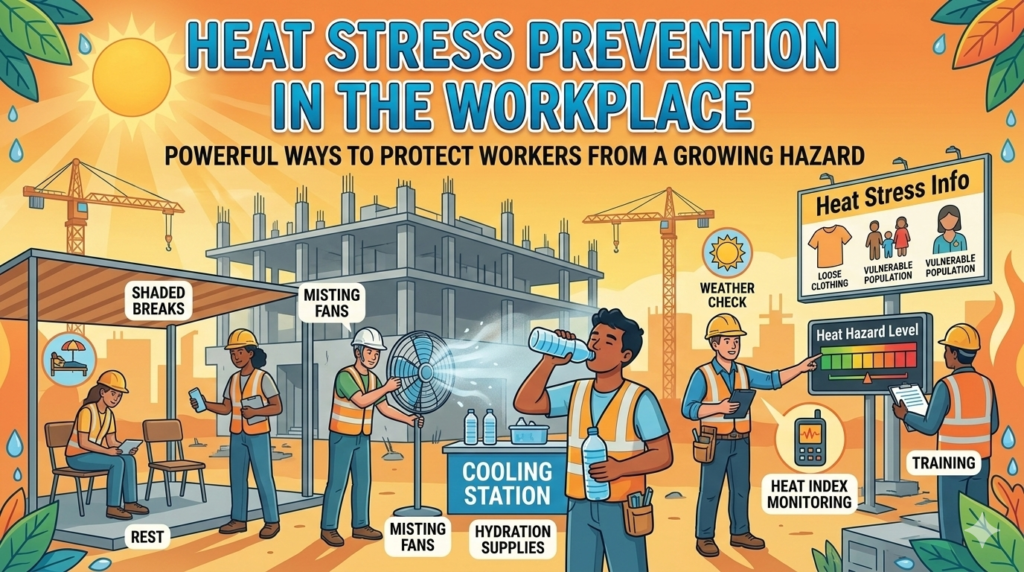
A strong OHSE program treats heat as a predictable hazard that can be assessed, controlled, monitored, and reviewed like any other serious workplace risk. That matters because heat illness can develop faster than many supervisors expect.
OSHA’s heat campaign says dozens of workers die and thousands become ill each year while working in hot or humid conditions, and the agency continues to promote practical prevention measures built around water, rest, shade, and planning.
At the same time, Canada’s Labour Program has confirmed that regulatory amendments published in February 2026 will come into effect in February 2027 for federally regulated workplaces, including requirements to control exposure to extreme heat when ACGIH thresholds are reached and to develop procedures with worker committee input.
- Why Heat Stress Prevention in the Workplace Matters More Than Ever
- Who Needs Heat Stress Prevention in the Workplace Most
- Heat Stress Prevention in the Workplace Starts With Risk Assessment
- Core Controls for Heat Stress Prevention in the Workplace
- Heat Stress Prevention in the Workplace Depends on Training and Emergency Response
- A Better Safety Culture Makes Heat Stress Prevention in the Workplace Work
Why Heat Stress Prevention in the Workplace Matters More Than Ever
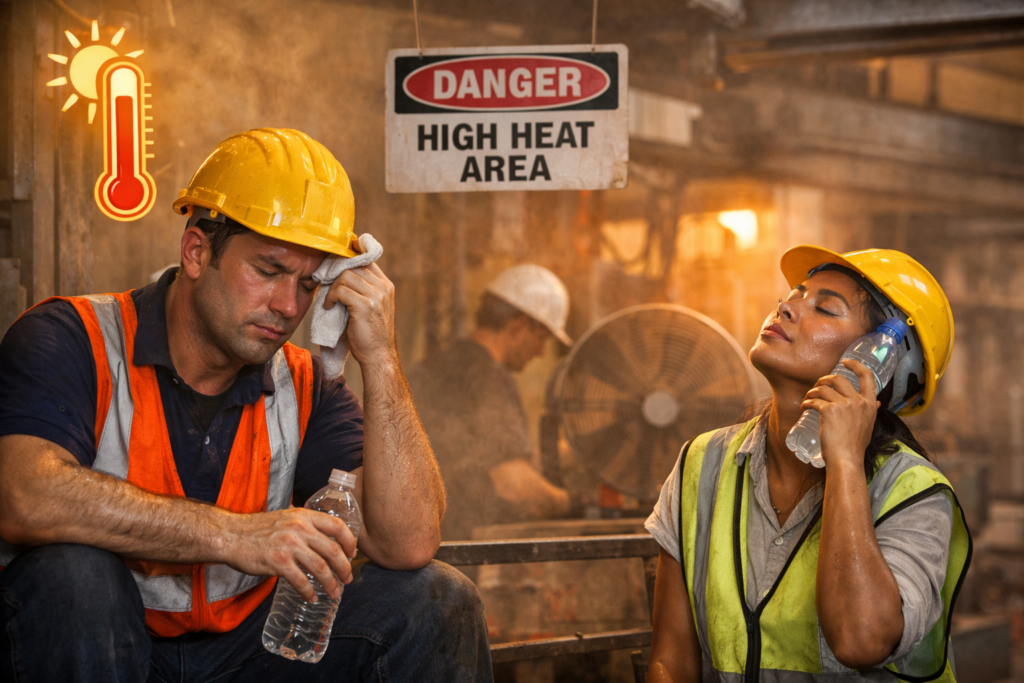
Heat stress affects more than outdoor crews under direct sunlight. Workers can also be exposed indoors when ventilation is poor, radiant heat is high, humidity builds up, or equipment and production processes raise the temperature. CCOHS makes it clear that heat can be dangerous whether the work is performed in summer weather outside or in hot indoor settings such as industrial plants.
That is why employers should stop thinking of heat as a weather problem and start treating it as an exposure problem connected to the workplace itself.
Another reason this topic matters is that prevention expectations are becoming more specific. OSHA’s proposed federal heat rule in the United States would require employers to create a plan to evaluate and control heat hazards in both indoor and outdoor settings, and Canada’s federal framework is also moving toward more defined thermal stress procedures.
Even where a jurisdiction does not yet have one single heat regulation, employers still have a duty to take reasonable precautions, assess hazards, and protect workers from foreseeable harm. Heat stress prevention is quickly moving from best practice to baseline expectation.
Who Needs Heat Stress Prevention in the Workplace Most
The most obvious high-risk groups are construction workers, roofers, landscapers, road crews, agricultural workers, and anyone doing heavy work outdoors. But indoor workers can also be highly vulnerable, especially in warehouses, commercial kitchens, laundry facilities, boiler rooms, mechanical rooms, factories, and facilities with inadequate cooling or high radiant heat.
NIOSH stresses that heat stress is not just about air temperature. It is also driven by metabolic heat from physical effort, humidity, and clothing or PPE that reduces the body’s ability to cool itself.
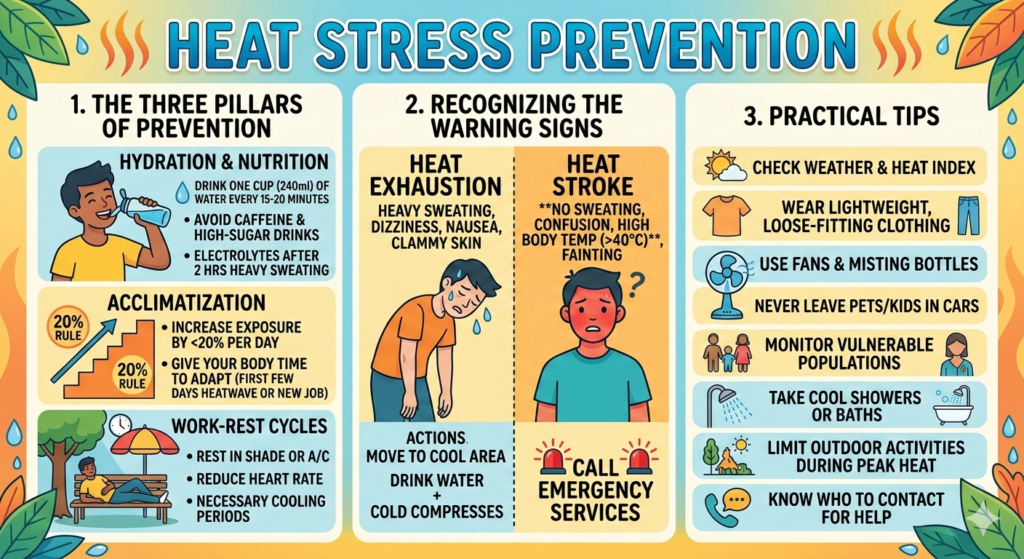
New workers and workers returning after time away deserve special attention. OSHA and CCOHS both highlight acclimatization as a key control, because people who are not gradually adjusted to heat are at greater risk.
A worker may look fit and capable but still be more vulnerable during the first days back on the job or during the first heat wave of the season. This is why a competent heat program should never assume that hydration alone is enough.
Heat Stress Prevention in the Workplace Starts With Risk Assessment
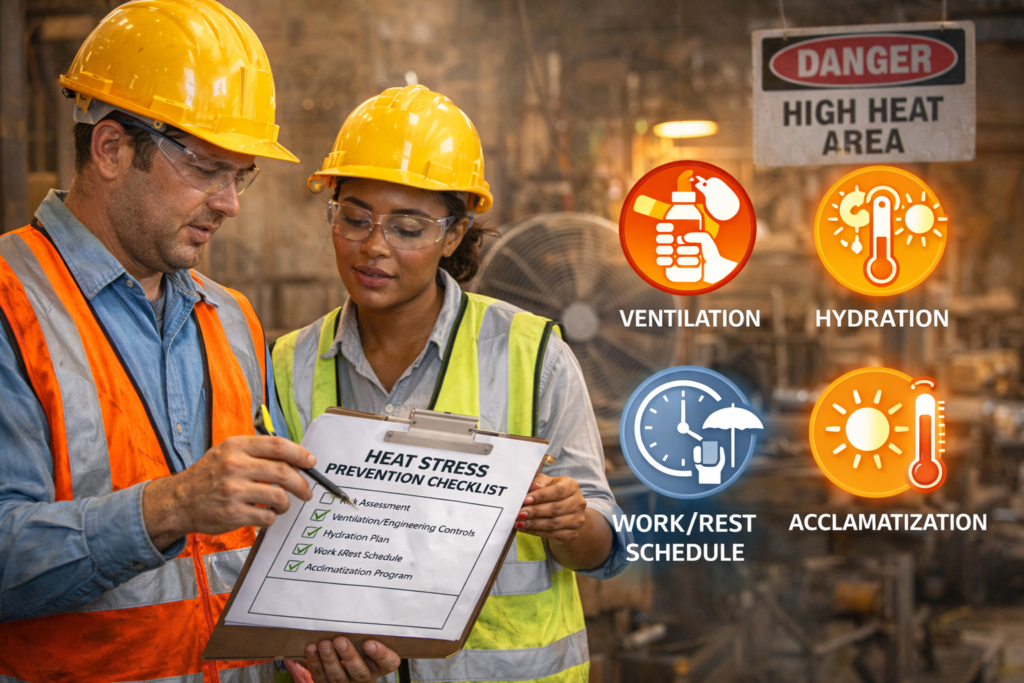
The foundation of heat stress prevention in the workplace is a proper risk assessment. CCOHS says a workplace where workers may be exposed to heat requires a risk assessment and appropriate control measures.
That assessment should consider air temperature, humidity, airflow, radiant heat, workload, exposure duration, clothing, PPE, shift timing, and whether workers are acclimatized. In practical OHSE terms, employers should identify where heat is generated, who is exposed, when exposure peaks, and what tasks make body temperature rise faster.
A good assessment also looks at organizational factors. Are workers rushing to meet deadlines? Are they working alone? Is there a shaded or cooled recovery area nearby? Is there a process for checking on symptoms before they escalate?
These questions matter because heat illness is often tied to production pressure, delayed breaks, or poor supervision rather than temperature alone.
This is also the point in your article where you can naturally connect readers to your existing hazard assessment procedure, PPE article, and incident reporting guide so the topic supports a broader internal OHSE content cluster.
Core Controls for Heat Stress Prevention in the Workplace
The best control strategy uses the hierarchy of controls rather than relying only on worker behavior. Engineering controls can include improved ventilation, spot cooling, insulation around hot surfaces, temporary cooling equipment, or changes that reduce radiant heat.
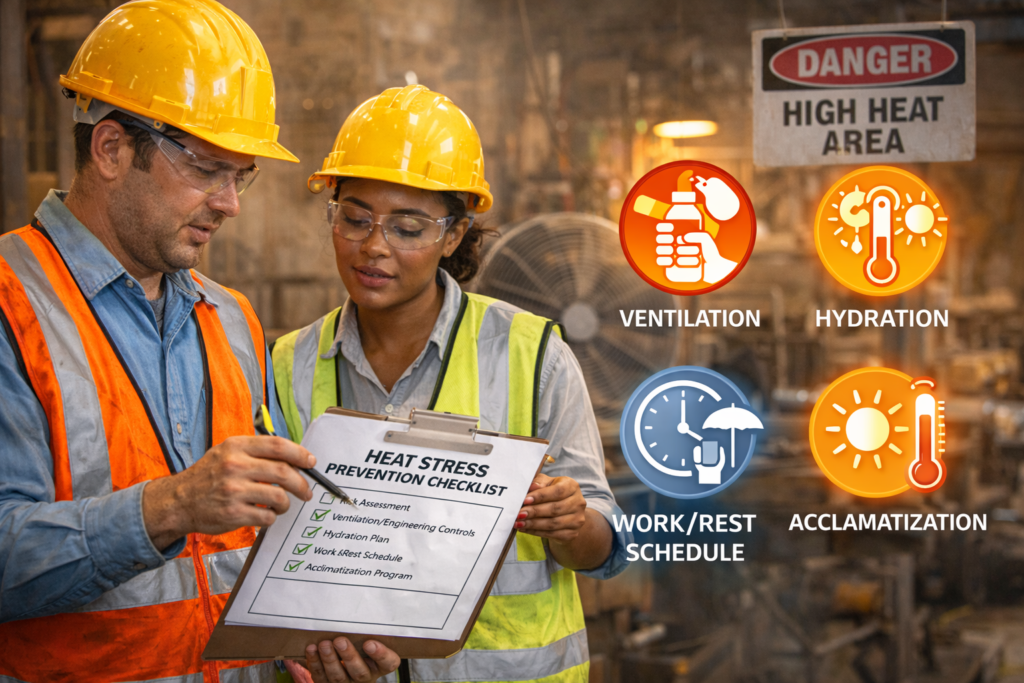
Administrative controls can include scheduling heavy work for cooler periods, rotating workers, increasing recovery time, limiting time in hot zones, and using acclimatization plans. Canada’s updated federal materials specifically reference engineering controls, administrative controls, environmental monitoring, protective clothing, and worker education as part of thermal stress procedures.
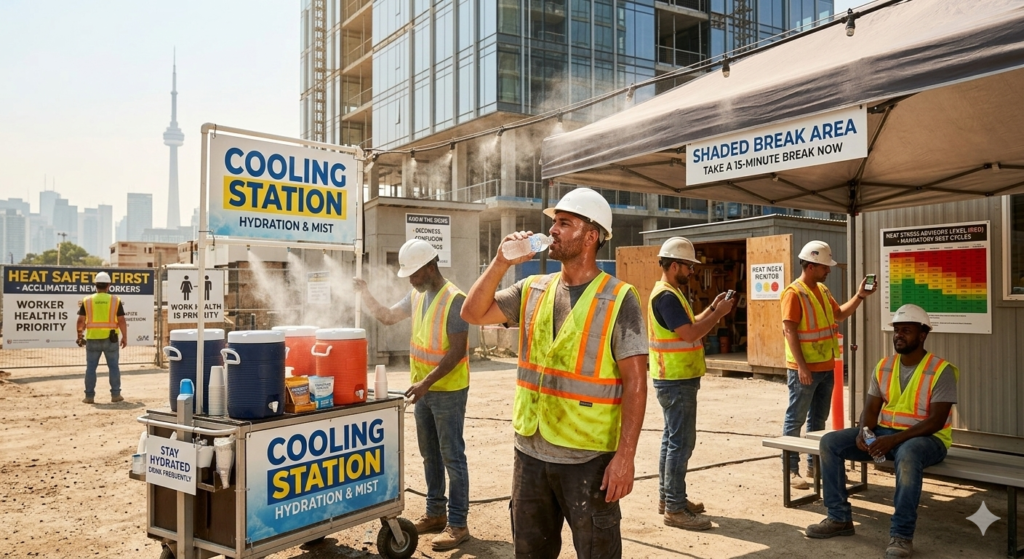
Hydration remains essential, but it should be structured, not casual. OSHA advises encouraging workers to drink at least one cup of water every 20 minutes while working in the heat, not simply waiting until they feel thirsty. That recommendation is useful because thirst can lag behind actual fluid loss. Employers should make cool potable water easy to access and should not design work in a way that discourages workers from stepping away for a drink.
Rest and recovery are just as important as water. OSHA continues to emphasize the simple message of water, rest, and shade, while CCOHS guidance points to acclimatization, work-rest scheduling, and control of work procedures as key administrative measures.
In real workplaces, this means supervisors should actively build rest into the job plan instead of leaving it to worker discretion during peak heat periods. A planned break is a control measure; an optional break is often not.
Heat Stress Prevention in the Workplace Depends on Training and Emergency Response
Training should help workers and supervisors recognize the early signs of heat illness and know exactly what to do. CCOHS lists warning signs of heat exhaustion such as heavy sweating, weakness, dizziness, visual disturbances, intense thirst, nausea, headache, muscle cramps, breathlessness, palpitations, and pale, cool, moist skin. CCOHS also warns that heat exhaustion can progress to heat stroke if untreated, which is why delays in response are so dangerous.
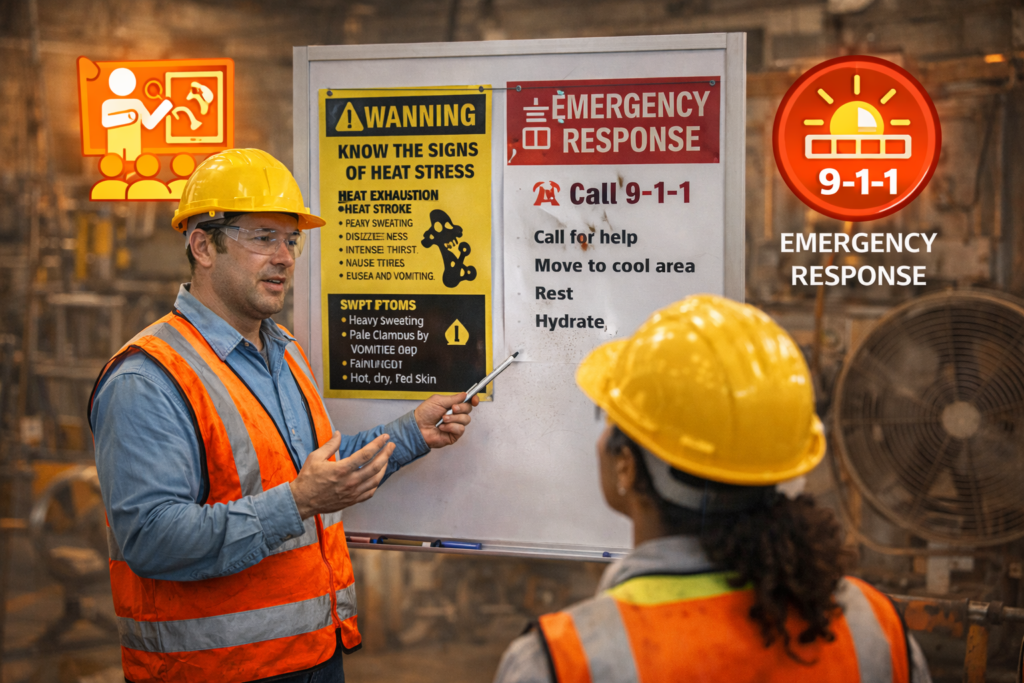
Emergency response should be simple and fast. A worker with symptoms should be moved to a cooler area, observed, given cool water if able to drink, and referred for medical attention when needed. Supervisors should know when to stop work, when to call emergency services, and how to communicate location details clearly.
A buddy system or frequent check-in process is especially important where people work alone, wear heavy PPE, or move between hot zones throughout the shift. This is another place where your article can naturally support internal links to your emergency response plan and lone-worker safety content.
A Better Safety Culture Makes Heat Stress Prevention in the Workplace Work
Heat policies fail when workers feel pressure to “push through” symptoms. A healthy OHSE culture makes it normal to report dizziness, fatigue, cramps, or confusion early without fear of embarrassment or discipline.
Supervisors should be trained to treat heat symptoms as operational warning signs, not as signs of weakness. When organizations normalize reporting and respond quickly, they prevent small symptoms from becoming serious incidents.
The most effective organizations also review heat incidents and near misses after every season or heat event. Canada’s new federal requirements include keeping records of incidents associated with thermal stress and documenting the conditions, protective measures, symptoms, and treatment involved. That kind of review helps employers improve controls, staffing, scheduling, and training before the next high-heat period arrives. Continuous improvement is what turns heat awareness into true heat risk management.
Heat hazards are not going away, and neither is employer responsibility. The smartest employers will act before the next heat event, not during it.
By combining risk assessment, hydration, acclimatization, engineering and administrative controls, training, and a clear emergency response process, organizations can protect workers, strengthen compliance, and build a more resilient safety culture. That is the real value of Heat Stress Prevention in the Workplace.
No comments yet