


PPE for young workers is an important part of staying safe in student and teen jobs, whether the work happens in a restaurant, retail stockroom, school shop, warehouse, landscaping crew, or community program. For many young people in Canada, a first job is also a first real exposure to workplace hazards. Personal protective equipment helps reduce harm, but it works best when it is selected properly, fits correctly, and is used alongside training, supervision, and safer work practices.
Parents, schools, and employers often focus on enthusiasm and reliability when a student starts working. Safety should be just as important. In Ontario and across Canada, young workers may not have much experience recognizing hazards, speaking up about concerns, or knowing when equipment is required. That is why clear orientation, age-appropriate instruction, and practical PPE habits matter from day one.
Why PPE for young workers matters in first jobs
Young workers often take on entry-level tasks that seem simple but still involve real risk. Cleaning chemicals, hot surfaces, sharp tools, slipping hazards, loud equipment, dust, and moving objects are common in part-time and seasonal jobs. In school co-op placements or training environments, there may also be shop tools, lab materials, or outdoor work conditions that require added protection.
PPE for young workers should never be treated as a substitute for safe work design. The best approach follows the hierarchy of controls: remove the hazard when possible, replace it with something safer, use guards or barriers, set safe procedures, and then use PPE as the final layer. For example, a quieter machine is better than depending only on earplugs, and a non-slip floor program is better than relying only on slip-resistant footwear.
Reliable safety basics and training resources can be found through CCOHS, while Ontario workplace information is available at Ontario.ca. Employers and educators can also use practical guidance and resources from OHSE.ca to support young worker safety programs.
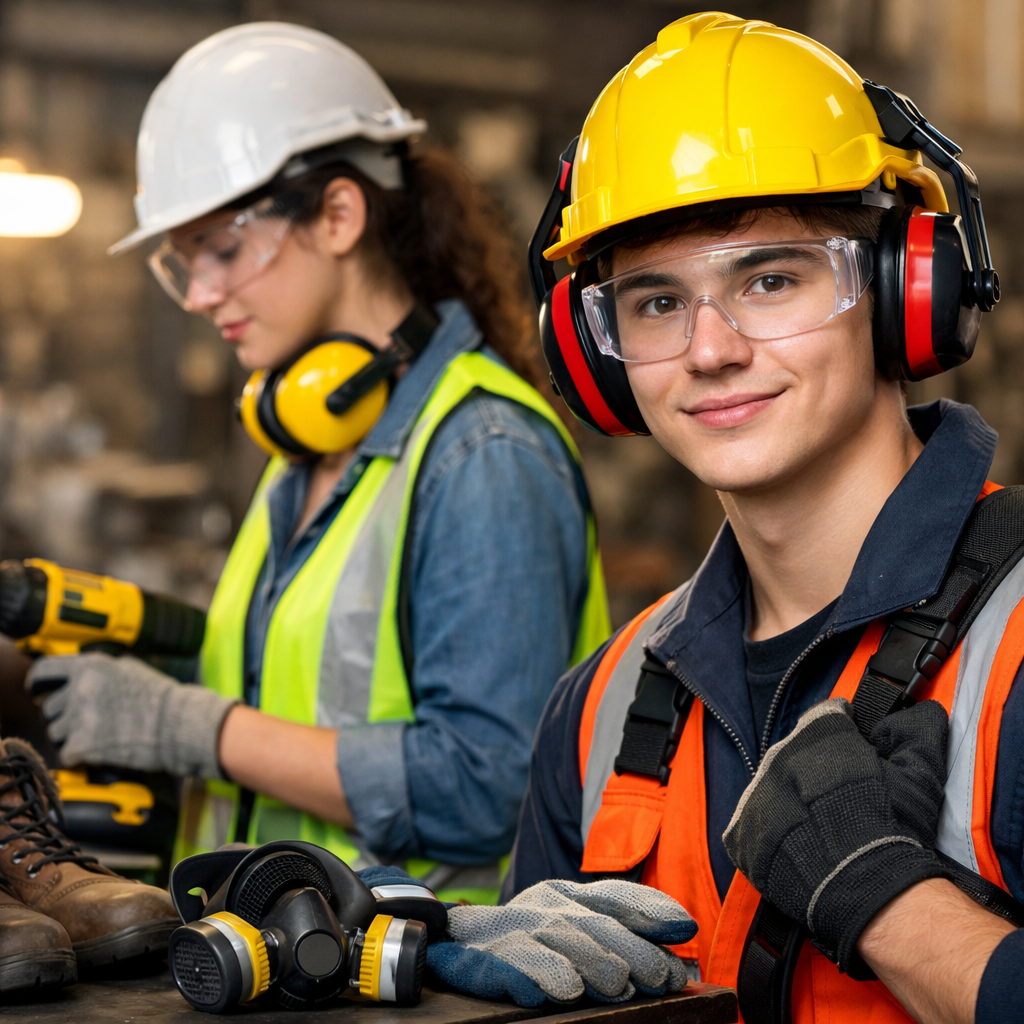
Common PPE for young workers by job task
The right PPE depends on the hazard, not just the job title. A cashier may need little beyond safe footwear, while a student working in food prep, groundskeeping, or a tech shop may need several types of protection during the same shift. Selection should be based on the actual task, the workplace assessment, and the manufacturer instructions.
Typical PPE items and where they may be used
- Safety footwear: helpful where there is risk of slips, wet floors, dropped items, or sharp objects underfoot.
- Gloves: chosen for the task, such as cut-resistant, chemical-resistant, heat-resistant, or disposable gloves.
- Eye protection: safety glasses or goggles for flying particles, splashes, dust, or cleaning products.
- Hearing protection: earplugs or earmuffs where equipment, tools, or music levels create harmful noise.
- Respiratory protection: only where required for specific hazards and with proper instruction, fit, and program controls.
- High-visibility clothing: useful around vehicles, loading areas, parking lots, road-adjacent work, or low-light conditions.
- Protective clothing: aprons, sleeves, coveralls, or lab coats to reduce contact with contamination, heat, or chemicals.
| Work setting | Common hazards | Possible PPE |
|---|---|---|
| Restaurant or café | Hot surfaces, knives, wet floors, cleaning products | Non-slip footwear, task-appropriate gloves, eye protection for chemicals |
| Retail stockroom | Box cutters, lifting, falling items, dust | Safety footwear, gloves, eye protection if required |
| Landscaping or outdoor work | Noise, flying debris, sun, vehicles, tools | Hearing protection, eye protection, gloves, high-visibility clothing |
| School shop or co-op placement | Particles, noise, sharp materials, machinery | Safety glasses, hearing protection, protective footwear, fitted clothing |
One important point for families and supervisors: not all PPE is one-size-fits-all. Smaller body size, different face shapes, and limited experience can affect fit and comfort. If PPE is uncomfortable, too large, or interferes with vision or movement, a young worker may avoid using it. That makes proper selection and trying it on in advance especially important.
How employers, schools, and families can support PPE for young workers
PPE for young workers works best when adults set clear expectations and build confidence. Employers should explain what hazards are present, when PPE is required, how to put it on and take it off, how to inspect it, where to store it, and when to replace it. A quick verbal instruction is rarely enough. Young workers benefit from demonstration, practice, and follow-up questions.
Schools and co-op coordinators can reinforce the same message by connecting classroom safety to real workplaces. Families can help by asking simple questions after a shift: What tasks did you do today? What PPE did you use? Did anything feel unsafe? These conversations make it easier for students and teens to recognize concerns early.
Practical steps that make PPE use more effective
- Check that the PPE matches the actual task and hazard.
- Make sure it fits the young worker properly.
- Teach how to inspect for damage before use.
- Keep PPE clean and stored in a dry, designated place.
- Replace worn, damaged, or expired items promptly.
- Supervise new workers closely until safe habits are consistent.
- Encourage questions and stop-work reporting without blame.
When training is part of the job or placement, practical online safety education can also help build readiness before a first shift. Employers and educators may find useful workplace learning support through learn.ohse.ca. For general injury prevention and youth safety awareness, Parachute may also be relevant.

Limits of PPE and common mistakes to avoid
It is easy to overestimate what PPE can do. Gloves do not make a young worker safe around every blade or chemical. Safety glasses do not replace machine guarding. A reflective vest does not protect someone who has not been trained to work around vehicles. PPE reduces risk, but it does not remove the hazard itself.
Some of the most common mistakes include wearing the wrong glove for the job, sharing damaged equipment, skipping eye protection for a “quick task,” wearing hood strings or loose clothing near moving parts, and failing to replace worn non-slip shoes. Another issue is assuming that if PPE is available, workers automatically know how to use it. They may not.
Canadian workplaces should also remember that manufacturer instructions matter. If a face shield must be worn with safety glasses, both are needed. If hearing protection requires a specific insertion or seal, that detail affects protection. If a respirator is required, follow workplace rules, local procedures, and manufacturer guidance carefully. Young workers should always follow their employer’s safety program and any applicable school or site-specific requirements.
A short checklist for PPE for young workers
Use this quick checklist before a shift, placement, or school-based work activity:
- Do I know the hazards of the task I am about to do?
- Has someone shown me what PPE is required and why?
- Does my PPE fit properly and feel secure?
- Is it clean, in good condition, and ready to use?
- Do I know how to wear, remove, clean, and store it?
- Do I know who to ask if something is damaged or missing?
- Do I understand that I should stop and ask questions if unsure?
PPE for young workers is most effective when it is part of a bigger safety culture that includes hazard assessment, proper training, supervision, and open communication. For Canadian students and teens, the goal is not to create fear around work. It is to build calm, practical habits that make first jobs safer and more confident from the start. Whether the setting is a school shop, summer camp, grocery store, or restaurant kitchen, the right PPE used the right way can help prevent avoidable injuries. Always follow local school, workplace, manufacturer, and emergency guidance where applicable, and treat PPE for young workers as an essential part of safe work, not an afterthought.


No comments yet