 Skip to content

Stretching Program Safely can be a smart addition to your ergonomics and fatigue strategy—but only if it’s designed like a real control, not a “look busy” ritual.
Too many workplaces roll out stretching because it’s visible and easy, then treat it like a checkbox. Workers quickly sense when a program exists mainly to appear proactive, especially if the job still forces awkward postures, rushed pace, heavy loads, or short staffing.
A stretching routine should support readiness, mobility, and recovery while reinforcing the bigger message: the employer is also fixing the work (tools, layout, staffing, rotation, and workflow).
When that balance is clear, people participate more willingly, supervisors stop pushing it like a script, and the program becomes part of a credible prevention culture.
- Stretching Program Safely starts with the right purpose
- Stretching Program Safely means understanding the real risks
- Stretching Program Safely focuses on mobility and readiness, not extreme flexibility
- Stretching Program Safely is designed for inclusion and choice
- Stretching Program Safely avoids “blame language” and fixes the work too
- Stretching Program Safely: how to build it as a simple workplace program
- Stretching Program Safely stays credible with the right frequency and timing
- Final reminder
Stretching Program Safely starts with the right purpose
Stretching Program Safely works best when the goal is realistic: preparing the body for task demands and encouraging safe movement habits. It should never be marketed as a guarantee against injury, or as a substitute for engineering controls. If a worker is lifting heavy items from the floor all day, stretching won’t “cancel out” poor design.
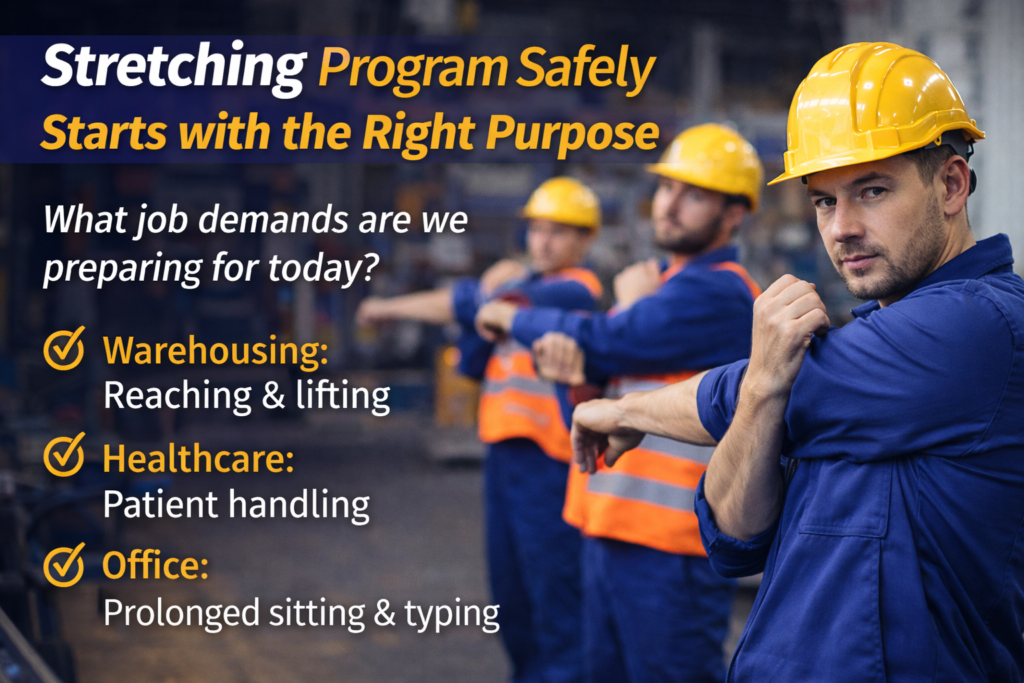
A good program begins with a simple question: What job demands are we preparing for today? In warehousing that might be repeated reaching and lifting; in healthcare it may be patient handling; in office settings it’s prolonged sitting and keyboard use.
Make the stretches relevant to those demands and explain the connection in plain language, not slogans.
To keep the message credible, include quick internal links to your existing prevention content—like an ergonomics guide (e.g., ergonomics basics) and MSI prevention tips (e.g., MSI prevention)—so readers see stretching as one part of a larger plan.
Stretching Program Safely means understanding the real risks
Stretching Program Safely is not “risk free.” Poorly chosen movements, forced range of motion, or aggressive stretching can increase discomfort—especially for workers with prior injuries, arthritis, nerve symptoms, or recent strains. Stretching also becomes risky when it’s rushed, competitive, or done in cold environments without any warm-up.
The most common safety issues come from:
- Overstretching (pushing into pain instead of mild tension)
- Bouncing or jerky movements that irritate tissues
- One-size-fits-all routines that ignore individual ability and restrictions
- Peer pressure (workers stretching to “prove” they can)
A safe program should use language like “optional range,” “work within comfort,” and “no pain.” If someone reports tingling, numbness, sharp pain, or symptoms that increase with stretching, the guidance should be to stop and report—not push through.
For general guidance your readers may recognize, you can link out to credible health education sources like Mayo Clinic and workplace prevention resources like CCOHS.
Stretching Program Safely focuses on mobility and readiness, not extreme flexibility
Stretching Program Safely usually means short, gentle mobility work and “warm-up style” movements—not deep static holds. Static stretching (long holds) can be fine, but it’s not always ideal right before physically demanding tasks, especially if it’s intense.
In many workplaces, the safest approach is dynamic movement: controlled, gradual range of motion that increases circulation and coordination.
A practical rule that keeps programs safe: aim for “comfortable tension,” not “maximum stretch.” The objective is to feel more ready for work, not to chase flexibility goals.
Stretching Program Safely: movements that usually fit most jobs
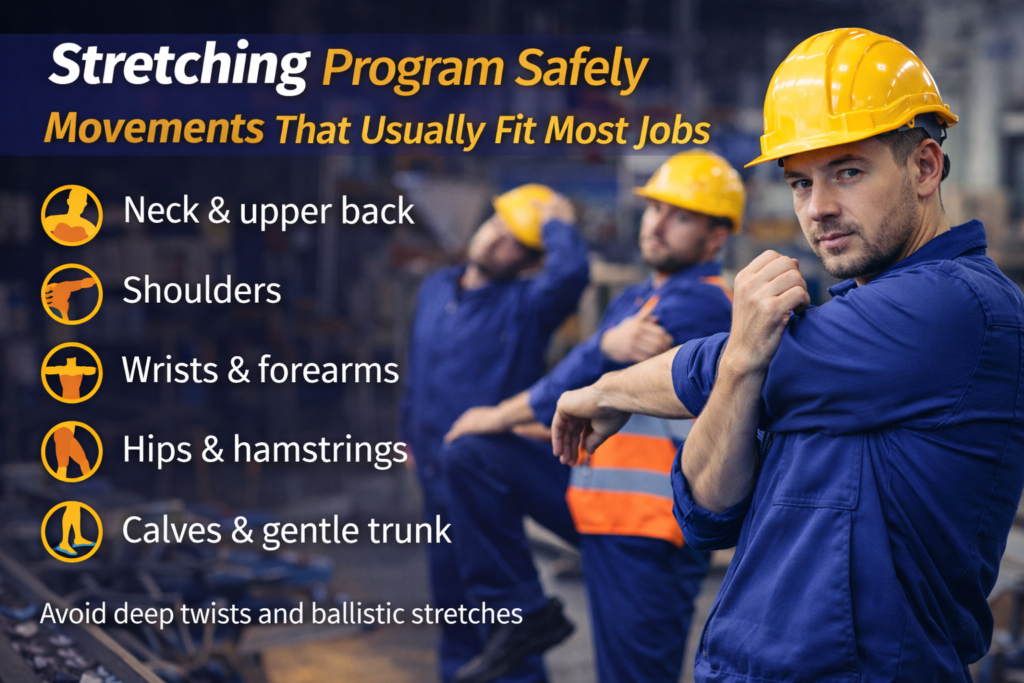
Keep routines simple and job-relevant. For many tasks, these areas matter most: neck/upper back, shoulders, wrists/forearms, hips, hamstrings, calves, and gentle trunk mobility. Avoid high-risk moves like deep spinal twists, ballistic toe touches, or aggressive neck rolls.
A short routine can be structured as:
- 30–45 seconds of gentle movement per body area
- 1–2 rounds depending on shift demands
- Smooth breathing, no holding breath
Stretching Program Safely is designed for inclusion and choice
Stretching Program Safely becomes performative when it’s forced, filmed, mocked, or treated like a “compliance parade.” If participation is mandatory, workers with restrictions can feel exposed or pressured to disclose personal health details. A safer approach is to make it encouraged and supported, with modifications normalized.
In practice, that means:
- Provide options (standing or seated versions, lighter ranges)
- Allow “participate by observing” without judgment
- Never ask workers to explain medical conditions publicly
- Train leaders to say, “Do what feels safe for you today.”
This is also where a short fatigue reminder fits naturally. If a crew is extending hours, a warm-up plus a quick alertness check is more meaningful than stretching alone. You can link internally to your fatigue content (e.g., fatigue management).
Stretching Program Safely avoids “blame language” and fixes the work too
Stretching Program Safely should never imply: “If you get hurt, you didn’t stretch.” That’s exactly how programs become performative—and how trust collapses.
The messaging must clearly say stretching is supportive, while the organization is also improving the job.
To keep this balanced, pair the routine with at least one visible improvement such as:
- Adjusting work height or adding lift assists
- Improving tool ergonomics or reducing grip force
- Introducing job rotation or micro-breaks
- Reducing peak overtime frequency where possible
If you want an external prevention framework to anchor that thinking, link to NIOSH for broader workplace health and prevention concepts.
Stretching Program Safely: how to build it as a simple workplace program
Stretching Program Safely doesn’t need to be complicated. A small, repeatable system works better than a fancy routine that nobody maintains. Here’s a straightforward model you can run in most workplaces.
Step 1: Match stretches to task demands
Start by listing the top 3–5 physical demands for each job group (reach, lift, push/pull, prolonged sitting, fine hand work).
Build the routine to reflect those demands. Workers immediately notice when it’s relevant, and relevance is the fastest way to reduce “eye-rolling.”
Step 2: Pilot with a small group and get honest feedback
Run a 2–3 week pilot. Ask two questions repeatedly: “Does this help you feel more ready?” and “Does anything make you sore or uncomfortable?” If a move irritates multiple people, replace it—no ego, no defending the routine.
Step 3: Train leaders to coach, not perform
The best facilitators don’t act like fitness instructors. They model safe ranges, remind people not to push into pain, and keep the routine short. Provide a simple script supervisors can use:
“Let’s do a quick readiness warm-up. Choose the version that feels safe for you. Mild tension is okay—pain is not. If anything bothers you, skip it and let me know after.”
Step 4: Add one “real control” alongside the routine
To avoid performative optics, pair the stretching program with one tangible improvement each quarter.
Even small changes—like raising a packing table, improving cart wheels, or adding a step platform—signal that the organization is addressing root causes.
Step 5: Measure what matters (without blaming)
Track participation trends, discomfort reports, and leading indicators like early symptom reporting—not just injury claims.
A stretching program is successful when workers speak up sooner, supervisors respond appropriately, and the job design keeps improving.
Stretching Program Safely stays credible with the right frequency and timing
Stretching Program Safely is usually most sustainable as 3–7 minutes at the start of shift, plus optional 1–2 minute “micro-mobility” moments during natural pauses (tool changes, team huddles, end-of-task resets).
If you try to run a 15-minute session every day, it will quickly feel like lost production time and turn into a rushed performance.
Timing tips that keep it real:
- Do the routine before the highest physical demand period
- Keep it consistent, short, and predictable
- Never use stretching to replace breaks or deny rest
Final reminder
Stretching Program Safely becomes valuable when it’s relevant to the work, optional and inclusive, coached with safe language, and backed by real ergonomic improvements.
When workers see that leadership is fixing hazards—not just staging a routine—the program stops feeling performative and starts supporting the goal everyone shares: ending the shift feeling better than you started, with Stretching Program Safely
No comments yet