
lab ventilation safety standards: Essential Requirements for Safer Laboratories


lab ventilation safety standards are a critical part of occupational health, safety, and environmental protection in any laboratory setting.
Whether a facility handles solvents, acids, biological agents, powders, or compressed gases, ventilation is one of the main barriers that prevents hazardous exposure and keeps routine work under control.
Good ventilation does more than remove unpleasant odors. It helps capture airborne contaminants at the source, protects workers from inhalation risks, reduces the chance of fire or explosion, and supports compliance with OHSE obligations.
In research labs, hospital labs, school labs, and industrial testing facilities, poor airflow can quickly turn a small issue into a serious incident. That is why understanding lab ventilation safety standards is essential for supervisors, safety officers, technicians, and employers alike.

Why lab ventilation safety standards matter in everyday lab work
Laboratories often use chemicals and processes that generate vapors, aerosols, fumes, dust, and mists. If these contaminants are not controlled properly, workers may suffer acute effects such as eye irritation, dizziness, headaches, breathing difficulty, or chemical burns.
Long-term exposure can lead to chronic respiratory illness, sensitization, organ damage, or occupational disease.
Lab ventilation safety standards are designed to reduce these risks by setting expectations for airflow, containment, exhaust design, pressure relationships, maintenance, and testing.
These standards also support emergency preparedness by helping to limit contaminant spread during spills, leaks, or equipment failure.
Common ventilation-related risks in laboratories
- Exposure to toxic chemical vapors from solvents, acids, and reagents
- Inhalation of dust from powders, nanomaterials, or sample preparation
- Release of biological aerosols during handling or centrifuging
- Fire and explosion hazards from flammable vapors accumulating in enclosed areas
- Cross-contamination between work zones due to poor airflow balance
- Loss of containment from malfunctioning fume hoods or local exhaust systems
A practical example is a chemistry lab where staff regularly decant flammable solvents on an open bench instead of inside a functioning fume hood.

Without effective extraction, vapor concentration may build up in the breathing zone and increase both health and ignition risks. In another example, a microbiology lab with poor negative pressure control may allow contaminated air to migrate into adjacent corridors or offices.
Key elements of lab ventilation safety standards
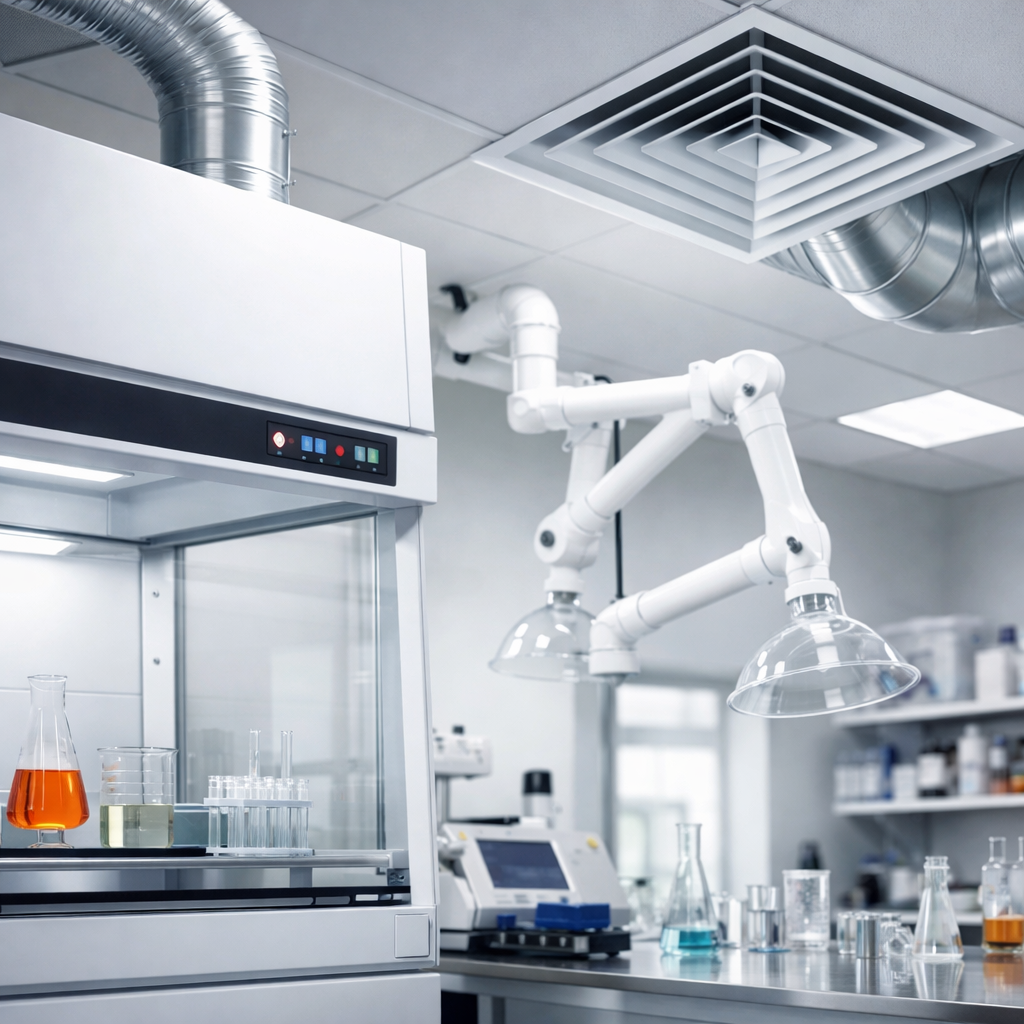
Effective lab ventilation is based on a combination of general dilution ventilation and local exhaust ventilation. General ventilation helps manage background air quality, while local systems such as fume hoods, snorkel arms, and biosafety cabinets capture hazards as close to the source as possible.
Lab ventilation safety standards typically focus on performance, not just equipment presence.
Core design and performance features
- Airflow direction: Air should move from clean areas toward higher-risk areas to prevent contaminant spread.
- Negative pressure: Many labs require negative pressure relative to adjacent spaces.
- Source capture: Hazardous emissions should be controlled at or near the point of generation.
- Air changes: Ventilation rates should be suitable for the type of lab activity and occupancy.
- Exhaust discharge: Contaminated air should be safely discharged away from air intakes and occupied areas.
- Monitoring and alarms: Systems should include indicators or alarms where failure could create immediate risk.
- Testing and balancing: Airflow performance should be verified during commissioning and rechecked routinely.
Standards and guidance may come from several sources, including OSHA laboratory safety guidance, CCOHS, ANSI/ASSP, NFPA, and local building or mechanical codes.
For example, OSHA emphasizes exposure control and safe laboratory practices, while CCOHS provides practical workplace guidance on ventilation, hazardous substances, and employer responsibilities.
| Ventilation Component | Main Safety Purpose | Typical OHSE Concern |
|---|---|---|
| Fume hood | Captures chemical vapors and fumes at source | Inhalation exposure, fire risk |
| Biosafety cabinet | Controls biological aerosols during handling | Infection risk, cross-contamination |
| General room ventilation | Maintains background air quality | Accumulation of low-level contaminants |
| Local exhaust arm | Removes emissions from specific tasks | Dust, solder fumes, localized vapor release |
Applying the Hierarchy of Controls to lab ventilation safety standards
One of the most practical ways to manage laboratory air hazards is to apply the Hierarchy of Controls. Lab ventilation safety standards fit mainly within engineering controls, but the most effective programs combine several layers of protection.
1. Elimination and substitution
Where possible, remove the hazard entirely or replace it with something less dangerous. For instance, use a less volatile solvent, a premixed solution, or a lower-toxicity reagent.
Reducing the amount of hazardous material used in a process can also cut the ventilation demand and exposure risk.
2. Engineering controls
This is where lab ventilation safety standards have the greatest direct impact. Engineering measures include chemical fume hoods, ducted exhaust systems, enclosed processes, glove boxes, and pressure-controlled rooms.
These controls should be selected based on the actual hazard, not just on convenience or cost.
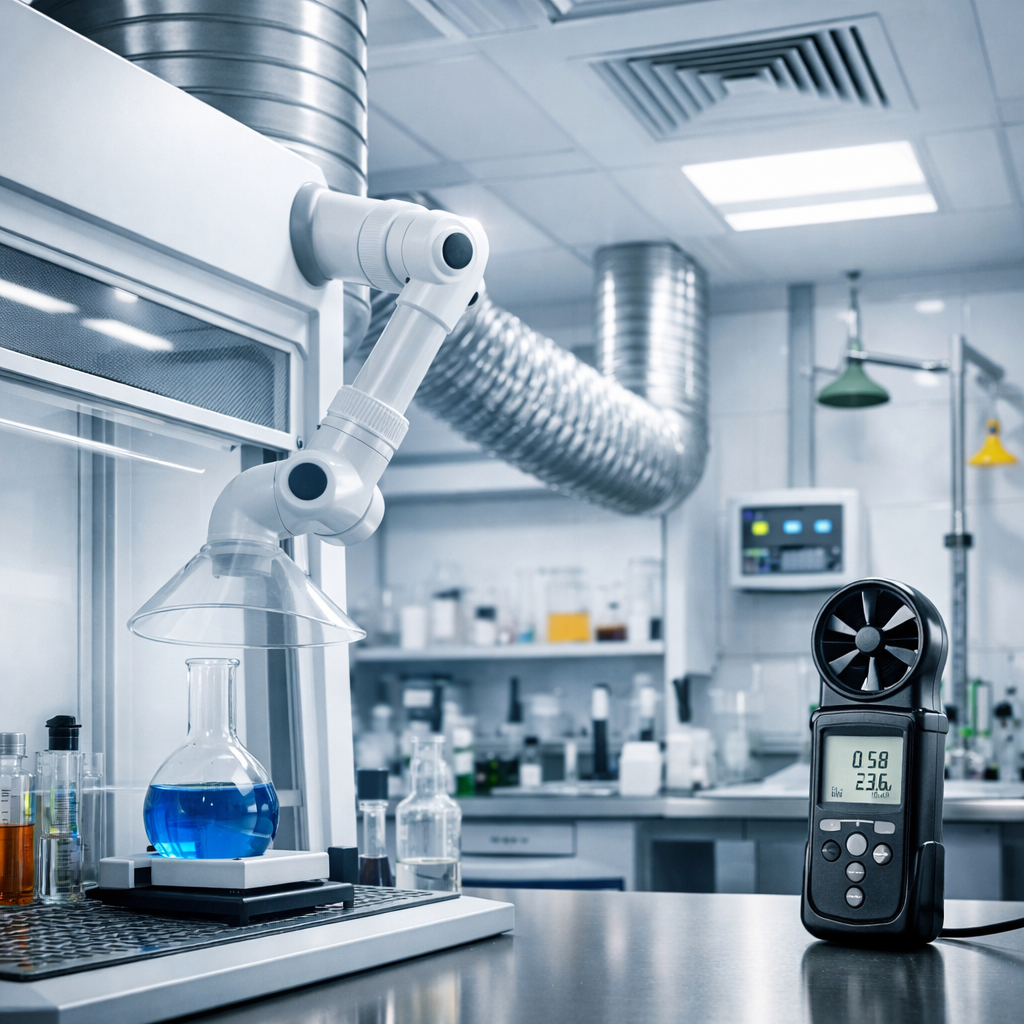
A common mistake is relying on room ventilation alone for tasks that clearly require source capture. General airflow cannot replace a properly functioning hood when handling concentrated acids, toxic vapors, or highly odorous chemicals.
3. Administrative controls
Written procedures, training, signage, access control, and scheduling are still essential.
Workers should know when a task must be done inside a hood, how to position materials to avoid blocking airflow, and what to do if an alarm sounds or airflow monitor shows failure. Periodic audits and refresher training help reinforce these rules.
Helpful resources may also be included in internal procedures, such as your safety training programs or chemical risk assessment guide.
4. Personal protective equipment
PPE is the last line of defense, not the first. Even in labs with strong ventilation, workers may still need safety glasses, splash goggles, gloves, lab coats, chemical aprons, or respiratory protection where risk assessment shows it is necessary.
Respirators should never be used as a substitute for required engineering controls unless there is a justified temporary or emergency situation and a formal respiratory protection program is in place.
Inspection, maintenance, PPE, and compliance in real workplaces
Compliance with lab ventilation safety standards depends on consistent verification. A well-designed system can still fail if filters are clogged, dampers are misadjusted, belts are worn, sash positions are ignored, or maintenance is delayed.
Routine inspections should include visual checks, airflow measurements, alarm testing, and review of user practices.
Practical compliance measures
- Test fume hoods and local exhaust systems at scheduled intervals
- Label equipment clearly with operating instructions and inspection dates
- Keep hood sashes at the recommended working height
- Avoid storing excess chemicals or large equipment inside hoods
- Report unusual odors, noise, vibration, or airflow alarms immediately
- Document corrective actions and maintenance records
- Review ventilation needs whenever processes or chemicals change
A useful compliance example is a university laboratory that conducts annual hood face velocity testing, quarterly user inspections, and retraining after any failed performance result. Another example is a pharmaceutical quality lab that links ventilation checks to permit-to-work and change-management processes, ensuring that any new solvent or procedure triggers a ventilation review.
Many employers also align their programs with recognized guidance such as NIOSH recommendations, OSHA expectations, and local OHSE regulations.
PPE still plays an important supporting role in these environments. For example, when transferring corrosive liquids inside a functioning hood, a worker may need chemical-resistant gloves, splash protection, and a buttoned lab coat. During spill response, additional PPE may be necessary depending on the substance and the ventilation status of the room.
The key point is that PPE supports lab ventilation safety standards; it does not replace them.
In conclusion, lab ventilation safety standards are a foundation of safe laboratory operations because they control airborne hazards before they reach workers, equipment, or adjacent spaces.
By recognizing risks, applying the Hierarchy of Controls, using suitable PPE, and maintaining strong inspection and compliance systems, employers can create safer and more reliable laboratories. When lab ventilation safety standards are built into daily practice, testing, training, and maintenance, the result is better health protection, stronger regulatory compliance, and a more resilient workplace.
No comments yet