
Traffic Management in Active Parking Lots During Snow Removal is one of the most important winter safety challenges for workplaces, hospitals, malls, warehouses, offices, and residential complexes.
Unlike closed job sites, an active parking lot is full of unpredictable movement—customers arriving, employees rushing in, delivery vehicles backing up, and pedestrians walking between parked cars with limited visibility.
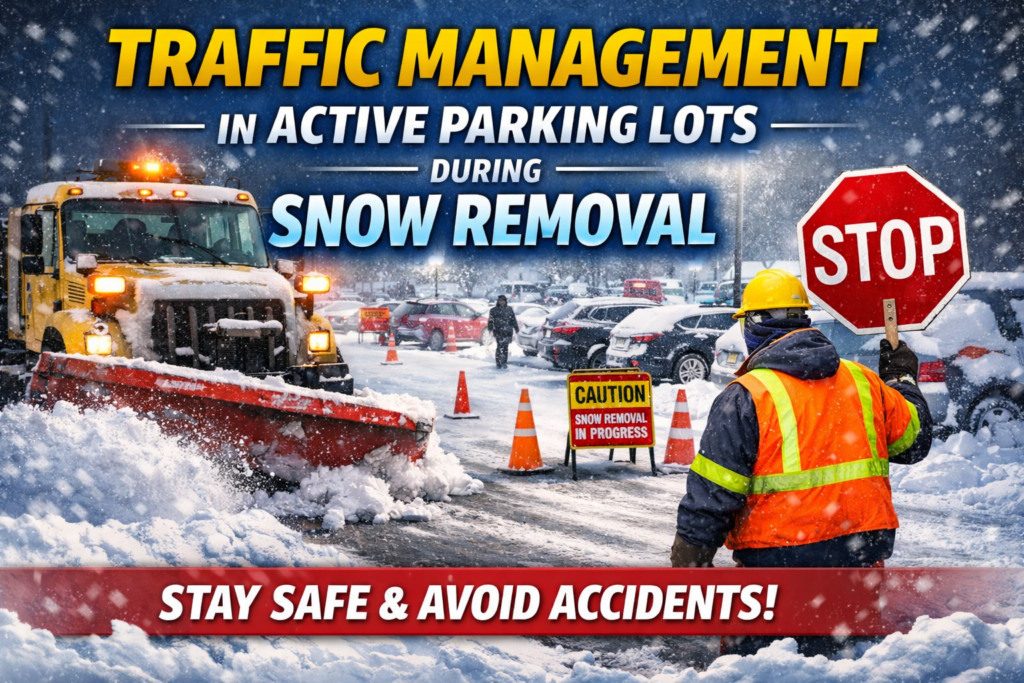
When snow removal begins, the risk multiplies fast. Heavy equipment, snow windrows, reduced traction, flying snow, blind spots, and temporary lane closures create the perfect conditions for slips, vehicle collisions, and struck-by incidents. The good news is these risks can be controlled with a solid plan, clear traffic controls, and disciplined execution.
This article breaks down practical, real-world controls that improve safety without shutting down business operations.
- Why Active Parking Lots Become High-Risk Zones in Winter
- Traffic Management in Active Parking Lots During Snow Removal Starts With Planning
- Site Setup Controls That Reduce Collisions Immediately
- Equipment Movement Rules That Prevent Struck-By Incidents
- Pedestrian Safety Controls That Actually Work
- Clear Communication Prevents Confusion and Aggressive Driving
- Managing Snow Piles, Visibility, and Sightline Blockers
- Inspection, Monitoring, and “Stop Work” Triggers
- Incident Readiness and Emergency Access
- Supervisor Checklist for Safer Snow Removal Operations
- Conclusion
Why Active Parking Lots Become High-Risk Zones in Winter
Active parking lots already have constant conflict points, even in good weather. In winter, those conflict points increase because snow piles narrow the driving area and block sightlines at corners, intersections, and crosswalks. Drivers may also focus more on avoiding skids than watching for pedestrians.
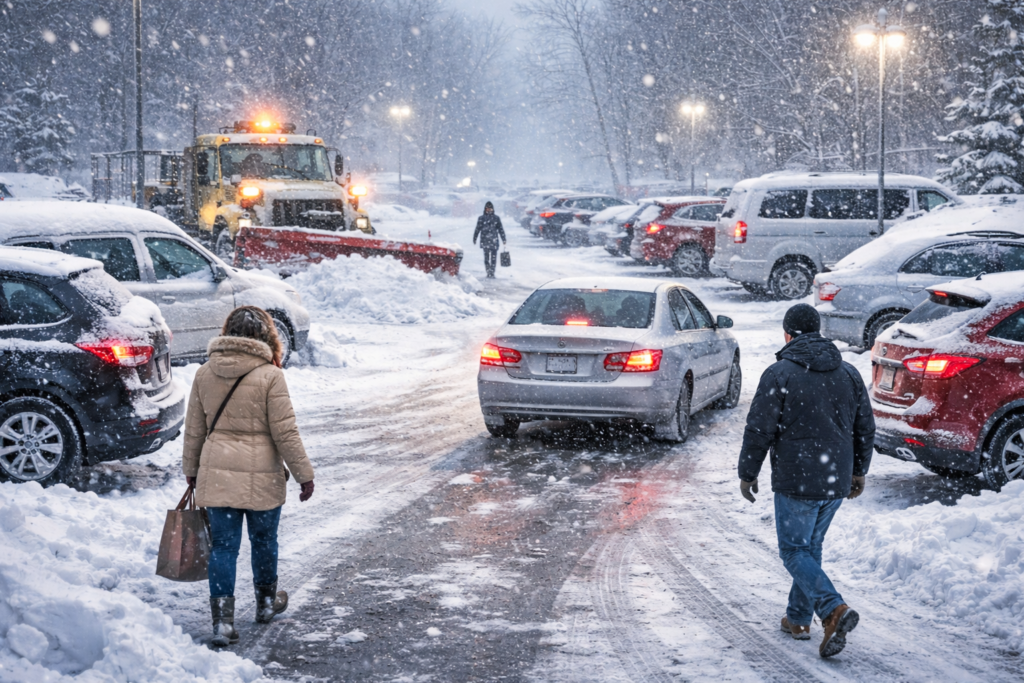
Pedestrians are also at higher risk because many will choose the shortest path instead of the safest route. People often walk behind vehicles, between cars, or across unmarked zones—especially if walkways are snow-covered or not cleared yet. Add icy conditions, low lighting, and blowing snow from plows, and the environment becomes high stress for everyone.
If your site supports vulnerable populations (such as healthcare facilities), the hazard increases further because mobility devices, wheelchairs, and slower walking speed require wider clear paths and more time to react.
For related prevention steps, you can also review internal guidance like Slip and Trip Prevention in Winter on your own safety site.
Traffic Management in Active Parking Lots During Snow Removal Starts With Planning
The safest snow removal operations begin before the first snowfall. Planning means identifying risk areas, deciding how traffic will flow, and making sure everyone knows the rules.
A strong plan includes a simple parking lot map that shows plow routes, equipment staging areas, pedestrian routes, and emergency access lanes. This map should be shared with supervisors, contractors, and staff so everyone is working from the same setup. If you’re using contractors, the plan must clearly define who is responsible for barricades, signage placement, and spotter support.
Scheduling is another major control. If possible, aim for snow clearing during low traffic times such as overnight, early morning, or during shift gaps. Even reducing traffic by 30–40% during plowing windows can dramatically reduce collision exposure.
To strengthen contractor management, align expectations using proven guidance like the CCOHS winter safety resources and document requirements in your work order scope.
Site Setup Controls That Reduce Collisions Immediately
Once snow removal begins, the work zone should look organized and intentional—not confusing or “free-for-all.” Drivers behave better when controls are obvious.
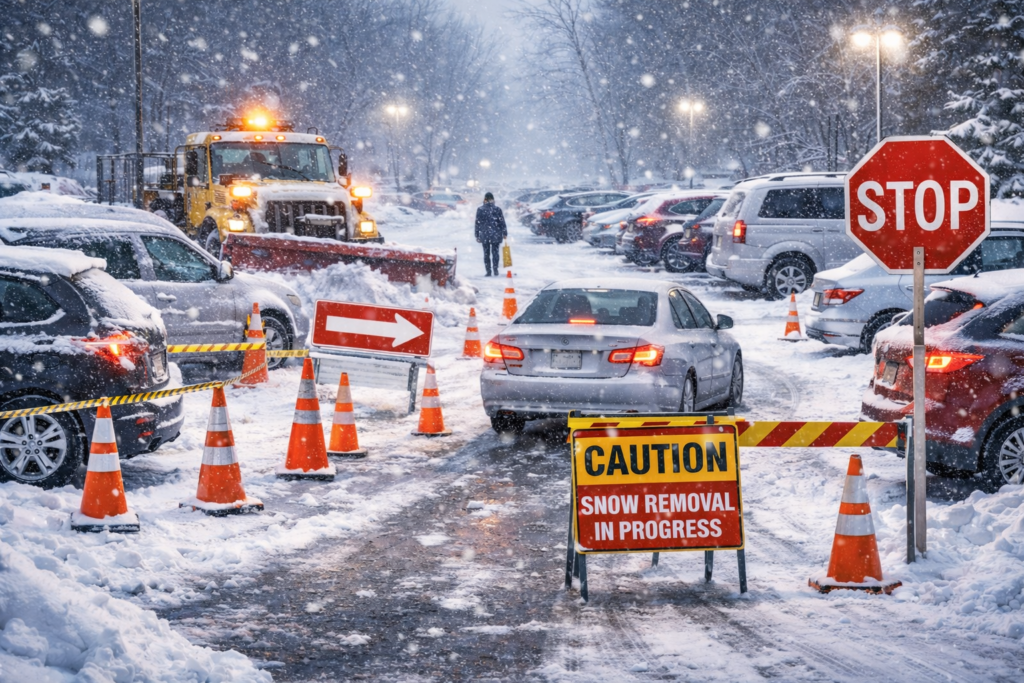
Start by creating a temporary traffic management setup using:
- Cones and barricades to block off active plow zones
- “Snow Removal in Progress” signage at entrances
- Directional arrows to guide traffic flow
- Temporary “No Parking” zones for windrow clearance
- High-visibility tape or reflective markers for night work
A major improvement is to limit random entry into the active clearing area. If your lot has multiple entrances, consider closing one temporarily and guiding vehicles through one controlled entrance. This reduces uncontrolled crossing paths and makes it easier for spotters to monitor movement.
If your organization already uses a broader winter plan, connect this parking lot control strategy with your internal program such as OHSE.ca Winter Safety so training and signage remain consistent.
Equipment Movement Rules That Prevent Struck-By Incidents
Plows, loaders, skid steers, and salt trucks are powerful and necessary, but they create serious struck-by and run-over risk when operated close to public traffic. The highest-risk moments are reversing, turning, and pushing snow into piles where pedestrians may be hidden.
To control equipment hazards, establish rules such as:
- No reversing without a spotter in high-traffic areas
- Lower operating speeds in active zones
- Mandatory flashing beacons and working backup alarms
- Defined equipment-only lanes separated from public vehicles
- Plowing patterns that minimize backing whenever possible
Operators should also stop work if pedestrian traffic becomes too dense. It is better to pause for two minutes than to gamble on tight clearances while visibility is poor.
For additional operator safety expectations, you can reference requirements from your provincial regulator like Ontario’s Ministry of Labour, Immigration, Training and Skills Development for workplace safety obligations.
Pedestrian Safety Controls That Actually Work
Pedestrians are the hardest group to control in an active lot because many assume the parking area is “safe enough.” During snow removal, that assumption becomes dangerous.
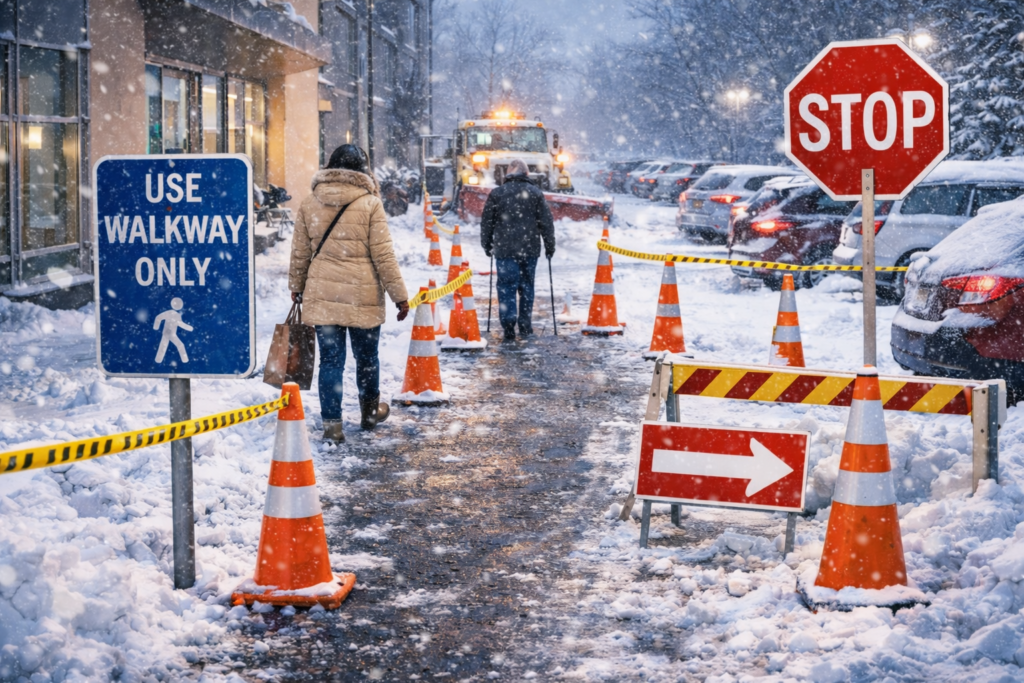
The best control is to create and protect a clear pedestrian route. This route should be plowed early, salted quickly, and separated from vehicles using cones or temporary barriers. If you have a sidewalk from the lot to the entrance, prioritize that area first instead of clearing empty parking rows.
Add extra safeguards such as:
- Marked crosswalks kept clear and visible
- “Use Walkway Only” signs near doors
- Temporary closure of shortcut paths
- Staff assistance for mobility-impaired visitors
- High-contrast lighting at entry points
If your team is also managing winter slip hazards, connect traffic management with practical controls described in parking lot slip prevention to reduce both pedestrian falls and vehicle conflicts at the same time.
Clear Communication Prevents Confusion and Aggressive Driving
Drivers get frustrated when they can’t tell where to go. Confusion leads to sudden stops, illegal turns, cutting through blocked areas, and risky reversing.
To avoid this, communicate in multiple ways:
- Place large signs at entrances explaining temporary traffic flow
- Use security or staff to guide vehicles during peak times
- Send staff alerts for planned clearing windows
- Post quick updates on internal channels for large sites
- Use “one-way” guidance where possible to reduce head-on conflicts
If snow removal occurs while customers are arriving, consider posting a short message at entry points like:
“Snow removal in progress. Follow cones and use marked pedestrian route. Please drive slowly.”
Even small reminders reduce speeding and improve patience—especially when the controls look professional and consistent.
Managing Snow Piles, Visibility, and Sightline Blockers
Snow piles are not harmless. Large windrows and piled snow can block sightlines and create blind exits where vehicles pull out without seeing traffic. They can also push pedestrians into driving lanes if walkways become narrowed.
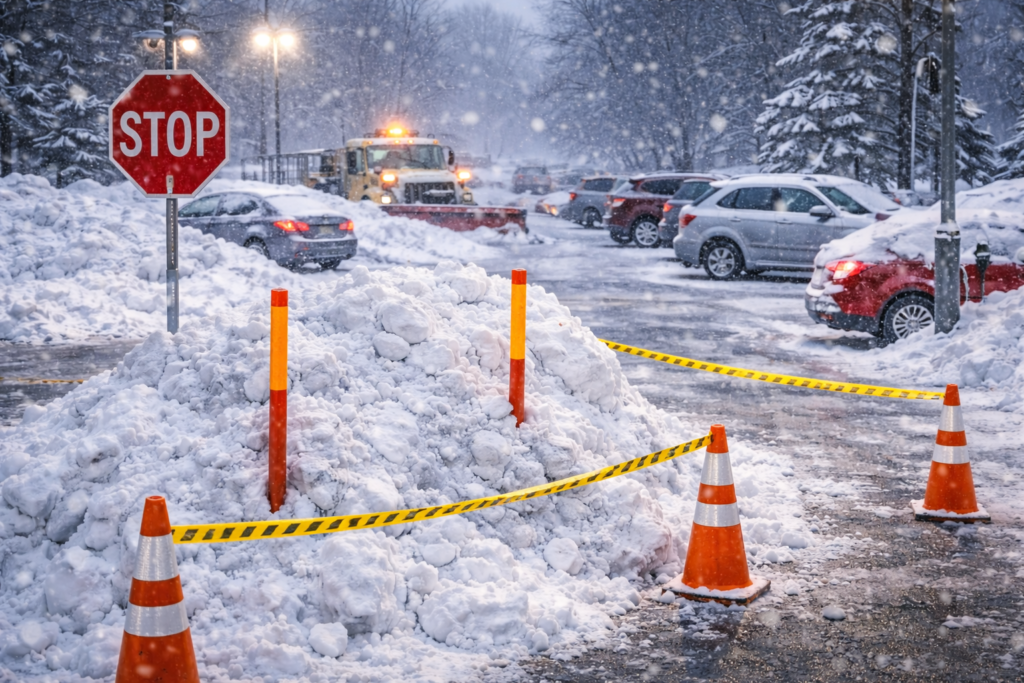
Plan snow storage locations in advance. Snow piles should never be placed:
- Near crosswalks
- At corners and intersections
- In front of fire routes or hydrants
- Where they block accessible ramps or paths
- Where meltwater will refreeze across walkways
If snow piles must be created near traffic lanes, use reflective markers or barricades. At night, poor visibility around piles can cause side swipes and pedestrian near misses.
This is a great place to align with recognized safety system expectations like CSA Z1000 which supports structured health and safety management and risk controls.
Inspection, Monitoring, and “Stop Work” Triggers
Snow removal is not a “set it and forget it” job. Conditions change quickly with temperature shifts, freezing rain, or sudden traffic spikes.
Assign a responsible person to monitor the operation and make real-time decisions. This role is especially important when contractors are working, because someone on site must ensure controls are in place and working properly.
Set clear triggers to stop or adjust operations, such as:
- Visibility dropping due to blowing snow
- A sudden rush of vehicles or pedestrians
- Equipment alarms not functioning
- Ice forming faster than it can be treated
- Barricades being moved or ignored repeatedly
Monitoring should also include checking salt coverage and ensuring pedestrian paths remain open. One missed patch of black ice near an entrance can lead to falls, complaints, and serious injuries.
Incident Readiness and Emergency Access
Even with strong controls, incidents can happen. Active parking lots must remain ready for emergency response at all times.
Make sure snow removal does not block:
- Ambulance and fire routes
- Accessible parking spaces and curb cuts
- Emergency exits and muster points
- Loading docks that must stay operational
Ensure staff know how to respond if a vehicle collision or pedestrian injury occurs. Quick actions like stopping equipment, securing the scene, calling emergency services, and documenting conditions can prevent secondary incidents.
A short incident response reference can be included in your winter program on OHSE.ca so teams can access it quickly when needed.
Supervisor Checklist for Safer Snow Removal Operations
This quick checklist supports consistent daily execution and helps reduce preventable incidents.
Before clearing begins:
- Confirm traffic routes and pedestrian paths
- Place signs and barricades at entrances
- Confirm spotter coverage for busy zones
- Ensure equipment lights/alarms are working
- Confirm snow storage locations
During active operations:
- Keep pedestrians separated and visible
- Prevent random driving through work zones
- Monitor corners and crosswalk visibility
- Pause work during peak pedestrian surges
- Salt early and re-apply where needed
After clearing:
- Inspect for icy patches and refreeze risk
- Confirm sightlines at exits and intersections
- Remove or reset temporary controls
- Document issues and improvements for next storm
Conclusion
Traffic Management in Active Parking Lots During Snow Removal is not just about moving snow—it’s about controlling interaction between vehicles, pedestrians, and heavy equipment in a fast-changing winter environment. By planning routes, separating people from machines, improving visibility, communicating clearly, and monitoring conditions in real time, workplaces can prevent serious winter incidents while keeping operations running smoothly.
When traffic control looks professional and predictable, people naturally behave safer. And when your winter operations team follows consistent rules every storm, you reduce injuries, complaints, vehicle damage, and downtime—season after season.
No comments yet