
Working Alone Risk Assessment: Essential Questions to Ask for Safer Solo Work


Working alone risk assessment is one of the most important steps an employer can take when people carry out tasks without direct supervision or nearby support.
Whether someone is locking up a retail store, visiting clients, maintaining equipment, cleaning a facility after hours, or working remotely in the field, the risks can change quickly when no one else is present to help.
A strong assessment does more than tick a compliance box. It helps identify hazards, evaluate who may be harmed, and put practical control measures in place before something goes wrong.
Guidance from organizations such as CCOHS and OSHA reinforces the need to assess the job, the environment, and the worker’s ability to respond to emergencies.
This article uses a question-based structure to make your working alone risk assessment practical, actionable, and easier to apply across real workplaces.

- What work is being done, and why does the working alone risk assessment matter?
- What hazards could arise when someone is alone?
- Is the worker capable, equipped, and supported to work alone safely?
- What emergency arrangements and control measures are needed?
- How often should you review your working alone risk assessment?
What work is being done, and why does the working alone risk assessment matter?
The first question is simple but essential: what exactly is the person doing while alone?
Different tasks create very different levels of risk. An office employee working quietly after hours does not face the same hazards as a technician entering plant rooms, a home care worker visiting unfamiliar properties, or a security guard patrolling isolated areas at night.
Your working alone risk assessment should break the job into specific activities rather than treating all lone work as one category. This makes it easier to identify where the real dangers lie and which controls are proportionate.
Ask these task-based questions
- Does the work involve hazardous machinery, electricity, chemicals, heights, confined spaces, or hot work?
- Is the worker handling cash, valuables, medication, or sensitive information that could increase the risk of violence or theft?
- Will the person be driving long distances, visiting remote locations, or entering private homes?
- Can the task be safely completed by one person, or does it require a second person for lifting, supervision, or emergency response?
- Is the work routine, or does it involve non-routine tasks such as maintenance, shutdowns, inspections, or troubleshooting?
This is also where the Hierarchy of Controls becomes useful. Before relying on check-ins or personal alarms, ask whether the hazard can be eliminated entirely.
For example, if a lone worker must manually reset a fault in a hazardous area, could the process be redesigned, automated, or completed during staffed hours instead? Administrative controls are important, but they should not be the first or only answer.

What hazards could arise when someone is alone?
A good working alone risk assessment must look beyond the obvious physical hazards. Being alone can turn a minor incident into a serious one simply because help is delayed.
A slip, fainting episode, equipment malfunction, aggressive customer interaction, or vehicle breakdown can become far more dangerous when no colleague is nearby.
Consider the full range of lone-working hazards
Think about the environment, the people involved, and the timing of the work.
Questions to ask include: Is the area well lit? Is mobile phone coverage reliable? Is there a history of violence, verbal abuse, or unpredictable behavior? Will weather, fatigue, or isolation affect decision-making? Are there any medical issues that could increase vulnerability if the worker becomes unwell?
| Hazard | Typical lone-working example | Possible control measure |
|---|---|---|
| Violence or aggression | Retail worker closing alone at night | Cash controls, CCTV, panic alarm, buddy call-out procedure |
| Medical emergency | Field worker in a remote area | Scheduled check-ins, GPS-enabled device, emergency escalation plan |
| Slips, trips, and falls | Cleaner working after hours | Good lighting, housekeeping, restricted high-risk tasks while alone |
| Equipment or machinery hazard | Maintenance worker servicing plant | Lockout procedures, permit-to-work, prohibit solo intervention |
| Travel or road risk | Sales employee driving between sites | Journey planning, fatigue rules, vehicle inspections, contact protocol |
Review previous incidents, near misses, and employee feedback as part of the assessment. Internal records often reveal patterns that generic checklists miss.
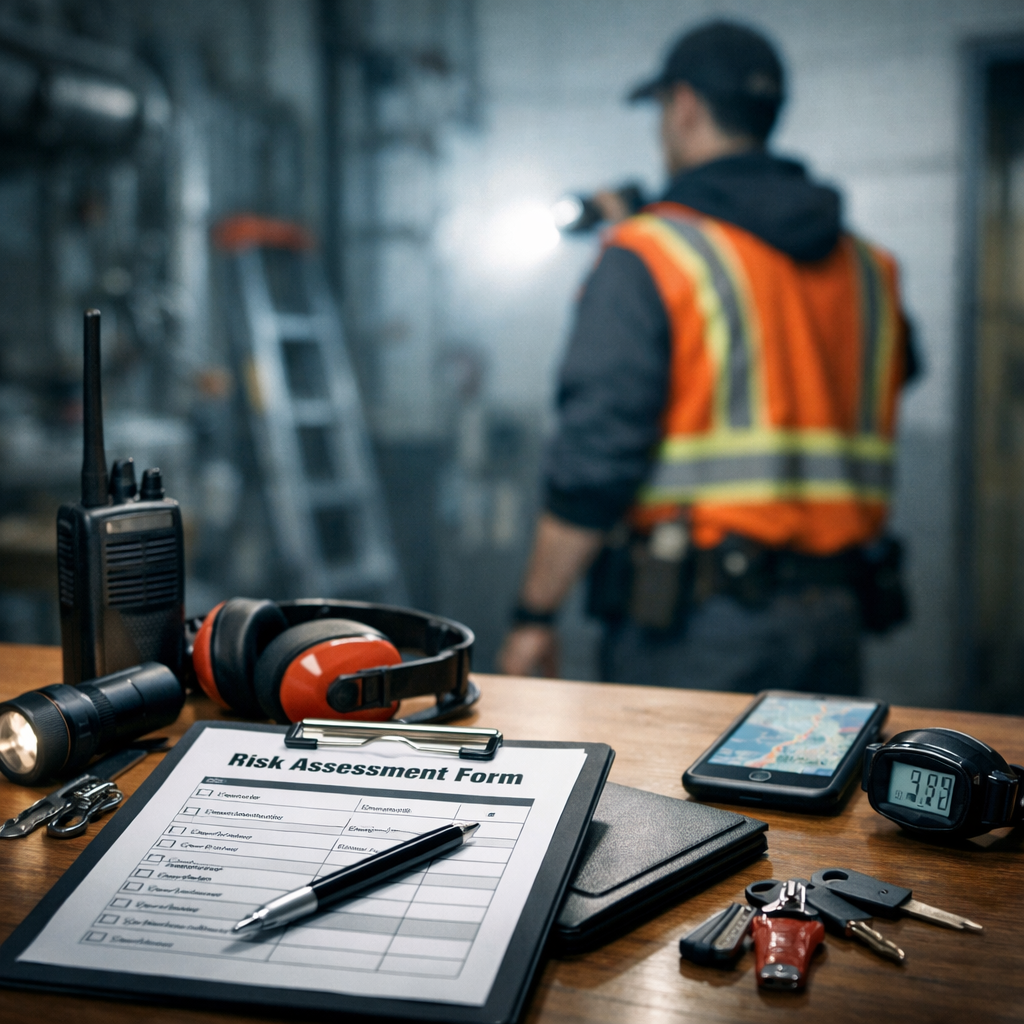
If you already have procedures for incident reporting or workplace safety training, link your lone-working controls to those systems so nothing operates in isolation.
Is the worker capable, equipped, and supported to work alone safely?
Not every task is suitable for every worker, and not every worker is suitable to perform a task alone.
This part of the working alone risk assessment focuses on competence, communication, and individual factors that may affect safety.
Questions about the worker
Has the person been trained for the task and the environment? Do they understand emergency procedures? Can they recognize warning signs of conflict, fatigue, equipment failure, or personal distress?
You should also consider whether language barriers, inexperience, temporary injury, medical conditions, or stress could affect their ability to work safely without immediate support.

This does not mean making assumptions. It means assessing fitness for the task and ensuring reasonable support is in place.
Questions about communication and supervision
How will the worker stay in contact, and what happens if contact is lost?
Many organizations rely on simple phone check-ins, but higher-risk work may need stronger controls such as lone worker devices, duress alarms, GPS tracking, timed welfare checks, or automatic escalation systems.
The key question is whether the chosen method matches the risk. If a worker enters an isolated area with poor signal, a mobile phone alone may not be enough.
It is also worth asking who monitors the check-in system, who responds to missed contact, and how quickly support can realistically arrive.
According to practical guidance from the UK HSE lone working guidance, employers should consider supervision arrangements even where workers are experienced, because being competent does not remove the need for oversight.
What emergency arrangements and control measures are needed?
This is where the assessment becomes genuinely useful. Once hazards are identified, the next question is: what controls will reduce the risk to an acceptable level?
Control measures should be proportionate, practical, and easy to follow under pressure.
Use the Hierarchy of Controls in your working alone risk assessment
Start at the top of the hierarchy and work down:
- Elimination: Can the task be rescheduled so it is not done alone?
- Substitution: Can a safer method, tool, route, or location be used?
- Engineering controls: Can access control, barriers, CCTV, automatic shut-offs, or safer equipment reduce the danger?
- Administrative controls: Can permits, check-in systems, safe work procedures, journey plans, and escalation rules improve safety?
- Personal protective equipment: Is any PPE needed, and does it support rather than hinder communication and movement?
Emergency planning should answer very practical questions. If the worker is injured, who is contacted first? If there is no response to a check-in, after how many minutes does escalation begin? If violence occurs, is there a code word, alarm, or immediate police response procedure? If travel is involved, does the worker carry location details, site access information, and emergency contacts?
A common mistake is to write emergency plans that look good on paper but fail in real conditions. Test them.
Run drills, check device coverage, verify contact numbers, and confirm that supervisors understand their responsibilities. A working alone risk assessment should be reviewed whenever tasks change, incidents occur, staffing shifts, or new equipment is introduced.
How often should you review your working alone risk assessment?
A lone-working assessment is never a one-time exercise.
Workplaces change, people change, and risks change with them. New locations, out-of-hours work, staffing shortages, seasonal weather, public-facing duties, and updated equipment can all alter the level of exposure.
Ask whether the original controls are still effective, whether workers are following them, and whether recent incidents or near misses suggest a gap in the system. Consult workers directly because they often spot practical issues before managers do.
In conclusion, a strong working alone risk assessment depends on asking the right questions before work starts: What is the task? What could go wrong? Is the worker capable and connected? What controls and emergency arrangements are in place? When these questions are answered properly, employers can reduce harm, meet legal duties, and create safer conditions for anyone working without immediate support.
No comments yet