

Safety huddle template practices give teams a fast, reliable way to surface risks, align on the plan, and assign owners—without dragging the shift.

Below is a complete, ready-to-run safety huddle template you can print today, plus a board layout, scripts, and simple metrics that hardwire follow-through.
- What a safety huddle is (and isn’t)
- The 10-minute safety huddle template (minute-by-minute)
- The board that makes your safety huddle template stick
- Leader scripts you can steal
- Coaching the team on the safety huddle template
- Metrics that matter (and fit on one board)
- Common pitfalls—and quick fixes
- One-page safety huddle template (copy/paste)
- Rollout in 7 days
- FAQs
What a safety huddle is (and isn’t)
A safety huddle template is a short, scheduled stand-up that prioritizes predictable risks and rapid action. It is not a staff meeting, project update, or complaint forum.
The goal is to prevent today’s mistakes before they happen. When you keep the ritual to ten minutes, staff stay engaged and leaders can run it every day—weekends included.
Benefits you can feel within a week
- Fewer surprises: staffing gaps, high-risk patients, equipment issues.
- Faster escalation: everyone knows how and when to speak up.
- Visible follow-through: actions are captured, assigned, and closed.
If you’re building broader reliability habits, pair this with your Error Prevention Toolkit and your SBAR handover scripts to reinforce common language across the unit.
The 10-minute safety huddle template (minute-by-minute)
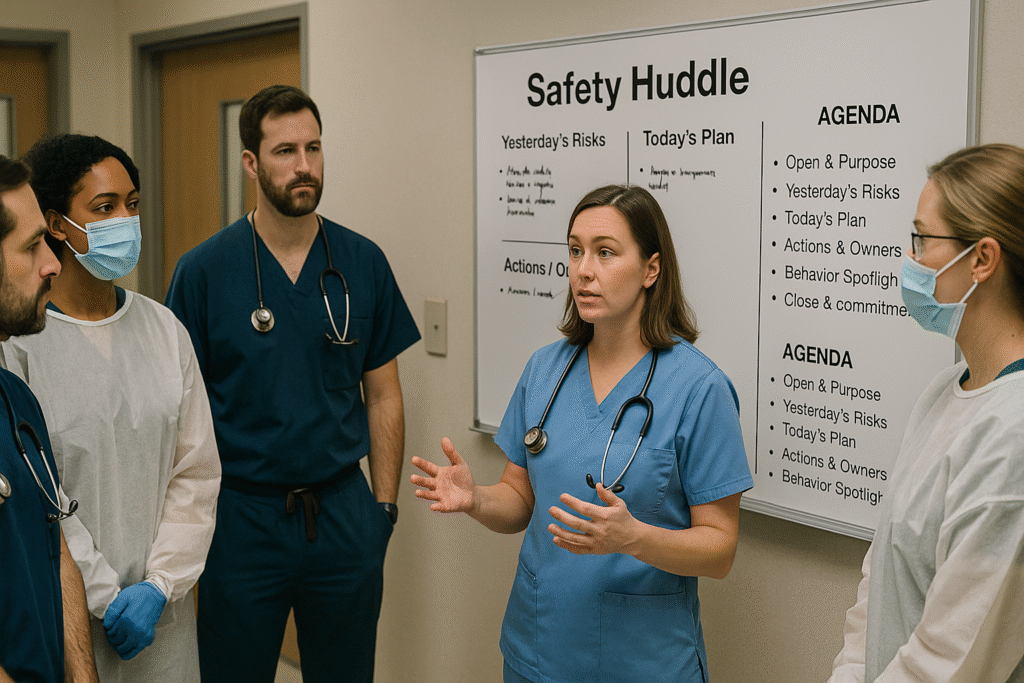
0:00–0:30 — Open & purpose
Leader: “Good morning. This safety huddle template keeps us under ten minutes, focused on today’s risks and owners.”
0:30–2:00 — Yesterday’s risks & outcomes
Two quick questions:
- “Did anything escalate yesterday? How did we resolve it?”
- “Any near misses to share, and what did we change?”
Keep each share to 20–30 seconds. Recognize reporters.
2:00–5:00 — Today’s plan and predictable risks
- Staffing realities (short coverage, new learners, special needs).
- High-risk tasks or patients (isolation, fall/pressure risk, sepsis watch).
- Equipment or environment (out of service, construction, weather).
Use SBAR one-liners to stay crisp: Situation now, brief Background, quick Assessment, and Recommendation for who/when.
5:00–8:30 — Actions & owners
For each risk, record one action with a single owner and a due time today. Example: “Infusion pump #17—tag and pull before 10:00, Sam.” Write it on the board where all can see. If it takes >24 hours, create a separate improvement ticket.
8:30–9:30 — Behavior spotlight
Choose one reliability behavior to reinforce (STAR pause, 3-way repeat-back, ARCC). Share a 30-second story where it prevented a problem. This keeps skills alive and creates positive peer pressure.
9:30–10:00 — Close & commitments
Leader: “Any barriers to the plan? If something changes, escalate using SBAR. Next check-in at 14:00 for high-risk items.”
Tip: If the huddle routinely runs long, you’re problem-solving live. Capture the action and move the discussion to a separate, time-boxed huddle-after-huddle with only the needed people.
The board that makes your safety huddle template stick
A visible board (physical or digital) turns talk into tasks. Keep it simple:
Top row (date and purpose)
“Safety Huddle — [Date]. Ten minutes. Risks → Actions → Owners.”
Three core columns
- Yesterday → Outcome
- Today’s Predictable Risks
- Actions / Owner / Due
Optional quick tiles
- Staffing snapshot: “3 RNs, 1 float, 1 orientee.”
- Equipment status: “2 pumps OOS; vendor ETA 13:00.”
- Behavior spotlight: “Closed-loop communication on high-risk meds.”
Print a one-page board for clipboards, and mirror it on a wall-mounted whiteboard. If your site runs digital huddles, a shared dashboard with these three columns is enough.
Leader scripts you can steal
Opening script (30 seconds)
“Welcome. This safety huddle template stays under ten minutes. We’ll review yesterday’s risks, today’s plan, and actions with owners. Share briefly, speak up early, and assume good intent.”
ARCC invitation
“If something feels unsafe, use ARCC: Ask a question, Request a pause, state your Concern, and use the Chain of command. I will back you up.”
Near-miss reinforcement
“Thanks to Rina for reporting yesterday’s label mix-up. Because she spoke up, we separated look-alike vials and added a STAR reminder at the cart.”
Closing script (30 seconds)
“Owners, repeat back your items and due times. If you get blocked, escalate with SBAR. See you at 14:00 for the quick progress check.”
Coaching the team on the safety huddle template
- Teach the why. Script a two-minute rationale for new staff. People support what they understand.
- Model brevity. Leaders must keep themselves to 30–45 second updates.
- Use SBAR. Ask for a one-line Situation and a clear Recommendation.
- Capture actions live. If it’s not on the board, it won’t get done.
- Recognize, don’t reprimand. Publicly appreciate near-miss reports and on-time closures.
For concise primers you can adapt, see the Institute for Healthcare Improvement and the AHRQ Patient Safety Network on building daily safety systems. For high-reliability culture tips, The Joint Commission offers practical roadmaps: High Reliability in Health Care.
Metrics that matter (and fit on one board)
A safety huddle template lives or dies by two numbers:
- Leading indicator: % of risks with an owner and same-day due time.
- Lagging indicator: # of unresolved actions older than 48 hours.
Add small weekly tiles for:
- Near-misses reported (goal: trending up at first).
- Time-to-escalation for defined events (rapid response, critical lab).
- Reliability behaviors observed (e.g., closed-loop comms on med passes).
Keep metrics visible, not hidden in a report. If yesterday’s actions are still open, lead the removal of blockers in the first minute.
Common pitfalls—and quick fixes
- Scope creep: If updates sprawl beyond the shift horizon, ask, “Does this change what we do today?” If not, move it to a project forum.
- No owner named: Every action must have one name and one due time—never “Team” or “ASAP.”
- Silent nodding: Invite quiet voices first. Rotate who reads the board to include learners.
- Unclear escalation path: Post the on-call chain next to the board and practice it in mini-drills.
- Tool fatigue: Don’t introduce five new behaviors at once. Spotlight one reliability skill per week.
One-page safety huddle template (copy/paste)
Purpose (10 min): Prevent today’s mistakes.
Cadence: Every shift; same time and place.
Agenda
- Yesterday’s risks → outcomes (90 sec)
- Today’s predictable risks (3 min)
- Actions + Owner + Due (3.5 min)
- Behavior spotlight (1 min)
- Close & commitments (30 sec)
Board
- Column 1: Yesterday → Outcome
- Column 2: Today’s Risks
- Column 3: Actions / Owner / Due
- Footer: On-call chain, 14:00 check-in, behavior of the week
Rules of engagement
- Use SBAR one-liners.
- Capture actions live; no side debates.
- Recognize near-miss reports.
Rollout in 7 days
Day 1: Print the safety huddle template board and agenda; walk the team through the why.
Day 2–3: Pilot on one shift; track time with a visible timer.
Day 4: Add the 14:00 mini check-in for high-risk items.
Day 5: Start counting leading/lagging metrics on the board.
Day 6–7: Share two quick wins where the safety huddle template prevented a problem or sped escalation.
FAQs
How big should the team be?
Enough to cover the shift—usually 5–10 people. If more, designate spokespeople to stay under ten minutes.
What if a unit can’t meet in one spot?
Mirror the board digitally; run the huddle on secure video or phone. Keep the same agenda and timebox.
Does this replace a full incident review?
No. The safety huddle template is for today’s risks and quick actions. Larger issues move to a root cause review or improvement huddle.
Wrap-up
When teams use a safety huddle template every shift, safety becomes visible: crisp SBAR updates, rapid assignments, and predictable follow-through.
Start small, keep it to ten minutes, and sustain momentum with simple metrics and weekly behavior spotlights. Your team—and your patients—will feel the difference. Safety huddle template.