
Warehouse Emergency Response Plan: A Practical Guide to Safer Operations


Warehouse emergency response plan development is one of the most important steps an employer can take to protect workers, visitors, inventory, and business continuity.
In busy warehouse environments, emergencies can escalate quickly, especially when forklifts, racking systems, hazardous materials, loading docks, electrical equipment, and high worker traffic are involved.
A clear and well-practiced warehouse emergency response plan helps teams respond fast, reduce injuries, control damage, and meet occupational health, safety, and environmental expectations.
This article explains the key risks, prevention measures, PPE considerations, compliance obligations, and practical examples that should shape an effective plan for real-world warehouse operations.
Why a Warehouse Emergency Response Plan Matters
A warehouse is not just a storage space. It is an active workplace where multiple hazards exist at the same time.
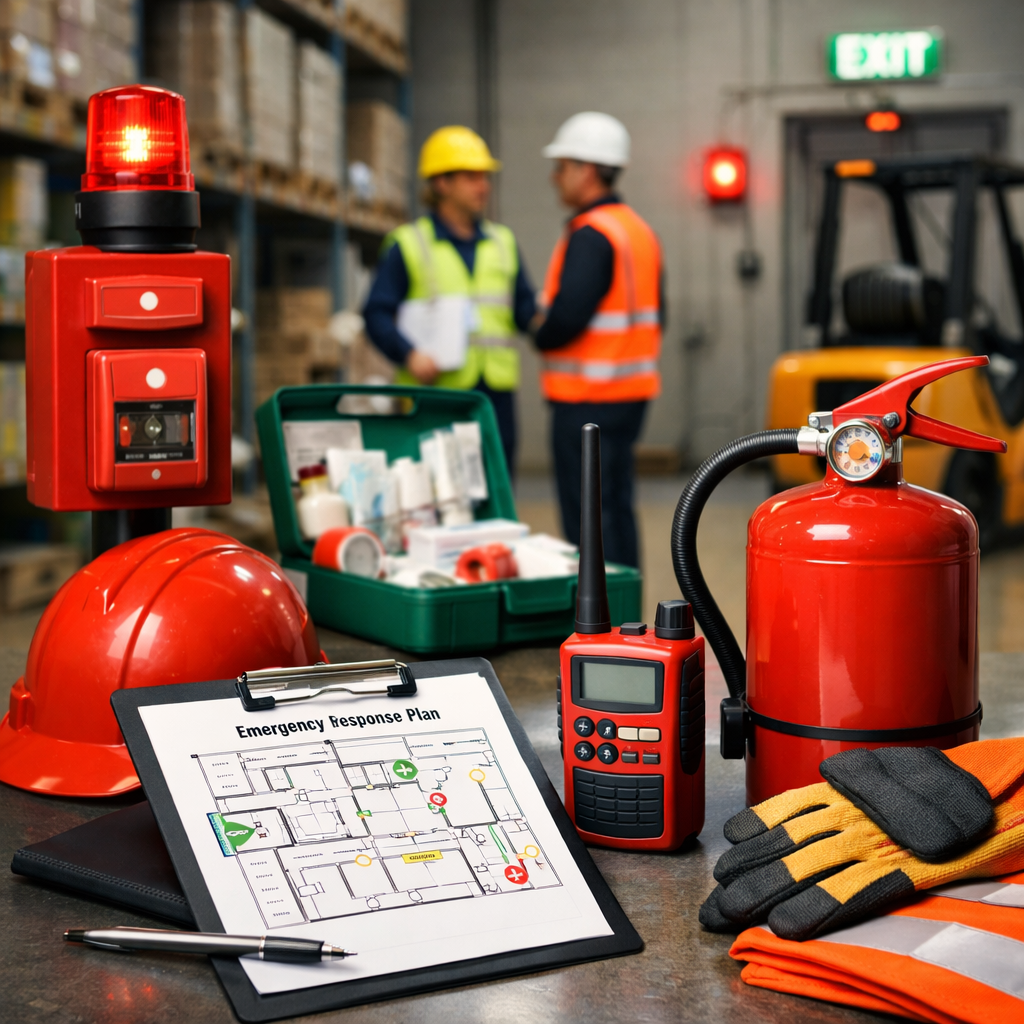
Vehicles move through pedestrian areas, goods are lifted and stacked at height, batteries are charged, flammable products may be stored, and contractors or delivery drivers often enter the site.
Without a documented warehouse emergency response plan, workers may not know who is in charge, where to evacuate, how to report an incident, or how to isolate hazards safely.
That uncertainty can cost valuable minutes during a fire, chemical spill, medical event, structural collapse, severe weather incident, or confined loading area emergency.
Common warehouse emergencies
- Fire involving stock, packaging, battery charging areas, or electrical panels
- Forklift collisions with workers, racking, doors, or vehicles
- Falls from ladders, mezzanines, docks, or elevated work platforms
- Chemical spills from cleaning agents, fuels, oils, or stored hazardous products
- Medical emergencies such as heat stress, crush injuries, or cardiac events
- Power failures affecting lighting, alarms, ventilation, or automated systems
- Severe weather, flooding, or wind damage that affects access and structural safety
A strong response plan reduces confusion by assigning responsibilities in advance.
It should identify incident commanders, first aid responders, fire wardens, spill response personnel, shutdown procedures, and communication methods for workers, visitors, and emergency services.

Core Risks, Prevention Measures, and the Hierarchy of Controls
The best warehouse emergency response plan does more than explain what to do after an incident. It also supports prevention by identifying hazards and controlling them before an emergency occurs.
This is where the Hierarchy of Controls becomes especially useful in OHSE planning.
Applying the Hierarchy of Controls in warehouses
Elimination means removing a hazard entirely where possible.
For example, eliminating unstable manual stock storage methods can reduce the risk of falling objects and collapse.
Substitution involves replacing a higher-risk product or process with a safer one.

A warehouse may substitute a less hazardous cleaning chemical to reduce spill and inhalation risks.
Engineering controls separate people from danger.
Examples include bollards around battery charging stations, guardrails at mezzanines, sprinkler systems, smoke detection, emergency lighting, spill containment, and racking protection barriers.
Administrative controls include safe work procedures, induction training, signage, inspection schedules, traffic management rules, emergency drills, and contractor controls.
PPE is the final layer and should support, not replace, stronger controls.
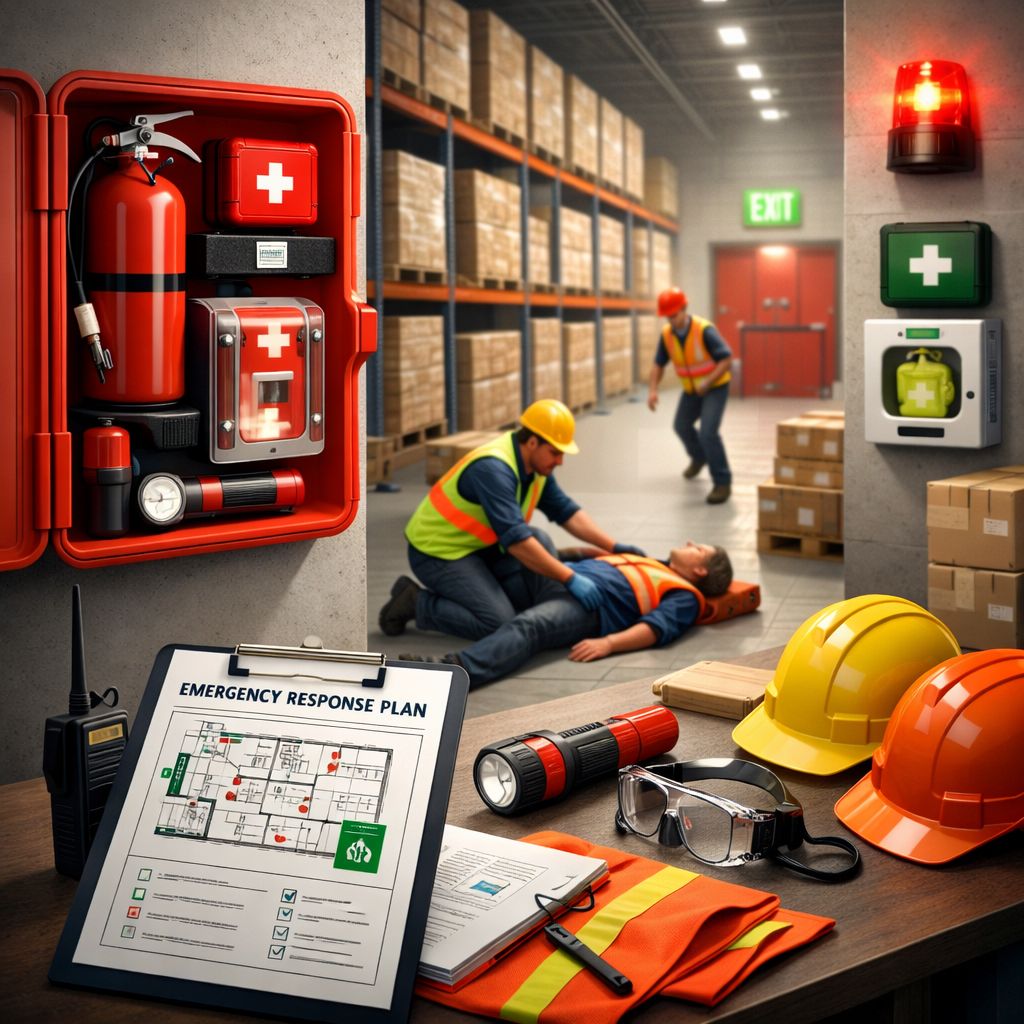
Prevention measures that strengthen emergency readiness
- Maintain clear evacuation routes and marked exits at all times
- Inspect fire extinguishers, alarms, sprinklers, and emergency lights regularly
- Separate pedestrians from forklifts using barriers and marked walkways
- Store hazardous substances according to safety data sheet requirements
- Secure racking loads and inspect shelving for impact damage
- Keep loading docks well lit and fitted with dock safety systems
- Train workers to report near misses before they become emergencies
A practical example is a warehouse with frequent forklift traffic near packing stations.
If management only provides high-visibility vests, the risk remains high. A better control strategy is to redesign traffic flow, install physical barriers, set speed limits, and train operators, with PPE used as added protection.
What to Include in a Warehouse Emergency Response Plan
An effective warehouse emergency response plan should be site-specific, easy to understand, and accessible to all workers.
It should also reflect shift patterns, language needs, contractor activity, and the types of products stored on site.
Essential elements of the plan
- Emergency roles and chain of command
- Contact details for emergency services and internal response team members
- Site maps showing exits, assembly points, shutoffs, hydrants, first aid kits, eyewash stations, and spill kits
- Evacuation procedures for fire, gas leak, structural risk, or severe weather
- Shelter-in-place procedures where evacuation is not the safest option
- Medical response procedures, including first aid and ambulance access points
- Hazardous substance spill response instructions
- Communication steps for alarms, radios, phones, and visitor control
- Procedures for accounting for all persons after evacuation
- Post-incident reporting, investigation, and corrective action steps
PPE in emergency response
PPE requirements depend on the hazards present in the warehouse.
Common items include safety footwear, high-visibility clothing, gloves, eye protection, hard hats, hearing protection, and respiratory protection where exposure risks exist.
Emergency responders within the warehouse may need additional PPE for spill control, smoke exposure, or contact with hazardous materials.
However, workers should only use specialized PPE if they are trained and authorized to do so.
For example, asking untrained staff to manage a chemical spill with respirators can create a second emergency instead of controlling the first.
Simple response planning table
| Emergency Type | Main Risk | Immediate Action | Key Equipment |
|---|---|---|---|
| Fire | Smoke inhalation, burns, rapid spread | Raise alarm, evacuate, isolate if safe | Alarm system, extinguishers, sprinklers |
| Forklift collision | Crush injury, structural impact | Stop area, call first aid, secure scene | Radios, first aid kit, barriers |
| Chemical spill | Exposure, fire, slip hazard | Isolate area, follow spill procedure, notify supervisor | Spill kit, gloves, eye protection |
| Power outage | Darkness, system failure, vehicle conflict | Stop operations, use emergency lighting, assess risks | Backup lighting, communication devices |
Training, Compliance, and Practical Warehouse Examples
A warehouse emergency response plan only works when people understand it and practice it.
Training should be provided during induction, refreshed regularly, and updated whenever processes, layouts, staffing, or stored materials change.
Drills and practical exercises
Evacuation drills help confirm whether alarms are heard, exits are usable, wardens understand their roles, and assembly points are suitable.
Tabletop exercises are also useful for testing less common scenarios such as a lithium-ion battery fire, ammonia leak, roof damage after a storm, or a contractor injury at the loading dock.
After every drill or real incident, review what worked and what did not.
That feedback should be used to improve the warehouse emergency response plan, signage, equipment, and training records.
Compliance and OHSE expectations
Employers should align their emergency planning with local legal requirements and recognized OHSE guidance.
In many workplaces, this includes fire safety rules, first aid obligations, hazard communication, worker training, emergency equipment maintenance, and incident reporting requirements.
OSHA emergency preparedness guidance offers useful direction on planning and worker protection.
CCOHS resources on emergency response planning also provide practical advice on program structure, drills, and responsibilities.
Where hazardous chemicals are stored, teams should also use safety data sheets and applicable chemical management rules, supported by resources such as OSHA Hazard Communication.
For organizations improving broader systems, internal documents such as a safety training checklist or warehouse risk assessment can support consistent implementation.
Practical examples from the workplace
Consider a pallet collapse in a picking aisle. A trained worker immediately stops traffic, reports the incident by radio, and prevents entry into the area.
The supervisor checks for injuries, isolates the racking, and arranges a structural inspection before work resumes. That is a simple but effective emergency response in action.
In another example, a battery charging station begins to smoke.
Because the site has a clear warehouse emergency response plan, workers know to raise the alarm, evacuate nearby areas, and allow trained responders and the fire service to handle the situation rather than attempting unsafe firefighting.
These examples show that response planning is not only about documents. It is about practical decisions made under pressure.
In conclusion, a well-designed warehouse emergency response plan supports safer people, stronger compliance, faster decision-making, and better control of high-consequence events.
By identifying risks, strengthening prevention, using the Hierarchy of Controls, selecting suitable PPE, and practicing realistic drills, employers can turn emergency planning into a real operational safeguard.
Every warehouse should review its layout, hazards, workforce needs, and legal duties regularly so the warehouse emergency response plan remains current, usable, and ready when it matters most.
No comments yet