
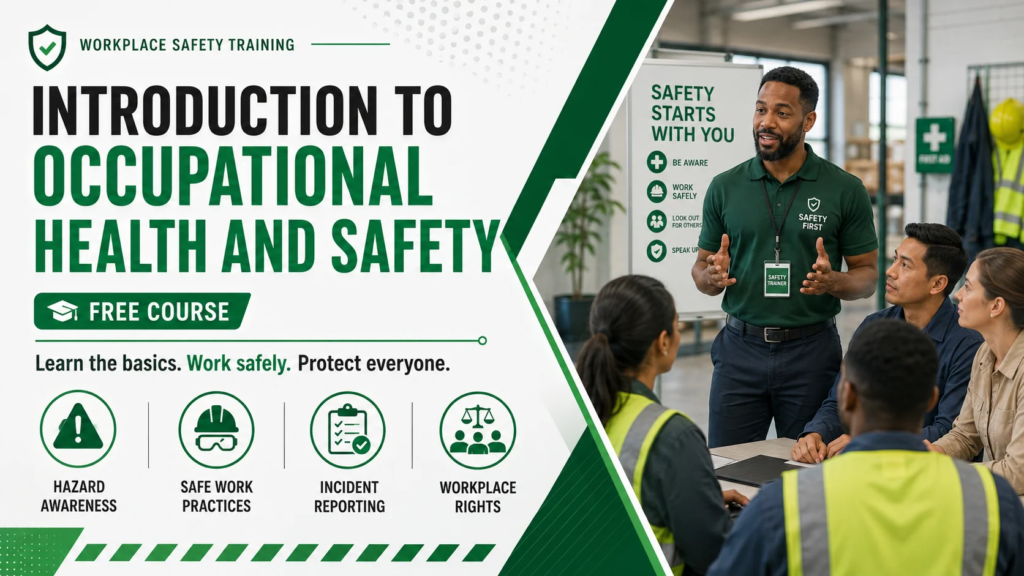
Free certification in Occupational Health & Safety is an accessible way to begin learning how workplace injuries, illnesses, and unsafe conditions can be prevented. Whether you are a student, job seeker, new worker, supervisor, small-business owner, or someone considering a career in safety, a free online course can help you understand the basic principles of hazard identification, risk control, worker rights, emergency preparedness, and safety communication.
However, the word “certification” can mean different things. Some free programs provide a downloadable certificate of completion, while others provide free education without an official certificate. A course certificate also does not automatically replace training required by an employer, provincial regulator, industry body, or approved training provider. Understanding that difference will help you choose the right course and avoid misleading claims.
- Why Take a Free Certification in Occupational Health & Safety?
- What You Can Learn From Free Safety Training
- Where to Find Free Certification in Occupational Health & Safety
- Free Course Certificate vs. Legally Required Training
- How to Choose a Valuable Free Safety Course
- Can a Free Certificate Help You Get a Job?
- Who Should Complete Free Occupational Health and Safety Training?
- Start Learning Today
Why Take a Free Certification in Occupational Health & Safety?
A free certification in Occupational Health & Safety allows you to explore the field without making an immediate financial commitment. It can be especially useful when you are applying for an entry-level position, preparing for a workplace orientation, or deciding whether to pursue advanced safety qualifications.
Occupational health and safety training introduces learners to common workplace risks, including slips and falls, unsafe equipment, hazardous materials, poor ergonomics, workplace violence, noise, heat exposure, and inadequate emergency planning. It also explains why workers, supervisors, and employers each have responsibilities for maintaining a safe workplace.
For job seekers, completing a relevant course can demonstrate initiative and an interest in safe work practices. It may strengthen a résumé, but it should be listed accurately as a “certificate of completion” or “online training course” unless the provider awards a regulated professional credential.
What You Can Learn From Free Safety Training
A well-designed introductory course should help you recognize hazards before they cause harm. The exact modules vary, but most programs cover the relationship between hazards, risk assessments, control measures, incident reporting, and worker participation.
You may learn how to:
- Identify physical, chemical, biological, ergonomic, and psychosocial hazards.
- Understand the hierarchy of controls.
- Report unsafe conditions, incidents, and near misses.
- Use personal protective equipment as one part of a broader control plan.
- Respond appropriately during workplace emergencies.
- Support a positive workplace safety culture.
These subjects provide a useful foundation for more specialized learning. After finishing an introductory course, you can explore our workplace safety courses or review additional occupational health and safety resources based on your industry.
Where to Find Free Certification in Occupational Health & Safety
Government agencies, recognized safety organizations, international institutions, and online education platforms offer different forms of free learning.
In Ontario, workers and supervisors can access the province’s basic health and safety awareness programs online. The worker program can be used to meet the basic awareness training requirement under Ontario Regulation 297/13, while supervisors have a separate five-step program. Employers must still provide workplace-specific information, instruction, and supervision.
The Canadian Centre for Occupational Health and Safety offers a large catalogue of online health and safety courses. Some awareness courses are available at no cost. For example, its workplace violence awareness course is free, although CCOHS states that its free awareness courses do not include a certificate of completion.
Some provincial and sector-based partnerships also provide eligible workers with free access to selected CCOHS courses. Examples include sponsored access for Manitoba workplaces, Saskatchewan workers, registered Canadian seafarers, and certain workers in the Northwest Territories and Nunavut. Eligibility and course availability should always be checked before enrolling.
Online platforms such as Alison also allow learners to enrol, study, and complete some occupational health and safety courses for free. Alison explains that an official digital or printed diploma is normally purchased separately, although learners may still have access to a learner record or achievement verification.
Free Course Certificate vs. Legally Required Training
Before registering for a free certification in Occupational Health & Safety, determine why you need the training. If your goal is general knowledge or professional development, a free online course may be suitable. If an employer requires a specific qualification, verify the exact course title, provider approval, delivery format, validity period, and practical components.
For example, Ontario construction workers who use fall-protection equipment may need working-at-heights training from a provider approved by the Chief Prevention Officer. A general online safety certificate is not a substitute for that approved program.
The same principle applies in the United States. OSHA provides training materials and maintains authorized Outreach Training providers, but OSHA explains that its 10-hour and 30-hour Outreach courses do not replace training required under specific OSHA standards.
A trustworthy provider should clearly state what the course does and does not qualify you to do. Avoid websites that promise instant legal certification, guaranteed employment, or universal recognition without identifying an accrediting or regulatory body.
How to Choose a Valuable Free Safety Course
Start by checking who developed the course. Government departments, established safety organizations, colleges, recognized industry associations, and credible training providers are generally easier to verify. Review the learning objectives, assessment method, certificate terms, course duration, instructor information, and date of the most recent update.
The course should also match your location and occupation. Safety laws differ between countries and between Canadian provinces and territories. A program based on U.S. OSHA requirements may provide useful knowledge, but it may not satisfy Canadian workplace obligations.
Look for content that explains practical risk control rather than focusing only on memorizing definitions. Strong courses discuss hazard identification, worker participation, incident prevention, emergency planning, and continual improvement.
These ideas are also reflected in ISO 45001, the international standard for occupational health and safety management systems. ISO explains that the standard addresses leadership, worker participation, hazard identification, operational controls, monitoring, and continual improvement.
Can a Free Certificate Help You Get a Job?
A free certification in Occupational Health & Safety can support a job application, particularly for entry-level roles where employers value safety awareness. It can also help you speak more confidently about hazards, reporting procedures, and safe work responsibilities during an interview.
Still, one short course will not make someone a qualified safety professional. Careers such as safety coordinator, occupational hygienist, safety officer, or health and safety consultant may require formal education, industry experience, approved training, and professional credentials.
Treat free learning as a starting point and continue building your knowledge through workplace experience, mentorship, specialized courses, and recognized qualifications.
When adding a course to your résumé, include:
- The exact course name.
- The training provider.
- Your completion date.
- The type of credential received.
Do not describe a certificate of completion as a licence, diploma, or professional designation unless the issuing organization officially identifies it that way.
Who Should Complete Free Occupational Health and Safety Training?
Free safety education can benefit people from almost every industry. New workers can use it to prepare for workplace orientation. Supervisors can refresh their understanding of safety responsibilities, while business owners can learn how effective hazard controls support safer operations.
Students and job seekers can use introductory training to explore careers in construction, healthcare, manufacturing, transportation, oil and gas, hospitality, mining, warehousing, and public services.
Free courses may also benefit existing employees who want to improve their understanding of workplace violence prevention, ergonomics, chemical safety, incident reporting, emergency response, or psychological health and safety.
Employers should remember that general online training is only one part of an effective program. Workers must also receive information about the specific hazards, equipment, procedures, and emergency arrangements in their actual workplace.
Start Learning Today
Free online safety education removes an important barrier for people who want to understand workplace risks. Choose a credible provider, complete the assessments honestly, save your training record, and confirm whether additional employer-specific or regulator-approved instruction is required.
The best result is not simply receiving a digital document. It is gaining knowledge that helps you notice hazards, ask better questions, follow safe procedures, and contribute to a healthier workplace.
Begin with a reliable course, continue learning, and use your new knowledge responsibly through free certification in Occupational Health & Safety.
No comments yet