
- Traffic Management Plan Tips for Busy Industrial Sites That Improve Safety and Flow
- Traffic Management Plan Tips for Route Design and Site Layout
- Traffic Management Plan Tips for Signage and Communication
- Traffic Management Plan Tips for Spotters and Speed Control
- Traffic Management Plan Tips for Review, Training, and Continuous Improvement
Traffic Management Plan Tips for Busy Industrial Sites That Improve Safety and Flow


Traffic management plan tips are essential for busy industrial sites where trucks, forklifts, light vehicles, contractors, and pedestrians all move through the same environment.
Without a clear plan, even a well-run facility can face congestion, near misses, property damage, and serious injury risks. A practical traffic management plan helps separate people from plant, define safe routes, control speed, and set clear expectations for everyone on site.
Industrial workplaces such as warehouses, distribution centers, quarries, manufacturing plants, ports, and large construction support yards often deal with changing layouts and high vehicle movement. That is why traffic planning should never be treated as a one-time document. It needs to reflect real conditions, shift patterns, delivery schedules, and equipment types.
In this guide, we will cover practical traffic management plan tips focused on route design, signage, spotters, speed control, and review practices. These measures align with good workplace safety principles and support guidance from organizations such as OSHA and CCOHS.
Traffic Management Plan Tips for Route Design and Site Layout
Good route design is the foundation of any effective traffic management system. If vehicle and pedestrian paths are unclear, every other control becomes harder to enforce.
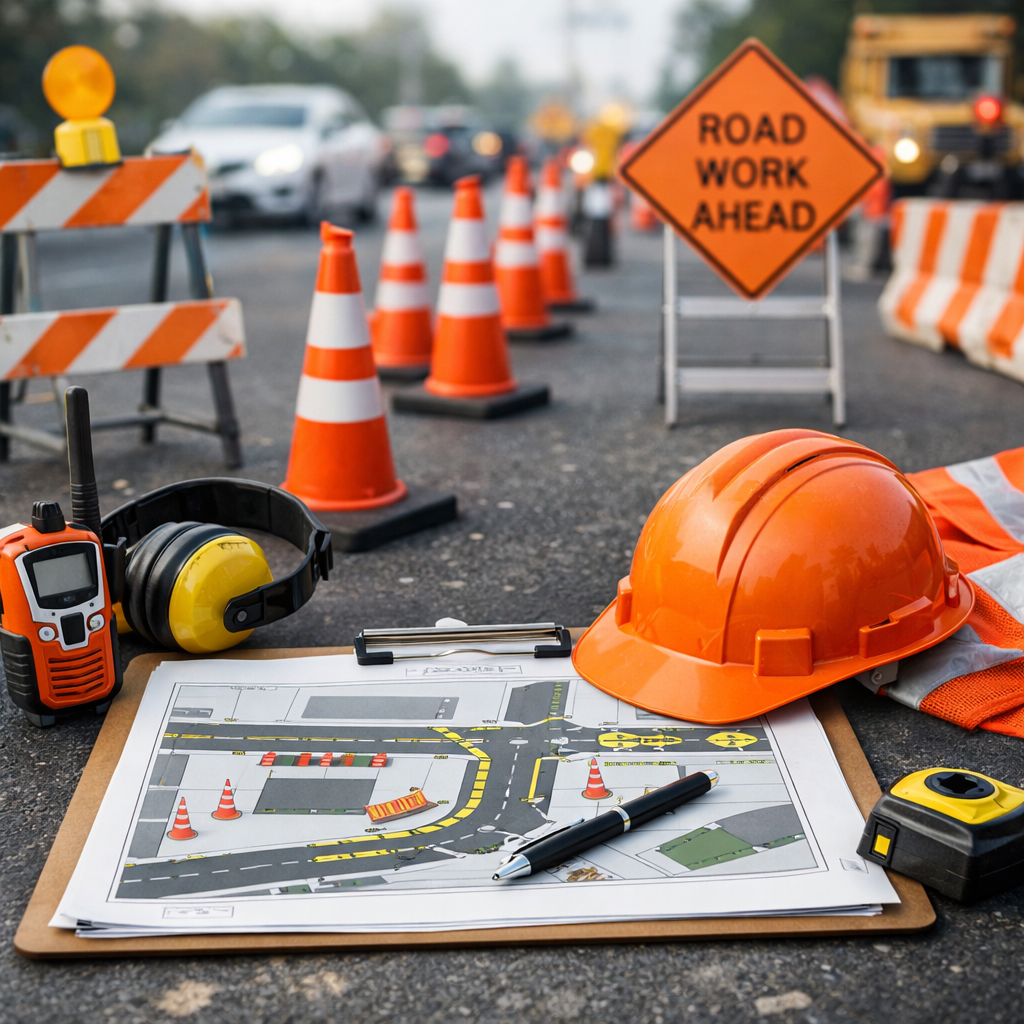
The first goal is separation. Wherever possible, keep pedestrians and vehicles apart using dedicated walkways, barriers, fencing, bollards, and marked crossing points. This reflects the Hierarchy of Controls: eliminating shared spaces is more reliable than relying only on signs or worker attention.
Design routes around real site movement
One of the best traffic management plan tips is to map how the site actually operates, not how it looks on paper. Review delivery entry points, loading zones, reversing areas, blind corners, fuel stations, maintenance bays, and staff parking.
For example, a warehouse may have forklifts crossing a pedestrian route near dispatch doors every few minutes. In that case, the safer solution may be to reroute foot traffic entirely rather than simply adding warning signs.
Use one-way systems where possible
One-way traffic flow reduces head-on conflicts, simplifies turning movements, and lowers congestion in narrow lanes. This works especially well for heavy vehicles entering weighbridges, loading areas, or waste transfer points.
When designing one-way routes, make sure there is enough turning space for the largest vehicle on site. Include route checks for contractors who may arrive with unfamiliar vehicle types.

- Separate heavy vehicles, forklifts, and pedestrians wherever possible
- Create clearly marked entry and exit points
- Minimize reversing by using drive-through layouts
- Protect crossings with barriers, gates, or raised walkways
- Consider lighting, drainage, dust, and surface condition in all route plans
It is also important to account for temporary changes. Maintenance shutdowns, new stockpiles, scaffolding, or seasonal demand can all affect traffic flow. Internal resources such as your safety inspection checklists and workplace risk assessment guide can help teams review these changes before incidents occur.
Traffic Management Plan Tips for Signage and Communication
Even the best route design can fail if workers and drivers do not understand it. Clear signage and communication make site rules visible, consistent, and easier to follow.
Signs should be placed where decisions happen: site entrances, intersections, crossing points, loading bays, speed transition zones, and restricted areas. Avoid cluttering one location with too many messages. Drivers need quick, obvious instructions, especially in noisy or high-pressure environments.
Make signs simple, visible, and consistent
Effective signs use standard symbols, large text, strong contrast, and durable materials. They should be readable in low light, rain, dust, or glare. Temporary signs should be just as clear as permanent ones.
For industrial sites with mixed workforces, consider language needs and use visual symbols wherever possible. Site induction materials should explain what each sign and route marking means.

Support signs with markings and briefings
Painted arrows, stop lines, pedestrian lanes, zebra crossings, and hazard zones reinforce driver behavior. Pre-start meetings and contractor inductions should also cover key traffic rules, including parking locations, reporting procedures, and exclusion zones.
The following table shows simple controls that can improve communication across a busy site:
| Control Area | Purpose | Example |
|---|---|---|
| Directional signage | Guide vehicle movement | One-way arrows and entry/exit signs |
| Pedestrian markings | Separate people from plant | Painted walkways and crossing zones |
| Warning signs | Highlight hazards | Forklift operating area or blind corner ahead |
| Instruction signs | Set mandatory behavior | Stop, give way, no entry, PPE required |
As part of your traffic management plan tips, inspect signs regularly. Faded paint, damaged posts, blocked views, or outdated instructions can create confusion and increase risk.
Traffic Management Plan Tips for Spotters and Speed Control
Spotters and speed limits are critical controls on industrial sites, especially where visibility is poor or vehicle movements are complex. However, both need structure to be effective.
Use spotters for high-risk movements
Spotters are particularly useful during reversing, oversized loads, tight maneuvering, and work near pedestrians or structures. Their role should be defined clearly so there is no confusion about signals, safe positions, or communication methods.

A common mistake is placing a spotter too close to the moving vehicle or in a blind zone. Spotters should remain visible to the driver at all times and stay out of the vehicle path. High-visibility clothing, radios, and agreed hand signals are basic requirements.
Where possible, reduce the need for spotters through better design. For example, installing mirrors, cameras, proximity sensors, or redesigning a loading area may be more reliable than depending on manual direction alone.
Set realistic and enforceable speed controls
Speed control is one of the most practical traffic management plan tips because speed directly affects stopping distance, impact severity, and driver reaction time. Site speed limits should reflect road width, surface condition, visibility, pedestrian activity, and vehicle type.
A blanket speed limit across the whole site may not be enough. Different zones often need different controls, such as lower limits near workshops, lunchrooms, crossings, and loading areas.
- Post speed limits at entry points and transition zones
- Use physical controls such as speed humps, chicanes, and rumble strips where suitable
- Apply stricter limits in shared areas and around blind corners
- Monitor compliance through supervision, telematics, or incident reviews
- Include contractor vehicles in all speed control rules
If workers regularly ignore speed limits, look beyond enforcement. Are routes too wide and inviting? Are delivery windows creating pressure? Is signage poor? Strong plans combine administrative controls with layout changes that naturally slow traffic.
Traffic Management Plan Tips for Review, Training, and Continuous Improvement
A traffic management plan only works if it stays current. Busy industrial sites change constantly, and that means controls must be reviewed, tested, and improved over time.
One of the most important traffic management plan tips is to review the plan after any incident, near miss, layout change, new equipment purchase, or contractor scope change. Waiting for an injury before updating the plan is a costly mistake.
Train everyone who uses the site
Workers, visitors, and contractors all need to understand how traffic moves through the site. Inductions should cover site maps, restricted areas, crossing rules, parking zones, speed limits, emergency routes, and reporting expectations.
Supervisors should also verify that training is understood in practice. A worker may sign an induction form but still take shortcuts through a forklift lane if supervision is weak or routes are inconvenient.
Use inspections, audits, and worker feedback
Routine inspections help identify worn markings, blocked sightlines, damaged barriers, and behavioral issues before they lead to harm. Formal audits can assess whether the written plan matches actual work practices.
Workers often spot traffic risks first, especially those operating forklifts, loading trucks, or walking between production areas. Encourage reporting of near misses and practical suggestions. Guidance from HSE workplace transport resources shows how continuous review supports safer site operations.
Useful review questions include:
- Have vehicle types or traffic volumes changed?
- Are pedestrians forced into vehicle routes at any point?
- Do spotters have clear procedures and training?
- Are speed controls working in real conditions?
- Have incidents, complaints, or near misses revealed weak points?
In conclusion, the most effective traffic management plan tips focus on practical control of movement rather than paperwork alone. Well-designed routes, visible signage, trained spotters, enforceable speed controls, and regular reviews all work together to reduce risk on busy industrial sites. When these measures are built into daily operations, organizations can improve safety, support compliance, and keep people, vehicles, and production moving efficiently.
No comments yet