
Slips, Trips, and Falls in Winter Worksites are among the most frequent and preventable causes of workplace injuries during the cold season.
Snow, ice, meltwater, and low light change the physics of everyday tasks, turning routine walks, ladder climbs, and loading-dock work into high-risk activities.

This guide provides a practical, field-tested approach to winterizing your programs so crews stay upright, productive, and safe when temperatures drop.
- Why Slips, Trips, and Falls Spike in Winter Worksites
- High-Risk Conditions and Controls at a Glance
- Engineering the Surface: De-Ice Smarter, Not Harder
- Lighting, Sightlines, and Wayfinding
- Footwear That Actually Works on Ice
- Administrative Controls: Plans That Survive Real Weather
- Training That Sticks in January (and March)
- Indoor Controls: Where Many Winter Falls Actually Happen
- Quick, Interactive Self-Audit (5 Minutes)
- Reporting, Learning, and Continuous Improvement
- Frequently Asked Questions
- Trusted Resources
- The Bottom Line
Why Slips, Trips, and Falls Spike in Winter Worksites
Cold weather multiplies hazards. Freeze–thaw cycles create “black ice” that’s invisible at dawn, packed snow behaves like ball bearings underfoot, and meltwater is tracked indoors to create slick floors.
Bulky clothing reduces mobility and peripheral vision; gloves compromise grip; shorter daylight hours impair hazard recognition. Together, these factors make Slips, Trips, and Falls in Winter Worksites a top seasonal risk that demands focused controls beyond your all-season program.

A strong winter STF plan aligns with the hierarchy of controls: remove hazards where possible, engineer safer surfaces and lighting, add administrative systems for maintenance and supervision, and choose winter-rated PPE that actually works in the field.
High-Risk Conditions and Controls at a Glance
| Winter Hazard/Location | Typical Triggers | Injury Patterns | Practical Controls |
|---|---|---|---|
| Parking lots & walkways | Black ice, refreeze at dusk, uneven snow | Back strains, wrist fractures, concussions | Pre-dawn inspection, mechanical plowing, anti-icing brine, high-traction grit, barricades, “last cleared” timestamp signage |
| Building entrances | Meltwater tracked inside, saturated mats | Same-level falls, shoulder/elbow sprains | 3-stage matting (scrape, absorb, finish), vestibule squeegees, floor fan or air curtain, frequent mop-and-dry log |
| Loading docks & ramps | Compacted snow, condensation from trailers | Knee/hip injuries, forklift skids | Dock shelters, heated ramp elements, grit bins every 25 m, go-slow policies, spotter on first pass |
| Stairs & ladders | Ice on treads, gloves reducing grip | Hand/wrist fractures | Heated handrails, anti-slip nosing, mandatory 3-point contact refreshers |
| Interior transitions | Cold–warm condensation, smooth tiles | Backward slips | Change flooring to high-COF surfaces, anti-slip coatings, “wet floor” cones only as backup (not a control) |
Engineering the Surface: De-Ice Smarter, Not Harder
Choosing the right method is more than tossing salt on the ground. Use this quick guide to align treatments with temperature and environmental constraints:
| Treatment | Effective Temp Range | Pros | Limitations | Best Use |
|---|---|---|---|---|
| Mechanical removal (plow/brush) | Any | Immediate hazard removal; prevents bond | Requires staging & fuel; windrows can refreeze | First response for accumulations |
| Rock salt (NaCl) | ~-9°C and warmer | Cheap, fast | Loses power in deep cold; corrosive | Mild cold, high-traffic lots |
| Calcium chloride (CaCl₂) | Down to ~-29°C | Works in deep cold; exothermic | Cost; residue | Extreme cold snaps |
| Sand/grit | Any | Instant traction; visible | Needs cleanup; can clog drains | Steep ramps, stairs |
| Brines (pre-wet) | Improves adherence | Less bounce/scatter; efficient | Requires tanks/sprayers | Preventive anti-icing before storms |
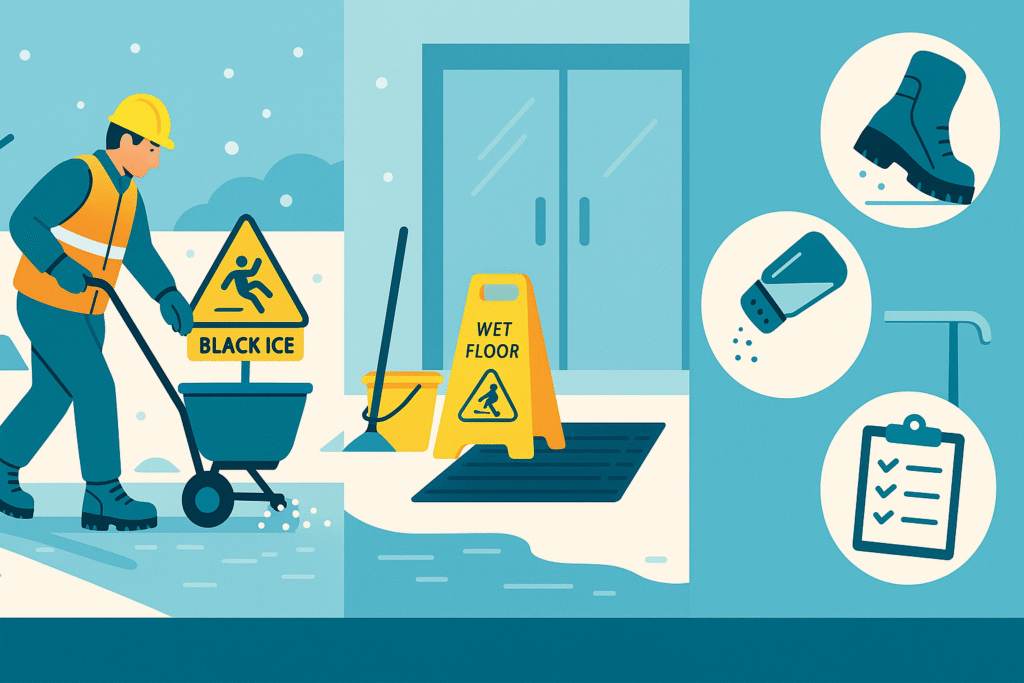
Pro tip: pair preventive anti-icing (brine applied before snow) with targeted de-icing after accumulation. That combination reduces total chemical use while keeping friction high—core to reducing Slips, Trips, and Falls in Winter Worksites.
Lighting, Sightlines, and Wayfinding
Winter work often starts and ends in darkness.
Improve hazard detection with bright, uniform lighting (avoid harsh contrasts that hide ice), reflective wayfinding to channel foot traffic onto treated paths, and snow stakes marking curb edges.
Where glare from ice is common, raise lux levels and use diffusers so surfaces can be read clearly.
Footwear That Actually Works on Ice
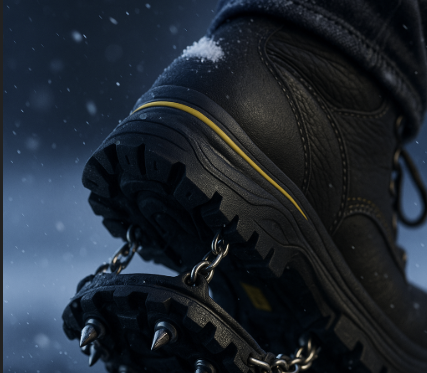
Not all “winter boots” are equal. Look for slip-resistance ratings and field-test with workers on your surfaces.
| Footwear/Traction | Typical Rating | Where It Shines | Notes |
|---|---|---|---|
| Slip-resistant outsole (SRC) | Lab-tested on ceramic+glycerol & steel+glycerol | Indoors & mild winter | Great baseline; can still struggle on glare ice |
| Microspike/coil cleats | Field-proven for ice | Outdoor lots, packed snow | Train on when to remove before entering buildings |
| Carbide stud overshoes | Aggressive ice traction | Remote sites, steep grades | Can damage floors; designate “on/off” zones |
| Insulated safety boots (CSA/ASTM toe) | Thermal + impact | All-day outdoor crews | Ensure toe room for socks; too tight = cold feet |
Educate crews to change traction devices before going indoors, and create “cleat stations” with benches, boot brushes, and wet bin storage.
This tiny infrastructure upgrade prevents a common cause of Slips, Trips, and Falls in Winter Worksites: wearing outdoor cleats on tile.
Administrative Controls: Plans That Survive Real Weather
A winter STF plan should be as operational as your snowplow schedule. Build these elements in:
- Pre-season survey: Map priority routes, slope angles, drainage, and shade spots that always refreeze first.
- Trigger points: Define actions by forecast (e.g., anti-icing at ≥60% chance of freezing rain; extra inspection during thaw/refreeze).
- Inspections & logs: Time-stamped checks before shift start, mid-shift, and at close—especially around entrances and docks.
- Communication: Push alerts when conditions change; display “last treated” times at entrances for transparency.
- Contractor alignment: Ensure third-party snow services meet your inspection/logging standard and product specs.
- Return-to-work protocols: Expedite modified duties to reduce lost time if an incident occurs.
Embed winter STF into your broader programs. For related risks, link supervisors to cold-stress measures (/cold-stress-prevention) and winter driving practices (/winter-driving-safety), since commuting and outdoor work intersect with the same weather systems.
Training That Sticks in January (and March)
Deliver short, frequent refreshers while conditions persist. Use reality-based drills:
- “Walk like a penguin” demos focusing on center of gravity, short steps, and eyes up for route selection.
- Carrying loads practice with totes at 50–75% typical weight to reinforce slow, two-handed handling.
- Incident reconstructions of near-misses from your site to show how micro-decisions prevented a fall.
Managers should model behavior—if supervisors cut across untreated snow, crews will too. Keep visible leadership during storms to reduce Slips, Trips, and Falls in Winter Worksites.
Indoor Controls: Where Many Winter Falls Actually Happen
Most winter injuries occur just inside the door. Install a three-stage mat system (scraper outside, absorbent runner, finishing mat) long enough that both feet contact each stage at least twice. Keep spare mats to rotate when saturated.
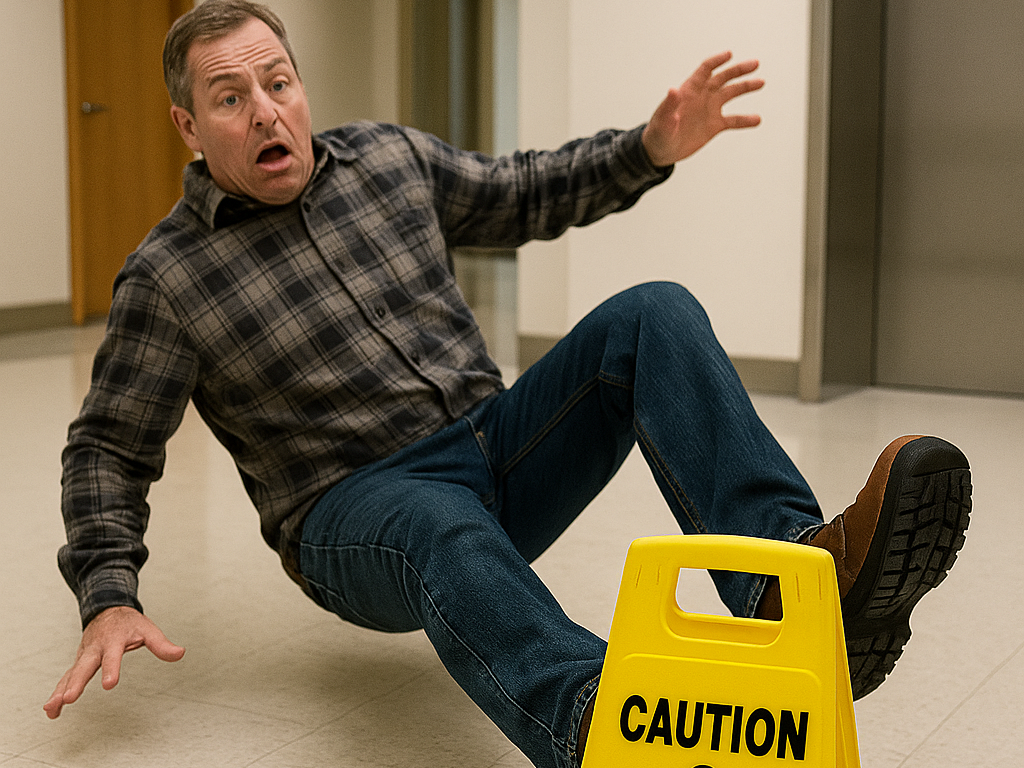
Add fans or air curtains to reduce condensation, and standardize a mop-and-dry response: spill kit at each entrance, with a completion log every time water is removed.
Quick, Interactive Self-Audit (5 Minutes)
Use this checklist with your team. Tick each item today:
- We have a map of priority pedestrian routes with treatment frequencies.
- Entrances show the last cleared/treated time.
- Grit bins and scoops are placed every 25–30 metres on slopes/ramps.
- Cleat stations exist at main doors with benches and boot brushes.
- A three-stage mat system is installed and rotated when saturated.
- Supervisors conduct and log pre-shift winter inspections.
- Staff are trained on safe gait and carrying loads in winter gear.
- Our contractor’s scope matches our product and logging standards.
Scenario question: Freezing rain started at 05:30, temperature now -4 °C, day warms to 0 °C by noon. What do you do at 11:00?
Answer key (expand in your briefing): Re-inspect shaded zones, re-treat with grit on slopes, swap soaked mats, and issue a noon alert about refreeze risk after 16:00.
Reporting, Learning, and Continuous Improvement
Encourage near-miss reporting with zero blame: every near slip is a forecast.
Tag reports with GPS/photo if possible; many organizations see pattern clusters at the same drains, curb cuts, or dock plates. Close the loop by posting actions taken.
Share successes in your winter toolbox talks (/toolbox-talks/winter) to reinforce what works against Slips, Trips, and Falls in Winter Worksites.
Frequently Asked Questions
What coefficient of friction (COF) should we target?
Aim for a dynamic COF ≥ 0.5 on pedestrian routes in winter. Verify with spot testing after treatment and adjust products or grit where readings fall short.
Are cones and “Wet Floor” signs enough?
No. Signage warns; it does not control. Use it while you implement real controls—matting, drying, and surface treatment.
Do traction cleats reduce indoor risk?
Only if managed. Provide on/off zones so workers don’t bring cleats onto tile, a common cause of Slips, Trips, and Falls in Winter Worksites.
How do we balance chemical use with the environment?
Preventive anti-icing reduces total salt. Sweep up residual grit after storms, and choose the mildest effective product for temperature bands.
Trusted Resources
- Canadian Centre for Occupational Health and Safety — Slips, Trips and Falls (guidance & checklists): https://www.ccohs.ca/oshanswers/safety_haz/falls.html
- NIOSH — Slips, Trips, and Falls (research & prevention): https://www.cdc.gov/niosh/topics/stf/
- OSHA — Winter Weather (controls for snow/ice, generators, and more): https://www.osha.gov/winter-weather
- OHSE.ca — Canadian articles and tools for winter programs: https://ohse.ca
The Bottom Line
When winter hits, success is won in the details: preventive anti-icing, real-time inspections, right-sized matting, and footwear that matches your surfaces.
Build these practices into your daily rhythm—not just storm days—and you’ll keep people moving safely, protect productivity, and reduce claims all season long.
Commit today to smarter controls for Slips, Trips, and Falls in Winter Worksites.
No comments yet